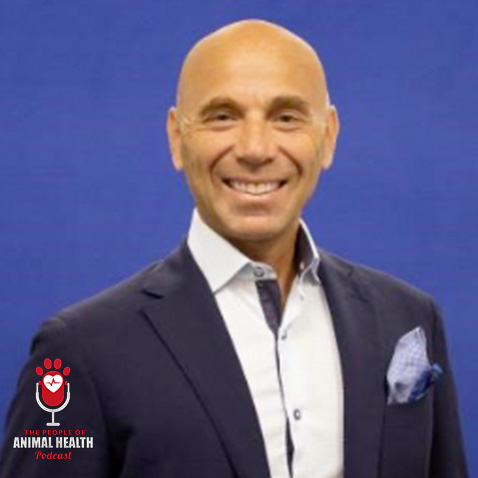
When Giovanni “Gio” Abruzzini accepted the opportunity to become President and CEO of Virbac North America in 2023, he entered an industry that was entirely new to him. After spending more than twenty six years building an accomplished career at Johnson & Johnson, leading businesses across Europe and North America, he could have remained comfortably within the human healthcare sector. Instead, he chose to embrace a completely different challenge, one that required learning a new industry, understanding a new customer base, and helping one of Animal Health’s most respected global companies strengthen its position in the largest Animal Health market in the world.
During his appearance on The People of Animal Health Podcast with host Stacy Pursell, Abruzzini shared how curiosity, humility, and a genuine passion for learning have shaped every stage of his professional journey. His story demonstrates that effective leadership is rarely built upon believing you already have the answers. Instead, it comes from asking thoughtful questions, listening carefully, and remaining willing to learn from every conversation, regardless of where that conversation takes place. Those principles have guided him from his childhood in Rome to executive leadership positions across multiple continents and now to leading Virbac’s North American operations during an exciting period of growth and transformation.
Growing Up in Rome With a Global Mindset
Although Abruzzini now leads one of the Animal Health industry’s most recognizable organizations in North America, his story begins thousands of miles away in Rome, Italy. Growing up as the youngest of five children gave him a unique perspective within a large, close knit family where he constantly observed older siblings navigating school, careers, and life experiences before it was his turn. Rather than viewing himself simply as the youngest child, he learned to appreciate the opportunity to learn from those around him while gradually developing his own path.
Reflecting on those early years, Abruzzini joked that he is still not entirely convinced he has finished growing up. That lighthearted sense of humor appeared throughout the conversation, but beneath it lies an appreciation for the environment that shaped him. Rome provided far more than a beautiful place to live. Surrounded by centuries of history, art, architecture, and culture, he developed an appreciation for learning and exploration that would later influence both his career and his leadership philosophy.
“I’m from Rome, Italy,” he explained. “I’m the youngest of five children. I’m the baby of the family.” Looking back, he described watching his older siblings accomplish remarkable things while motivating him to pursue opportunities of his own. Those experiences taught him that every stage of life offers another chance to learn, improve, and grow.
That curiosity eventually extended well beyond Italy’s borders. After beginning his career, Abruzzini accepted opportunities that allowed him to live and work throughout Europe and North America, gradually transforming himself from what he describes as a Roman into “a citizen of the world.” Each move introduced unfamiliar cultures, different business environments, and new ways of thinking, experiences that would ultimately become some of his greatest leadership teachers.
A Career Built Across Continents
Before entering Animal Health, Abruzzini spent more than two decades with Johnson & Johnson, holding senior leadership positions in Italy, France, Sweden, the United Kingdom, and the United States. Those assignments exposed him to a wide variety of healthcare markets while allowing him to lead organizations with different cultures, priorities, and customer expectations.
Rather than viewing international assignments as disruptions, Abruzzini came to see them as opportunities to become a better leader. Every relocation forced him to begin again, learning everything from transportation systems and schools to local customs and business practices. Those experiences reinforced an important lesson that continues guiding his leadership today.
“When you arrive to a country at the airport,” he explained, “you don’t know how to get home.” Although simple, that realization immediately reminds leaders that they do not possess all the answers. Success therefore depends upon remaining curious, asking questions, listening carefully, and respecting the knowledge already possessed by the people around them.
Abruzzini believes those experiences shaped three characteristics every leader should develop. First, leaders need what he jokingly describes as “big, huge ears” because genuine listening always precedes effective leadership. Second, they need capable hands that allow them to operate comfortably at every level of an organization, whether visiting a distribution center, working alongside employees in the field, or participating in executive strategy sessions. Finally, and perhaps most importantly, they need “a huge heart” because leadership ultimately depends upon loving the work, caring deeply about employees, and remaining genuinely committed to customers.
“You need to love what you’re doing,” he said. “You need to love your employees, you need to love your customers.” That philosophy has remained remarkably consistent regardless of which country he has called home.
Choosing Animal Health for the Right Reasons
After spending much of his career in one of the world’s largest healthcare companies, Abruzzini’s transition into Animal Health surprised many people. However, his decision reflected thoughtful career planning rather than a desire for change alone.
He explained that throughout his Johnson & Johnson career, he particularly enjoyed businesses where professional expertise, consumer behavior, and complex distribution channels intersected. As Johnson & Johnson increasingly concentrated on pharmaceuticals and medical devices, those broader commercial opportunities gradually became less central to the company’s strategy. Abruzzini realized he wanted to continue working in an environment where scientific expertise, customer engagement, and commercial execution all played equally important roles.
Animal Health offered exactly that combination. “Animal health is a great example,” he explained, because the industry brings together professional recommendations, consumer decision making, and channel complexity in ways that closely matched the aspects of healthcare he had enjoyed most throughout his career.
Once he entered the industry, however, another surprise quickly emerged. It was not the products. It was not the science. It was the people.
“The people in Animal Health are so different,” Abruzzini observed. “There is the purpose and the energy that is in the organization. That’s the first thing that I see from everybody working in that category.” Unlike many industries where employees simply happen to work in a particular field, he found professionals who had deliberately chosen Animal Health because of their passion for animals and their desire to improve their wellbeing.
He also discovered an unusual spirit of collaboration that contrasted sharply with his previous experience in large pharmaceutical companies. Competitors within Animal Health often communicate openly, exchange ideas, and work together on initiatives that strengthen the industry as a whole. That collaborative culture impressed him immediately and reinforced his belief that he had entered a profession driven by shared purpose rather than competition alone.
Listening Before Leading
When Abruzzini officially became President and CEO of Virbac North America in March 2023, he resisted the temptation many new executives face by immediately announcing sweeping changes or introducing ambitious strategic initiatives. Instead, he focused almost entirely on learning.
“I’m a big fan of the question why,” he explained. “I love asking why, why, why as many times we can.” That mindset became the foundation of his first ninety days because he understood that meaningful solutions require first understanding the underlying causes of existing challenges.
Even before officially joining Virbac, Abruzzini contacted friends to ask whether they knew any veterinarians willing to spend a day with him. Without introducing himself as Virbac’s incoming CEO, he visited a Veterinary practice simply to observe, ask questions, and better understand both the profession and the company’s reputation within the marketplace.
“I did a full day of staying in the vet even before starting,” he recalled. Rather than discussing corporate strategy, he listened carefully while asking one simple question: “What do you think about Virbac?”
The answer surprised him. The veterinarian responded that Virbac was “French” and had “some good products on the dental category.” While complimentary, that perception contrasted dramatically with what Abruzzini discovered shortly afterward during conversations at Virbac’s global headquarters in France. There he learned about the company’s extensive international presence, market leadership across numerous countries, and one of the industry’s broadest product portfolios spanning everything from pet nutrition to euthanasia solutions.
The difference between those two conversations immediately revealed an important opportunity. “I had this stark difference,” he explained. On one hand stood a globally respected Animal Health leader with extraordinary capabilities. On the other stood a North American marketplace that recognized only a small portion of what the company truly offered.
That realization became the starting point for everything that followed.
Instead of assuming the products needed improvement, Abruzzini concluded that the larger challenge involved execution, communication, and market positioning. As he described it, there had been “a loss in translation” between Virbac’s global strengths and how those strengths were reaching customers in North America. Solving that disconnect would require listening carefully to employees, customers, distributors, and veterinarians before implementing changes designed to unlock the company’s full potential.
Building a Stronger Virbac in North America
Once Giovanni Abruzzini recognized the gap between Virbac’s global reputation and its North American presence, he understood that meaningful growth would require much more than introducing additional products or launching new marketing campaigns. The opportunity lay in helping veterinarians, distributors, and employees better understand the full capabilities of a company that had quietly established itself as one of the world’s leading Animal Health organizations. Rather than attempting to reinvent Virbac, he focused on ensuring that the company’s strengths became more visible throughout the North American marketplace.
That process began with listening. Abruzzini spent considerable time meeting employees across departments, visiting customers, speaking with distributors, and learning how different stakeholders viewed the organization. Those conversations consistently reinforced the same conclusion. Virbac possessed exceptional products, talented employees, and a compelling mission, but many people simply were not aware of the breadth of solutions the company already offered.
“I always say there was a little bit of a loss in translation,” he explained while describing the disconnect between Virbac’s international reputation and its visibility in North America. Rather than treating that realization as a criticism, he viewed it as an exciting opportunity because awareness can be improved much more quickly than product quality or scientific innovation.
His strategy therefore centered on strengthening execution while encouraging every employee to understand how their individual responsibilities contributed to a larger organizational purpose. Growth, in his view, would come from aligning talented people around a shared vision while consistently delivering outstanding experiences for veterinarians and pet owners.
Creating a Culture of Curiosity and Accountability
Throughout the interview, Abruzzini repeatedly returned to one concept that has become central to his leadership philosophy: curiosity.
He believes curiosity allows organizations to continue improving because it prevents leaders from assuming they already possess every answer. Asking thoughtful questions encourages employees to think critically, challenge assumptions, and search for better solutions rather than accepting existing processes simply because they have always existed.
For Abruzzini, the question “why” serves as one of the most valuable management tools available. Whether discussing customer feedback, internal operations, or business performance, he encourages his leadership team to keep asking why until they uncover the true cause of an issue rather than merely addressing its symptoms.
“I’m a big fan of the question why,” he said. “You keep asking why until you really understand what is behind the issue.” That approach creates deeper conversations while helping organizations avoid superficial solutions that fail to address underlying challenges.
However, curiosity alone is not enough. Abruzzini believes curiosity must eventually lead to accountability.
Once leaders understand the underlying causes of a challenge, they must develop clear plans, communicate expectations effectively, and empower employees to execute those plans confidently. That combination of thoughtful analysis and disciplined execution has shaped much of his leadership throughout his career and continues guiding Virbac’s strategic direction.
Learning From Customers Every Day
One of the aspects of Animal Health that has impressed Abruzzini most is the close relationship between veterinarians and the companies serving them. Unlike many industries where executives rarely interact directly with end users, Animal Health provides constant opportunities to learn from practitioners who use products every day while caring for patients.
Those conversations have become an essential part of his leadership routine. Whether visiting Veterinary hospitals, attending conferences, or meeting distributors, Abruzzini views every interaction as an opportunity to gather information that can strengthen future decisions. Rather than arriving with predetermined conclusions, he prefers listening first and allowing customers to shape his understanding of the marketplace.
He acknowledged that entering a new industry requires humility because experienced veterinarians possess decades of practical knowledge that no executive can immediately duplicate. Instead of pretending to be an expert overnight, he chose to become a student. “I had to learn,” he admitted. “I needed to understand the customer, understand the veterinarian, understand the industry.”
That willingness to learn has earned respect throughout the organization because employees recognize that their leader values expertise regardless of job title. Good ideas can originate anywhere, provided leaders remain open enough to hear them.
Balancing Global Experience With Local Needs
Having worked across multiple countries, Abruzzini understands that successful international leadership requires balancing global consistency with local flexibility. Every market possesses unique characteristics shaped by customer expectations, regulatory environments, competitive dynamics, and cultural differences. Consequently, strategies that succeed in one country cannot simply be copied into another without thoughtful adaptation.
North America presents particularly unique opportunities because of its size, sophistication, and influence within the Animal Health industry. Veterinarians expect scientific excellence, distributors demand operational reliability, and pet owners increasingly seek innovative products supported by strong educational resources. Meeting those expectations requires understanding local priorities while leveraging the global capabilities that distinguish Virbac from many competitors.
Abruzzini believes his international experience prepared him well for that responsibility because every relocation throughout his career reinforced the importance of adapting without abandoning core values. Regardless of geography, organizations succeed when employees remain committed to customers, embrace continuous improvement, and communicate openly across every level of the business.
Leading With Purpose
Perhaps the strongest impression Abruzzini leaves during the podcast is that leadership extends far beyond financial performance. Although business results certainly matter, he believes organizations achieve sustainable success only when employees understand the broader purpose behind their work.
Animal Health provides that sense of purpose naturally because every product ultimately contributes to healthier animals and stronger relationships between pets and the families who care for them. Abruzzini described feeling inspired by the passion he encountered immediately after joining the industry because colleagues consistently demonstrated genuine commitment to improving animal wellbeing rather than simply selling products.
“The purpose is unbelievable,” he observed. “People really care.” That shared commitment creates an environment where collaboration flourishes because employees recognize that they are working toward something larger than quarterly business objectives alone.
For Abruzzini, maintaining that sense of purpose requires leaders to communicate regularly, celebrate successes, and continually remind employees how their individual contributions influence customers and patients throughout the industry.
Looking Toward the Future
As Virbac continues expanding its presence throughout North America, Abruzzini remains optimistic about both the company’s future and the broader Animal Health industry. Rising pet ownership, increasing demand for preventive medicine, advances in diagnostics, nutrition, and therapeutics, and stronger human animal bonds all create opportunities for continued innovation. At the same time, he recognizes that sustained growth will require organizations to remain adaptable because customer expectations and competitive dynamics continue evolving rapidly.
He also believes the next generation of leaders will need qualities extending beyond technical expertise. Emotional intelligence, cultural awareness, curiosity, and the ability to unite diverse teams around shared goals will become increasingly important as organizations grow more complex and globally connected.
Reflecting on his own journey from Rome to executive leadership in North America, Abruzzini expressed gratitude for every experience that challenged him to think differently. Each country expanded his perspective. Each leadership role strengthened his confidence. Each conversation reinforced the importance of listening before speaking.
A Leadership Philosophy Built on Listening
By the conclusion of his conversation with Stacy Pursell, Giovanni Abruzzini had shared much more than the story of a successful international executive entering Animal Health. He offered a thoughtful philosophy of leadership rooted in humility, curiosity, and genuine respect for the people who make organizations successful.
Rather than arriving with preconceived answers, he chose to begin his Virbac journey by spending a day inside a Veterinary hospital, asking veterinarians what they thought about the company and listening carefully to every response. That single decision perfectly captures the leadership approach that has guided him throughout his career. Great leaders do not begin by assuming they know everything. They begin by asking thoughtful questions, remaining open to unexpected answers, and building trust through genuine curiosity.
His experiences across multiple countries, industries, and leadership roles have reinforced another important lesson. Every organization already possesses remarkable strengths. The leader’s responsibility is to uncover those strengths, align them around a common purpose, and create an environment where talented people can accomplish more together than they ever could individually.
As Virbac continues strengthening its position throughout North America, Abruzzini’s thoughtful, people centered approach offers an excellent example of modern leadership within the Animal Health industry. His appearance on The People of Animal Health Podcast demonstrated that while products, markets, and technologies will continue evolving, the qualities that define exceptional leadership remain remarkably timeless. Leaders who listen carefully, learn continuously, communicate honestly, and lead with purpose will always be well positioned to inspire both their organizations and the people they serve.
Listen to Giovanni Abruzzini’s episode on The People of Animal Health Podcast with Stacy Pursell!