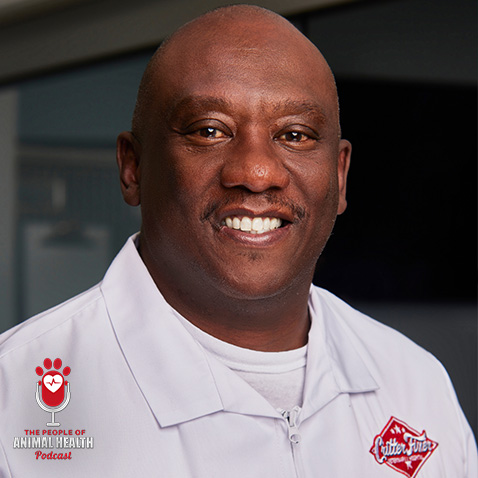
Dr. Terrence Ferguson has built a career defined by purpose, perseverance, and an unwavering commitment to helping others succeed. As the co-founder of Critter Fixer Veterinary Hospital, co-star of Critter Fixers: Country Vets, entrepreneur, mentor, and community advocate, he has become one of the most recognizable figures in the Veterinary profession.
Yet during his appearance on The People of Animal Health Podcast with host Stacy Pursell, it became clear that his accomplishments are rooted in values established long before television cameras entered his life. Throughout the conversation, Dr. Ferguson reflected on growing up in rural Georgia, discovering his passion for Veterinary medicine, building a thriving practice, mentoring future veterinarians, and embracing new technologies that continue reshaping Animal Health. While his career has taken him in remarkable directions, his philosophy has remained remarkably consistent. Success, in his view, comes from hard work, authenticity, continuous learning, and a willingness to help others achieve their own goals.
Growing Up In A Small Town With Big Dreams
Dr. Ferguson’s story begins in Talbotton, Georgia, a community so small that he laughingly describes it as having “two traffic lights and a caution light.” Growing up in a town where his graduating class consisted of only about fifty students created an environment where neighbors depended upon one another and hard work became a way of life. Those early experiences shaped both his work ethic and his leadership style because success required people to support one another while taking personal responsibility for their own future.
Looking back, Dr. Ferguson credits his hometown with teaching lessons that still guide him today. Living in a close knit community meant people knew one another well, and reputation mattered. Character was measured not only by accomplishments but also by consistency, reliability, and integrity. Those qualities later became essential as he built successful Veterinary hospitals and led growing teams of employees.
His interest in Veterinary medicine developed at an unusually young age after an experience that would permanently change the direction of his life. When he was about eight years old, a family dog was struck by a car. Determined to help, young Terrence cared for the injured animal himself. Although he now laughs that the dog probably suffered little more than road rash, the recovery felt miraculous through the eyes of a child.
“That was enough to inspire me to want to become a veterinarian,” he recalled. “That lit the fire.”
Many children dream about becoming veterinarians, but for Dr. Ferguson that early experience became much more than a passing interest. It planted the conviction that caring for animals could become his life’s work, and that sense of purpose never disappeared.
Leadership Lessons That Began At Tuskegee
When Dr. Ferguson enrolled at the Tuskegee University College of Veterinary Medicine, he quickly distinguished himself not only as an outstanding student but also as an emerging leader. Serving as class president for three consecutive years while earning the Pfizer Small Animal Veterinary Award required balancing academic excellence with the responsibility of representing classmates and working collaboratively with faculty members.
Those experiences helped prepare him for challenges that extended far beyond Veterinary school.
Leadership, he explained, begins with setting the right example. Whether people are watching or not, consistency matters because trust develops through everyday actions rather than occasional accomplishments. As class president, he learned to listen carefully, work alongside others, and demonstrate the standards he expected from everyone around him.
“I learned to work with others and lead others,” he explained. “I learned to be an example and make sure I was doing the right thing when people were looking and doing the right thing when people were not looking.”
Those principles later became foundational as Critter Fixer Veterinary Hospital expanded from a small startup into one of the nation’s most recognized Veterinary practices.
Building Critter Fixer Through Determination
When Dr. Ferguson and Dr. Vernard Hodges opened Critter Fixer Veterinary Hospital in 1999, confidence alone did not drive their decisions. Instead, necessity became the catalyst for growth. Their first location served a relatively small community, and both veterinarians quickly realized that one practice alone would not provide enough opportunity for two doctors over the long term. Rather than waiting years before expanding, they made the bold decision to open a second hospital only a few months after launching the first.
Looking back, Dr. Ferguson admits the move required considerable faith because neither partner possessed guarantees about what the future would hold. They simply recognized that the early stages of a business often provide the best opportunity to establish systems, build momentum, and create a foundation capable of supporting future growth.
Instead of pursuing rapid expansion through aggressive hiring, they spent the next fifteen years personally managing both hospitals. Although that approach demanded extraordinary effort, it produced an unexpected advantage.
It allowed them to build the culture they envisioned.
By remaining deeply involved in daily operations, they established expectations for patient care, client service, teamwork, and professionalism long before significant expansion occurred. When additional veterinarians and staff members eventually joined the organization, they entered an environment where the culture had already been clearly defined.
“The culture was there,” Dr. Ferguson explained. “We knew what type of people we wanted to be in those clinics.”
That intentional approach to culture ultimately became one of Critter Fixer’s greatest competitive strengths. Like minded professionals wanted to work there because they recognized an organization built upon shared values rather than simply financial success.
Showing The Public What Veterinary Medicine Really Looks Like
The launch of Critter Fixers: Country Vets introduced millions of viewers to Dr. Ferguson, Dr. Hodges, and the remarkable work performed inside their hospitals. While the show’s popularity has brought national recognition, Dr. Ferguson hopes its greatest contribution has been changing how the public understands Veterinary medicine itself.
Many pet owners see only brief appointments inside examination rooms, making it difficult to appreciate the sophisticated diagnostics, advanced surgical procedures, and complex medical decision making taking place behind the scenes. Television has given audiences an opportunity to witness that reality firsthand.
Rather than portraying veterinarians as professionals who simply administer vaccines and routine treatments, the series highlights advanced imaging, ultrasound, endoscopy, surgery, laboratory diagnostics, and countless other aspects of modern Veterinary medicine that closely parallel human healthcare.
“We practice quality medicine,” Dr. Ferguson explained. “I think it allowed people to see what goes on behind the exam doors.”
That broader understanding benefits both the profession and pet owners. As clients gain greater appreciation for the complexity of Veterinary medicine, they become better equipped to understand treatment recommendations while recognizing the expertise required to deliver exceptional patient care.
Mentoring Future Leaders Through Athletics
Outside the Veterinary hospital, Dr. Ferguson has devoted significant time to coaching young athletes, an experience that has reinforced many of the same leadership principles he applies when mentoring veterinarians. Although football and Veterinary medicine may appear unrelated, he sees remarkable similarities between the two.
Success in either field depends upon preparation, repetition, discipline, and confidence developed through consistent practice. Coaches help athletes master skills until they become second nature. Similarly, experienced veterinarians help younger colleagues build clinical judgment through repetition, feedback, and encouragement.
For Dr. Ferguson, the ultimate objective remains the same regardless of the setting.
“I want to give them the skills needed,” he explained, “so they can be successful.”
That philosophy reflects his broader commitment to helping others achieve their potential rather than simply measuring his own accomplishments. Whether mentoring Veterinary students, coaching athletes, or leading employees, he believes true leadership involves preparing others to succeed long after formal instruction has ended.
Expanding Horizons Through Opportunity
One of Dr. Ferguson’s most meaningful community initiatives has been organizing college tours for student athletes from underserved communities. Growing up in rural Georgia taught him that many talented young people never pursue ambitious goals simply because they have never experienced those opportunities firsthand.
Visiting college campuses changes that perspective.
Walking through classrooms.
Meeting admissions representatives.
Standing on campus.
Imagining themselves as future students.
Those experiences transform higher education from an abstract idea into an attainable goal.
Dr. Ferguson believes physical exposure often creates confidence that cannot be developed through brochures or television advertisements alone. Once students have seen a university with their own eyes, they begin believing they belong there.
As he explained, representation extends beyond seeing successful people who share similar backgrounds. Sometimes seeing the actual place where dreams can become reality proves equally powerful. That belief continues driving his commitment to expanding opportunities for young people while helping them recognize possibilities they may never have considered otherwise.
Expanding Access Through Vet For A Day
One of the most meaningful parts of Dr. Terrence Ferguson’s career has been introducing young people to Veterinary medicine before they decide what their futures might hold. Vet For A Day began locally at Critter Fixer Veterinary Hospital as a way to give students from underserved communities an authentic look inside the profession. Rather than offering only lectures or career brochures, the program allows participants to observe surgery, learn basic suturing techniques, practice animal restraint, explore endoscopy, and discover the wide range of responsibilities veterinarians handle each day.
The initiative quickly grew beyond anything Dr. Ferguson and Dr. Vernard Hodges initially imagined. Corporate supporters began providing backpacks, stethoscopes, and educational materials, while universities, zoos, aquariums, and other organizations helped expand the program across the country. What started as a local effort became a national pathway for students who might never otherwise step inside a Veterinary hospital.
The greatest reward has been watching early participants move closer to professional careers. “Some of these kids are getting ready to either enter college or apply to Veterinary schools,” Dr. Ferguson said. Knowing that Vet For A Day helped shape those decisions has affirmed that meaningful exposure can permanently change a young person’s direction.
For Dr. Ferguson, representation matters, but direct experience can make opportunity feel even more attainable. A student who sees a Veterinary hospital, touches the equipment, meets the professionals, and practices clinical skills can begin replacing uncertainty with confidence. The profession no longer feels distant because that student has already taken a first step inside it.
Building Opportunity Through Athletics And Education
Dr. Ferguson’s commitment to young people also extends through athletics, education, and community service. Coaching has shown him that the principles behind athletic development closely resemble the principles behind Veterinary mentorship. Neither success nor confidence develops immediately. Athletes and veterinarians both need instruction, repetition, constructive feedback, and enough practice to apply their skills under pressure.
“What I’m trying to do in both instances is train those individuals to win,” he explained. Whether he is teaching an athlete to execute a play or helping a future veterinarian master a technical skill, his objective remains consistent. He wants people to gain the preparation and confidence required for lasting success.
That philosophy also inspired his college tour program for student athletes from communities where higher education can sometimes feel unreachable. Dr. Ferguson wanted participants to visit both large and small campuses, meet admissions representatives, learn application requirements, and imagine themselves living and learning in those environments. He understood that students could not confidently pursue opportunities they had never experienced.
“Physical structure representation can also matter,” he said. “It looks more attainable when I can see it and I can walk and I can touch it.” By visiting campuses before submitting applications, students begin viewing college as a realistic next step rather than an abstract possibility belonging to someone else.
His commitment to service also appears through a foundation created by his son, TJ, while TJ was beginning college and competing in athletics. Dr. Ferguson was especially proud that his son did not wait until achieving wealth or professional recognition before helping others. As he explained, “No one can do everything, but we can all do something.” That principle has allowed the foundation to support families while strengthening the bond between father and son.
Enjoying The Process Behind Every Challenge
Despite balancing Veterinary medicine, television, ranching, real estate, family responsibilities, community programs, and a passion for restoring muscle cars, Dr. Ferguson does not describe himself as overwhelmed. Instead, he remains energized by the process behind each new challenge.
“For me, I love the process,” he said. “Whether it’s restoring a muscle car, repairing an ACL on a dog, or trying to determine what is wrong with it, I enjoy the process.”
That mindset helps explain his longevity and continued enthusiasm after more than twenty five years in practice. He does not focus exclusively on the final result because much of his fulfillment comes from examining a problem, developing a plan, adjusting when necessary, and gradually moving toward a solution. Veterinary medicine remains appealing because no two days unfold exactly the same way, and each case requires a different combination of scientific knowledge, practical skill, creativity, and communication.
His process driven nature also shapes his daily routine. Dr. Ferguson frequently wakes during the early morning hours and mentally walks through the coming day before activity begins. Those quiet periods allow him to organize responsibilities, anticipate challenges, and visualize the steps required to complete complicated tasks.
“I wake up and process everything almost step by step,” he explained. “When I get ready to do it that next day, it’s not something new to me. I’ve kind of seen and processed it before.”
Although the day may not follow his mental plan perfectly, preparation gives him a stronger starting point. This habit began during college, when early mornings provided a quiet environment for studying, but it eventually became an important leadership and business practice.
Adapting To A Rapidly Changing Profession
The pace of technological advancement has been one of the greatest surprises of Dr. Ferguson’s Veterinary career. While innovation occurred throughout his first fifteen years in practice, he believes the profession has changed much more dramatically during the past decade, with development accelerating even further in recent years.
Advanced imaging, endoscopy, improved diagnostics, new medications, and sophisticated treatment options have allowed veterinarians to practice better medicine while helping animals live longer. Client education has advanced as well, which means many pet owners now arrive with a stronger understanding of subjects such as dental care, pain management, preventive medicine, and chronic disease.
Artificial intelligence may create the next major transformation. Dr. Ferguson has already seen how AI can review radiographs within minutes and identify potential abnormalities for a veterinarian to consider. He anticipates systems that will eventually combine imaging, laboratory results, histories, and other diagnostic information before generating differentials or recommending possible next steps.
“I don’t think it’ll ever get to the point that the veterinarian has nothing to do,” he said, but he believes AI will provide substantial assistance with diagnostics and treatment decisions.
At the same time, he cautioned veterinarians against allowing convenience to weaken their clinical abilities. “I don’t want the veterinarians to become lazy because we need to make sure that we are veterinarians,” he explained. Technology should strengthen professional judgment rather than replace it. Veterinarians must continue understanding medicine deeply enough to evaluate suggestions, recognize errors, and make decisions grounded in the needs of individual patients.
Learning The Business Through Trial And Error
One of Dr. Ferguson’s greatest early challenges was learning how to operate a business without formal management education. Veterinary school taught him and Dr. Hodges how to diagnose disease, perform surgery, and care for patients, but it did not teach them how to manage payroll, evaluate financial performance, develop pricing, recruit employees, or guide a growing organization.
“We learned how to become veterinarians, but we didn’t necessarily learn how to become businessmen,” Dr. Ferguson said.
Because Critter Fixer opened before online information became widely available, they relied heavily upon books, observation, experimentation, and experience. They made mistakes, adjusted their approach, and gradually developed the knowledge required to keep both hospitals financially healthy through changing economic conditions.
One of Dr. Ferguson’s most important business lessons involves understanding the metrics that drive revenue. In Veterinary medicine, he identifies two especially important measurements: the number of clients entering the practice and the average client transaction. Those figures help leaders understand whether their hospitals depend upon high patient volume, higher spending per visit, or a balanced position between those models.
“The biggest two metrics in Veterinary medicine are the amount of people that come in the door and your average client transaction,” he explained. Practice owners must decide which model matches their market, staffing, values, and desired style of medicine, while monitoring performance closely enough to make timely adjustments.
For Dr. Ferguson, successful business leadership does not require obsessing over every number. However, leaders must understand which numbers reveal the true condition of their organizations. Staying informed allows them to protect employees, improve patient care, and make decisions before small problems become larger threats.
Choosing Sacrifice Over Selfishness
When asked what principle he wished every listener could learn, Dr. Ferguson offered one of the interview’s most memorable observations. He believes everyone has an S on their chest, but each person must decide what that letter represents.
“Is that S going to be selfishness, or is the S going to be sacrifice?” he asked.
Dr. Ferguson has chosen sacrifice by investing time in mentorship, coaching, education, outreach, and service. He wants everyone around him to win because he views success as something that can expand rather than something that must be guarded.
This philosophy also explains why he does not identify one book as the single source of his leadership education. Although books have provided useful information, much of his growth came from observing people whose examples offered lessons he could incorporate into his own life. Some were formal mentors, while others simply demonstrated qualities he admired.
He studied how they worked, treated people, responded to adversity, and approached responsibility. Over time, those examples helped him construct his own leadership philosophy, just as repeated cases gradually help veterinarians develop stronger clinical judgment.
Remaining Authentic While Reaching Back
Dr. Ferguson ended the conversation with advice shaped by decades of experience in a profession where he and Dr. Hodges initially believed they needed to look or behave a certain way to succeed. Eventually, they discovered that authenticity created stronger relationships than conformity ever could.
“Don’t be afraid to be who you are,” he said. “You just have to be yourself and be authentic and love people.”
That lesson has become even more important as television has expanded his visibility. Although millions of viewers recognize him, Dr. Ferguson continues approaching patients, clients, employees, and students with the same humor and humility that characterized his life before national recognition. He does not take himself too seriously, but he takes his responsibilities to others very seriously.
His final message also emphasized continuous education. “Don’t ever stop learning,” he advised, because Veterinary medicine changes too rapidly for any professional to depend entirely upon knowledge acquired years earlier. New technology, treatments, client expectations, and business realities require veterinarians to remain curious throughout their careers.
Most importantly, he encouraged listeners to reach back and help the next person move forward. That idea connects every major part of his journey, from coaching athletes and organizing college tours to expanding Vet For A Day and mentoring future veterinarians.
Dr. Terrence Ferguson’s appearance on The People of Animal Health Podcast demonstrated that leadership is not measured only through business growth, television success, or professional recognition. It is also measured through the confidence created in a student, the skills developed in a young veterinarian, the opportunities opened for a family, and the hand extended toward someone who has not yet reached the next step.
His career began with an injured dog and a childhood desire to help animals, but it grew into a much broader mission. By embracing hard work, enjoying the process, adapting to change, remaining authentic, and choosing sacrifice over selfishness, Dr. Ferguson has created a legacy that continues strengthening the Veterinary profession while inspiring others to believe they can build meaningful careers of their own.
Listen to Dr. Terrence Ferguson’s episode on The People of Animal Health Podcast with Stacy Pursell!