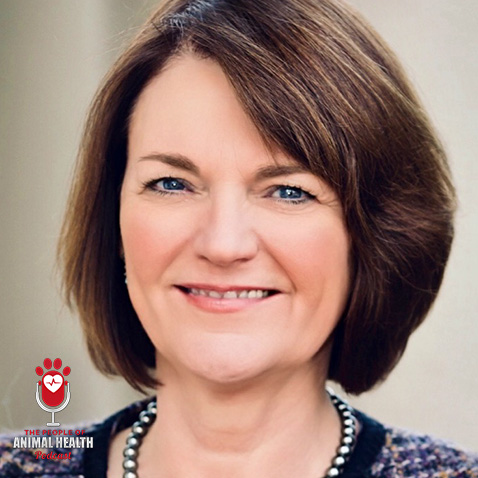
During a career spanning more than three decades, Julia Stephanus has helped launch groundbreaking products, build startup companies from the ground up, guide organizations through acquisitions and public offerings, mentor emerging leaders, and champion greater investment in Animal Health innovation. Whether serving as founder and CEO of Summit Vetpharm, helping build Aratana Therapeutics into one of the industry’s most successful biotechnology companies, advising startups through Avviare, or identifying promising innovations through Borealis Ventures, Stephanus has consistently positioned herself where new ideas become transformational businesses.
During her appearance on the inaugural episode of The People of Animal Health Podcast with host Stacy Pursell, Stephanus reflected on the experiences, challenges, and mentors that shaped her remarkable career. Her story demonstrates that leadership is rarely defined by a single accomplishment. Instead, it develops through years of hard work, resilience, curiosity, and an unwavering willingness to embrace opportunities that others might overlook. Throughout the conversation, one theme emerged repeatedly: great careers are built by people who recognize unmet needs, surround themselves with exceptional teams, and never stop looking for ways to make the Animal Health industry stronger than they found it.
Farm Life Built the Foundation
Julia Stephanus grew up on a family farm near Madison, Indiana, a small community in the southern part of the state where agriculture shaped both daily life and personal values. Long before she ever entered a corporate boardroom or helped launch innovative Animal Health companies, she learned lessons about responsibility, perseverance, and teamwork while working alongside her parents and two older brothers.
The family’s operation reflected the diversity common to many Midwestern farms during that era. They raised Black Angus cattle while growing corn, tobacco, and alfalfa hay. Beyond the commercial livestock, Stephanus eagerly cared for a variety of animals that found their way into her life, including puppies, kittens, a lamb, a rescued raccoon, and the geese that always seemed to occupy the farm ponds. Those experiences nurtured a lifelong appreciation for animals while teaching her that meaningful accomplishments require consistent effort rather than occasional bursts of enthusiasm. Farm work followed the rhythms of the seasons rather than convenient schedules, and everyone contributed regardless of age. “I worked hard on the farm with my parents and my two older brothers,” she remembered.
Education received equal emphasis within the household. Stephanus genuinely loved school, approached her studies seriously, and understood early that academic success would create opportunities extending well beyond the family farm. At sixteen, she accepted her first paying job, carefully saving every dollar possible while borrowing the remainder necessary to attend Indiana University. Financial realities also influenced her college decision. Indiana University represented the state’s major non-agricultural university while remaining affordable enough for a hardworking farm student determined to earn her degree. “It was really all I could afford at the time,” she explained.
Looking back today, Stephanus believes those early years provided exactly the preparation she needed for an entrepreneurial career. Farm life taught resilience, discipline, and accountability, while paying her own way through college reinforced the importance of personal responsibility. Those lessons would eventually prove just as valuable in executive leadership as they had been in rural Indiana.
Discovering a Passion for Marketing
Although agriculture surrounded her throughout childhood, Stephanus did not initially envision herself building companies within the Animal Health industry. Instead, her first professional inspiration emerged during college through an internship at Dow Chemical in Midland, Michigan. That experience introduced her to corporate America for the first time. More importantly, it introduced her to product management. “When I was in college I did an internship at Dow Chemical,” she explained. “I decided from that internship that I wanted to be a product manager.”
Rather than viewing products simply as things companies sold, she became fascinated by the strategic thinking behind successful brands. Understanding customer needs, positioning products effectively, developing commercial strategies, and guiding innovations from concept to market appealed to both her analytical abilities and her natural curiosity. She also recognized something equally important: outstanding product managers first understand customers. Consequently, instead of immediately pursuing marketing, Stephanus deliberately began her career in sales, believing firsthand customer experience would ultimately make her a stronger marketer. “I figured out I could leverage what I knew about agriculture,” she said.
That decision led her into crop protection sales in Springfield, Illinois, where she worked directly with some of the nation’s largest corn and soybean producers alongside agricultural dealers serving commercial farming operations. The timing presented unique challenges. The early 1980s remained overwhelmingly male dominated throughout agricultural sales, and many of her colleagues possessed years of farming experience plus university degrees specifically focused on agronomy. “I really had to hustle to compete with them,” she recalled.
Unlike many of her peers, Stephanus lacked formal agronomy training. In fact, she joked that she barely understood what agronomy actually meant when she first entered the profession. Rather than allowing that knowledge gap to discourage her, she compensated through preparation, determination, and an exceptional work ethic. The results spoke for themselves. She became the top sales representative throughout the Midwest region while also assuming responsibility for training newly hired representatives.
Those early accomplishments established a pattern that would continue throughout her career. Whenever confronted with unfamiliar challenges, Stephanus responded by learning faster, working harder, and refusing to allow perceived disadvantages to become permanent limitations.
Following a Mentor into Animal Health
One of the most significant turning points in Julia Stephanus’s career occurred because of a mentor who recognized both her potential and her ambitions. Her supervisor during those early crop protection years happened to be a veterinarian, and beyond managing sales performance, he took an active interest in helping develop her professionally.
When he eventually accepted a position with an emerging biotechnology company in Minnesota, he offered Stephanus exactly what she had been pursuing since her Dow Chemical internship: a product manager position. “He offered me what I had been yearning for,” she remembered.
Without hesitation, she followed him to Molecular Genetics in Minnetonka, Minnesota, beginning what would become a lifelong career in the Animal Health industry. The timing could not have been more exciting.
Biotechnology was transforming healthcare, and companies throughout both human health and Animal Health were exploring entirely new scientific possibilities. Genentech had recently captured widespread attention, recombinant DNA technology was beginning to reshape medicine, and Molecular Genetics found itself among the earliest Animal Health companies applying those innovations commercially. “We were building a monoclonal antibody for E. coli scours in calves,” Stephanus explained.
For someone passionate about product development, the opportunity represented an ideal combination of science, innovation, agriculture, and commercial strategy. Instead of marketing traditional pharmaceutical products, she now participated in developing technologies that many considered revolutionary. “It was a very exciting time,” she recalled.
Although Molecular Genetics eventually shifted away from Animal Health, Stephanus has always viewed those years as the beginning of an extraordinary professional journey because they introduced her to biotechnology decades before it became commonplace throughout the industry. More importantly, they reinforced her conviction that the greatest opportunities often emerge where innovation and entrepreneurship intersect.
Learning Through Industry Transformation
The years following Stephanus’s introduction to Animal Health coincided with one of the industry’s most significant periods of consolidation. Rather than spending decades with a single organization, she found herself repeatedly navigating mergers, acquisitions, organizational restructuring, and changing corporate identities. Looking back, she views those experiences as an unexpected education rather than an inconvenience. “The first half of my career was filled with a lot of company consolidations,” she explained.
Throughout those years she worked for an impressive list of companies that eventually became part of Pfizer Animal Health, including Molecular Genetics, Solvay, Hoffmann La Roche, SmithKline Beecham, and Pharmacia. Each organization contributed something unique:
- Some expanded her scientific understanding.
- Others strengthened her commercial expertise.
- Still others introduced new leadership approaches, business strategies, or organizational cultures.
Rather than resisting continual change, Stephanus learned to embrace it while recognizing that every transition created another opportunity to broaden her perspective. Those experiences also exposed her to nearly every aspect of commercial Animal Health, from product development and marketing to sales leadership, strategic planning, licensing, acquisitions, and executive management. By the time she eventually considered launching companies herself, she had accumulated an unusually comprehensive understanding of how successful Animal Health organizations operate.
She could not have known it then, but every merger, every new responsibility, and every organizational change had quietly prepared her for the entrepreneurial chapter that would ultimately define the second half of her remarkable career.
Building Companies That Changed Animal Health
By the early 2000s, Julia Stephanus had accumulated an extraordinary range of experience across virtually every commercial discipline within the Animal Health industry. Years spent navigating mergers, managing brands, launching products, and leading commercial organizations had prepared her for a challenge unlike anything she had previously attempted: starting her own company.
The opportunity came through Summit Vetpharm, a startup built around a single companion animal parasiticide. At first glance, the odds appeared daunting. The company possessed one product, limited resources, and entered one of the industry’s most competitive therapeutic categories. Meanwhile, established multinational corporations already dominated the marketplace with extensive product portfolios, enormous sales organizations, and decades of customer relationships.
“It was a single product company in the parasiticide category,” Stephanus recalled.
The challenge extended beyond external competition. Summit Vetpharm was capitalized by Sumitomo, an organization with little experience supporting startup businesses, meaning Stephanus faced pressure from both investors and competitors simultaneously. “I had a lot to prove internally and I had a lot to prove externally,” she said.
Rather than allowing those obstacles to discourage her, she embraced them. Every decision required careful prioritization because startups rarely enjoy the luxury of unlimited resources. Teams must move quickly, remain flexible, and continually solve problems with creativity rather than simply increasing spending. Those realities perfectly matched Stephanus’s leadership style. She believed exceptional people working toward a common purpose could accomplish far more than organizational size alone might suggest.
Against considerable odds, Summit Vetpharm successfully established itself within the marketplace before ultimately being acquired by Ceva Animal Health in 2010. Looking back, Stephanus still considers building the company one of the defining accomplishments of her career because it demonstrated that thoughtful strategy, disciplined execution, and an outstanding team could successfully compete against some of the largest companies in Animal Health. “The highest point was probably starting Summit Vetpharm against all odds,” she reflected.
Her entrepreneurial journey did not end there. Soon afterward, another opportunity emerged that would once again place her at the forefront of Animal Health innovation: Aratana Therapeutics. Unlike Summit Vetpharm, which focused on commercializing a specific product opportunity, Aratana represented the next generation of Animal Health biotechnology. Initially organized as a development company, it sought to bring innovative therapeutics to Veterinary medicine using scientific approaches that had already demonstrated promise in human health.
Stephanus played a central role in transforming the organization from a development-focused enterprise into a fully integrated commercial company capable of launching products independently. “When it started it was really development only,” she explained. “We were able to build out the commercial organization, get our first registrations, and launch our first products.”
Those accomplishments ultimately helped position Aratana for a successful initial public offering before its eventual acquisition by Elanco in 2019. For Stephanus, taking the company public represented another extraordinary professional milestone because it demonstrated that Animal Health biotechnology had matured into an industry attracting significant investor confidence while delivering meaningful innovation to Veterinary medicine.
Rediscovering Where She Belonged
Despite her many accomplishments within Animal Health, Stephanus also experienced periods of uncertainty that ultimately reinforced how deeply connected she had become to the industry. One particularly difficult chapter began in 2003 after another acquisition eliminated her executive position. For the first time in her career, she found herself unexpectedly separated from an organization because of circumstances entirely outside her control.
Shortly afterward, she received an offer to become Chief Executive Officer of another Animal Health company. Professionally, the opportunity appeared ideal. Personally, however, it required yet another relocation. Having already moved numerous times to support her career, Stephanus and her family reached an important decision. Her daughters had established friendships, schools, and community connections in New Jersey, and she believed remaining there represented the right choice for her family despite the professional sacrifice involved.
Instead, she accepted a senior marketing position with Forest Laboratories in Manhattan, entering human health for the first time. “I figured I’d done every other species. I might as well complete my career with humans,” she joked.
Although the work proved intellectually stimulating and confirmed that her commercial skills transferred effectively between industries, something never felt quite right. “I couldn’t shake the feeling that I was an outsider in human health,” she said.
The challenge extended beyond the work itself. Every day required a two-hour commute each way between New Jersey and Manhattan, making it increasingly difficult to balance executive responsibilities with family life. After approximately two and a half years, Stephanus made an important realization. “I learned that Animal Health was where I wanted to be, and I never wanted to leave it again,” she said.
That experience reinforced something she continues telling young professionals today. Sometimes stepping away from a profession allows someone to appreciate even more clearly why it always felt like home.
Investing in the Future of Innovation
Following her success with Summit Vetpharm and Aratana Therapeutics, Stephanus shifted much of her attention toward helping the next generation of Animal Health entrepreneurs. Through Avviare, she advised emerging companies navigating commercialization, fundraising, strategic planning, and organizational growth, sharing hard earned experience with founders beginning journeys remarkably similar to her own. “I’ve spent the majority of my time working with startups in Animal Health,” she explained.
That commitment naturally led her to Borealis Ventures, where she now focuses on identifying promising technologies while attracting additional investment into Animal Health. “I felt like that was something that was sorely needed,” she added.
For Stephanus, increasing access to capital represents far more than a financial objective. Every promising startup requires resources capable of transforming scientific discoveries into products benefiting veterinarians, producers, pets, and livestock around the world. By encouraging greater investment, she hopes to accelerate innovation throughout the entire Animal Health industry.
Her commitment to developing future leaders also extends through A Feather in Her Cap, an organization recognizing outstanding women while encouraging mentorship throughout Animal Health. Although the Veterinary profession has become increasingly diverse, Stephanus observed that executive leadership historically lagged behind changing demographics. A Feather in Her Cap seeks to address that challenge by celebrating accomplished leaders while creating opportunities for future generations to learn from their experiences.
Mentorship has remained deeply personal for Stephanus because several influential leaders shaped her own development. One executive mentor at Pfizer encouraged her to look beyond immediate responsibilities while expanding her professional network. Another supervisor challenged her to stop seeking constant guidance and instead begin mentoring others herself. “He basically told me, ‘You’ve got this. It’s time for you to mentor other people,'” she said.
That advice permanently changed her perspective on leadership because she realized successful executives create lasting impact not only through business results, but also through developing future leaders.
Building a Lasting Legacy
As Stacy Pursell asked Stephanus about adversity, she shared one of the most difficult periods of her life. Only four months after launching Summit Vetpharm, her husband received a cancer diagnosis. While simultaneously building a startup company, leading employees, raising a family, and supporting her husband through treatment, Stephanus faced pressures unlike anything she had previously experienced. Fortunately, following approximately a year of treatment, he recovered fully and remains cancer free many years later.
Those experiences reinforced the importance of perspective. Career success certainly matters, but family matters even more. Reflecting on advice she would offer her younger self, Stephanus wished she had devoted more time to team activities while growing up because she later realized extraordinary accomplishments rarely occur individually. “You can do so much more goodness and great things when other people are involved,” she said.
That appreciation for teamwork has shaped every organization she has built, every board she has joined, and every entrepreneur she now mentors. She also shared one personal habit that has consistently helped her navigate difficult decisions. “When I have a problem, I think about it before I go to bed,” she said. Rather than forcing immediate answers, she deliberately allows her subconscious to continue processing challenges overnight.
Throughout her career, books have provided another important source of learning. She enthusiastically recommended FYI: For Your Improvement as an exceptional leadership resource, describing how she kept copies both at home and in her office while coaching employees. She also praised Zoobiquity for highlighting the remarkable knowledge veterinarians contribute to medicine and Zero to One for inspiring entrepreneurs to create genuinely new solutions rather than simply copying existing business models.
As the interview concluded, Stephanus left listeners with a message reflecting both optimism and purpose. For her, Animal Health improves the lives of people, animals, and the environment simultaneously while offering extraordinary opportunities for innovation and meaningful careers. Her advice was beautifully simple:
“Figure out how you can make a difference,” she said.
Then she shared the words her mother repeated throughout her childhood on the Indiana farm where everything began: “You see what needs to be done, go do it.”
Those few words capture not only Julia Stephanus’s remarkable career, but also the legacy she continues building throughout the Animal Health industry. Rather than waiting for someone else to solve difficult problems, she has consistently chosen to create solutions herself while encouraging others to do the same. Through innovation, entrepreneurship, mentorship, and visionary leadership, she has helped shape the modern Animal Health industry while inspiring future generations to build upon the foundation she helped create.
Listen to Julia Stephanus’s episode on The People of Animal Health Podcast with Stacy Pursell!