When most people think about the leaders who shape the Veterinary profession, they often picture veterinarians in clinical practice, researchers developing breakthrough treatments, or executives leading major animal health companies. Yet behind every healthy profession is another group of leaders working quietly behind the scenes to ensure the public is protected, professional standards remain high, and the regulatory framework evolves alongside the changing needs of society.
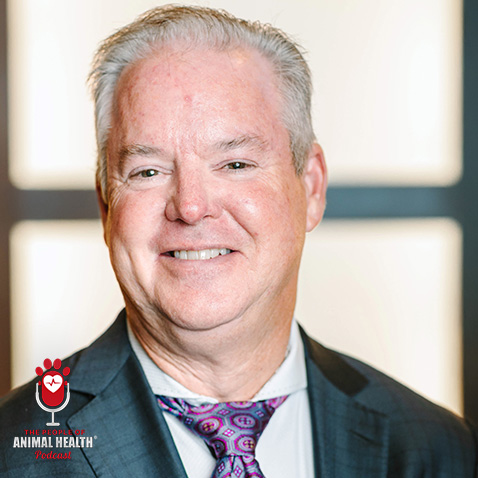
Jim T. Penrod is one of those leaders.
As Chief Executive Officer of the American Association of Veterinary State Boards (AAVSB), Penrod has spent the past decade helping guide the organization through one of the most transformative periods in Veterinary medicine’s history. From telemedicine and workforce mobility to artificial intelligence and competency-based licensing examinations, he has consistently challenged regulators to think proactively about the future rather than simply reacting to change after it arrives.
During his appearance on The People of Animal Health Podcast with Stacy Pursell, founder and CEO of The VET Recruiter, Penrod reflected on his unconventional journey into the Veterinary profession, his philosophy of leadership, and why thoughtful regulation plays a vital role in protecting both animals and the public. Throughout the conversation, one theme surfaced repeatedly: meaningful innovation happens when organizations are willing to embrace change while remaining committed to their core mission.
An Unconventional Path into Veterinary Medicine
Unlike many guests on The People of Animal Health Podcast, Jim Penrod did not grow up dreaming of a career connected to Veterinary medicine. In fact, his professional journey began in an entirely different field.
Although he was born in New York, his family relocated to Ohio when he was just three years old, and it was there that he spent most of his childhood. After graduating from high school, he attended The Ohio State University, earning a degree in landscape architecture. At the time, he envisioned designing communities and large-scale developments rather than working in professional regulation.
“I actually received a degree in landscape architecture through The Ohio State University,” Penrod explained. “From there, I moved out to Virginia where I spent 30 years until I came to AAVSB.”
His early career followed that plan. He worked for several landscape architecture firms before launching his own land planning business, designing large residential and commercial developments throughout Virginia and neighboring states. Like many entrepreneurs, however, he soon learned that even well-planned careers can be disrupted by forces outside one’s control.
When the economy declined and development projects slowed dramatically, Penrod found himself facing an unexpected crossroads.
“Times got a little difficult,” he recalled. “The economy went south, and so I had to go find a different job.”
Rather than viewing the setback as defeat, he embraced it as an opportunity to reinvent himself. That willingness to adapt would become one of the defining characteristics of his career.
Discovering a Profession Few People Plan For
Penrod often jokes that association management is not a profession children aspire to enter.
“It’s funny,” he said. “Nobody says as a kid that I want to be an association professional when I grow up.”
Instead, people usually discover the profession through unexpected opportunities, and that’s exactly what happened to him.
After entering association management, he joined the Council of Landscape Architectural Registration Boards (CLARB), where he steadily advanced through the organization over a remarkable twenty-four-year career. Starting in operational roles and eventually becoming Chief Operating Officer, Penrod developed extensive expertise in professional regulation, governance, licensure, examination development, and organizational leadership.
Looking back, he believes the greatest reward wasn’t simply career advancement.
It was realizing that association management provided an opportunity to make a meaningful difference in an entire profession.
“As I’ve been in association management for the past few decades,” he said, “I really feel like I’ve made a difference in the professions I’ve worked for.”
That sense of purpose eventually led him to seek an executive leadership role of his own. When the opportunity to lead the American Association of Veterinary State Boards emerged in 2015, it represented not only a new professional challenge but also an opportunity to serve a profession that touches virtually every aspect of public health, food safety, and animal welfare.
Although he entered Veterinary medicine from outside the profession, he quickly discovered that many of the principles of professional regulation transcend individual disciplines.
Understanding the Mission of the AAVSB
For many people outside regulatory circles, the American Association of Veterinary State Boards operates largely behind the scenes. Yet its work affects virtually every licensed veterinarian and Veterinary technician in North America. The organization serves sixty-three licensing jurisdictions across the United States, Canada, and U.S. territories, providing guidance, resources, and services that help regulatory boards fulfill their responsibility to protect the public.
Penrod explained that one of AAVSB’s most important responsibilities involves developing model statutory language and regulatory guidance that jurisdictions can use when creating or updating their Veterinary practice acts. Rather than requiring every jurisdiction to develop regulations independently, AAVSB provides carefully researched model language that helps create greater consistency while allowing individual boards to adapt regulations to meet local needs.
The organization also administers the Registry of Approved Continuing Education (RACE) program, which evaluates and approves continuing education opportunities used by veterinarians and Veterinary technicians to maintain licensure in many jurisdictions.
Beyond continuing education, AAVSB facilitates licensure portability by transmitting professional credentials when licensees seek licensure in additional states or provinces. Another critical responsibility is developing the Veterinary Technician National Examination (VTNE), which serves as the licensing examination for Veterinary technicians throughout much of North America. While each of these programs addresses different aspects of professional regulation, Penrod emphasized that they all serve the same overarching objective.
“It’s really all about protecting the public,” he explained.
That commitment guides every strategic decision the organization makes.
A New Strategic Vision
When Penrod arrived at AAVSB in 2015, one of his first priorities was helping the organization think more intentionally about the future. Rather than focusing exclusively on day-to-day operations, he worked closely with the Board of Directors to develop a comprehensive strategic plan designed to anticipate the profession’s evolving needs.
Among the strategic priorities identified early in that process was telemedicine. At the time, Veterinary telemedicine remained a relatively new and controversial topic. Many within the profession recognized its potential to improve access to care, while others expressed understandable concerns regarding patient safety, standards of care, and the veterinarian-client-patient relationship.
Instead of waiting for outside organizations or legislators to define how telemedicine should function within Veterinary medicine, Penrod believed the profession itself should lead that conversation.
“It took a committee of volunteers about two years,” he recalled, “to develop some language around telemedicine and telehealth.”
The resulting work culminated in revisions to AAVSB’s Model Practice Act that included language allowing for the establishment of a virtual veterinarian-client-patient relationship (VCPR) under appropriate circumstances.
The initiative represented a significant shift in regulatory thinking. Rather than viewing technology as a threat, AAVSB sought to establish a thoughtful framework that balanced innovation with public protection.
That forward-thinking approach earned Penrod the Veterinary Innovation Summit’s Innovation Award in 2019. More importantly, it demonstrated that regulation could serve as an enabler of responsible innovation rather than an obstacle to progress.
Lessons That Cross Professional Boundaries
Although Veterinary medicine differs dramatically from landscape architecture, Penrod believes the fundamental principles of professional regulation remain remarkably consistent.
During his years with CLARB, he learned that successful regulation always begins with the same question: How do we protect the public while allowing professionals to serve society effectively?
“I think regulation is really similar across most professions,” he explained. “The details matter, but it’s really all about protecting the public.”
That perspective proved invaluable when he transitioned into Veterinary medicine. Rather than approaching Veterinary regulation as something entirely unfamiliar, he recognized many of the same challenges he had encountered previously:
- Licensure standards
- Professional competence
- Ethical conduct
- Continuing education
- Public trust
The specifics differed, but the underlying mission remained unchanged. What did change, however, was the increasing role technology would play in reshaping nearly every aspect of professional practice.
Innovation Must Improve Access to Care
Throughout the interview, Penrod repeatedly emphasized that innovation should never exist simply for innovation’s sake. Instead, new technologies and regulatory approaches should ultimately improve access to Veterinary care while maintaining public protection.
He pointed to telemedicine as a prime example. Although debates surrounding virtual care continue throughout the profession, Penrod believes regulators must ask a broader question: How can technology responsibly help more animals receive timely Veterinary care?
Many pet owners live in rural or underserved communities where access to Veterinary services remains limited. Others face transportation challenges or mobility issues that make routine visits difficult. Technology alone cannot solve every access problem. However, thoughtfully implemented telehealth services may provide valuable support in appropriate situations while preserving high standards of care.
Similarly, regulatory organizations must continually evaluate how licensure processes can better support workforce mobility. As more veterinarians choose relief work or practice across multiple jurisdictions, traditional licensing systems must adapt without compromising public protection.
Finding that balance remains one of AAVSB’s ongoing priorities.
“We’re trying to figure out,” Penrod explained, “how can we get those folks that have pets—or even food animals—access to Veterinary care when, for so many, it’s out of reach.”
Leading Through Transparency and Collaboration
When asked about his leadership philosophy, Penrod’s response reflected the same collaborative approach that has characterized much of his career. Rather than focusing on titles or individual accomplishments, he immediately shifted attention toward the people around him.
“I think it’s really being compassionate, being transparent about what I’m doing, being open,” he said.
Leadership, in his view, is less about directing others and more about creating an environment where talented people can perform at their highest level. Over more than three decades in association management, he has come to appreciate that organizational success rarely depends on any single individual.
Instead, lasting progress emerges when teams share ideas openly, communicate honestly, and remain united by a common purpose: “I’ve appreciated the folks around me,” Penrod reflected.
That humility has become one of the hallmarks of his leadership style. Whether guiding strategic planning, navigating controversial policy discussions, or helping shape the future of Veterinary regulation, Penrod consistently returns to the same principle: meaningful change happens through collaboration.
As Veterinary medicine continues evolving at an unprecedented pace, that philosophy has positioned AAVSB to remain proactive rather than reactive. Instead of simply responding to emerging technologies and changing workforce dynamics, the organization strives to anticipate future challenges and develop thoughtful solutions before they become urgent.
For Jim Penrod, that proactive mindset is not simply good leadership—it is an essential responsibility for any organization entrusted with protecting both the Veterinary profession and the public it serves.
Throughout his career, Jim Penrod has viewed regulation not as a barrier to progress, but as a framework that allows innovation to flourish responsibly. As technology reshapes Veterinary medicine at an unprecedented pace, he believes regulatory organizations have an obligation to think several years ahead, anticipating challenges before they become obstacles. That forward-looking mindset has become one of the defining characteristics of his leadership at the American Association of Veterinary State Boards (AAVSB), where preparing the profession for tomorrow is every bit as important as addressing today’s needs.
Artificial Intelligence Is Changing the Regulatory Conversation
While telemedicine dominated many regulatory discussions during Penrod’s early years at AAVSB, he believes artificial intelligence now represents one of the most significant developments facing Veterinary medicine. “Obviously the biggest thing in the marketplace right now is artificial intelligence,” he said.
Rather than waiting for AI technologies to become widespread before considering regulatory implications, AAVSB has intentionally taken a proactive approach. The organization has already published a white paper examining artificial intelligence and is assembling a task force to develop guidance on how AI should be incorporated into Veterinary medicine while maintaining public trust.
Penrod emphasized that the discussion extends far beyond futuristic concepts. Artificial intelligence is already becoming part of everyday Veterinary practice.
Some clinics are using AI-powered scribes to generate medical records more efficiently. Others are exploring decision-support tools that assist with diagnosis, imaging interpretation, and treatment planning. As these technologies become increasingly sophisticated, regulators must ensure they enhance—not replace—the professional judgment of veterinarians.
“We’re looking at how it can be used appropriately and still protect the public,” Penrod explained.
That includes addressing questions surrounding data privacy, particularly as practices rely more heavily on AI-powered documentation systems that process sensitive client and patient information. It also means defining appropriate boundaries for diagnostic applications, ensuring that veterinarians remain accountable for clinical decisions regardless of what technology recommends.
For Penrod, the challenge isn’t deciding whether artificial intelligence belongs in Veterinary medicine. That question has largely been answered.
Instead, the focus has shifted toward establishing thoughtful guardrails that allow innovation to improve patient care while preserving professional accountability.
Supporting a More Mobile Workforce
Another significant change Penrod has observed involves the evolving expectations of today’s Veterinary workforce. As new graduates increasingly seek flexible schedules and improved work-life integration, relief practice has become substantially more common than it was only a decade ago.
“More recently,” he noted, “I think we’ve seen a rise in relief vets.”
Unlike traditional associates who remain employed by a single practice, relief veterinarians often work across multiple hospitals and, in many cases, multiple states. While this flexibility benefits both veterinarians and practices facing staffing shortages, it also creates new regulatory challenges.
Each jurisdiction maintains its own licensing requirements, renewal processes, and administrative procedures. Helping veterinarians navigate those complexities has become an increasingly important part of AAVSB’s mission. Fortunately, Penrod believes technology offers practical solutions.
One initiative receiving considerable attention involves expanding AAVSB’s centralized licensure database. The organization has maintained such a system since the late 1990s, but recent efforts have focused on creating direct connections with regulatory boards that provide daily updates regarding license status.
The long-term vision is ambitious. Rather than waiting days or weeks to verify credentials, regulatory boards would eventually have immediate access to current licensure information.
“The goal,” Penrod explained, “is to have an on-demand system where regulatory boards can simply look up someone’s name and see if they’re in good standing.”
That type of real-time information sharing could dramatically reduce administrative delays while helping qualified professionals begin practicing more quickly.
Preparing for the Veterinary Professional Associate
Among AAVSB’s newest initiatives is the development of an examination for the Veterinary Professional Associate (VPA), a profession that has generated significant discussion throughout Veterinary medicine following Colorado’s approval of the role. Penrod was careful to distinguish AAVSB’s responsibility from broader policy debates surrounding the profession itself.
“Our focus,” he explained, “is not whether we support the profession.”
Instead, the organization’s responsibility begins once jurisdictions recognize a new professional role. The question then becomes straightforward: How can regulators ensure graduates possess the competence necessary to practice safely?
Developing a licensing examination represents an essential part of that process.
Yet Penrod believes the VPA examination also presents an opportunity to rethink how professional competence should be measured.
Moving Beyond Memorization
Traditional licensing examinations have historically focused on knowledge. Candidates study large volumes of information before demonstrating that knowledge through standardized testing.
Penrod acknowledges that this model has served professions well for many years. However, he also believes the rapid availability of information through artificial intelligence and digital technologies requires educators and regulators to think differently.
“Anyone can have knowledge at their fingertips,” he observed.
The more important question is whether professionals can apply that knowledge effectively. For that reason, AAVSB hopes the VPA examination will emphasize competency rather than memorization. Instead of simply asking whether candidates remember specific facts, future assessments may increasingly evaluate how applicants reason through clinical situations, solve problems, and apply information appropriately.
Penrod described it as creating “the examination of the future.”
Such an approach aligns with broader trends across healthcare education, where competency-based assessment continues gaining momentum. For Veterinary medicine, it represents an opportunity to ensure newly licensed professionals possess not only knowledge but also the judgment required to use it responsibly.
Right-Touch Regulation
During the interview, Penrod reflected on a recent international meeting of Veterinary regulators in New Zealand. Although participants represented countries with different legal systems, cultures, and practice environments, he found it striking how similar their regulatory challenges had become.
One concept discussed extensively was “right-touch regulation.” The philosophy is deceptively simple. Regulation should be no more restrictive than necessary to protect the public.
“Set the regulations as simple and as light as you can,” Penrod explained.
He noted that the overwhelming majority of Veterinary professionals consistently act ethically and responsibly. Most practitioners regulate themselves through professionalism. Others are influenced by colleagues, employers, and organizational culture. Only a very small percentage require formal disciplinary intervention.
Rather than creating increasingly complex regulations for everyone, right-touch regulation focuses enforcement where it is truly needed—on those rare individuals whose actions place animals or the public at risk.
For Penrod, that approach reflects trust in the profession while still preserving accountability.
A Profession Built on Compassion
Although Penrod entered Veterinary medicine from outside the profession, one characteristic immediately stood out. “The most surprising thing,” he said, “is just how compassionate the people are.”
He described Veterinary professionals as exceptionally welcoming, collaborative, and genuinely committed to doing the right thing. Those observations strengthened his belief that regulation should empower professionals whenever possible rather than unnecessarily limiting their judgment.
He hopes regulators continue moving toward systems that place greater confidence in veterinarians while intervening only when circumstances truly require oversight.
That philosophy, once again, reflects the principle of right-touch regulation.
Technology Will Continue Changing Veterinary Medicine
When asked how the profession has evolved during the past decade, Penrod pointed once more to technology. He described Veterinary medicine as appropriately cautious. The profession rarely adopts new tools simply because they are fashionable. Instead, veterinarians typically wait for evidence demonstrating safety, effectiveness, and practical value.
“The profession is very conservative,” he observed. “They want to see proof before adopting things.”
He believes that careful approach ultimately benefits patients. Once technologies prove themselves, however, adoption accelerates rapidly.
Artificial intelligence appears poised to follow that same trajectory. Telemedicine, digital recordkeeping, diagnostic software, and other innovations will likely become increasingly integrated into everyday practice as evidence supporting their use continues to grow.
Rethinking the Business of Veterinary Medicine
Perhaps the most intriguing portion of the interview came when Penrod discussed how Veterinary business models may evolve. After attending a presentation focused on emerging technologies and consumer behavior, he began considering how healthcare delivery itself could change.
Rather than paying separately for examinations, medications, food, and preventive care, future clients may purchase comprehensive health plans centered on long-term outcomes. “I thought it was an interesting concept,” said Penrod.
In such a model, veterinarians would oversee every aspect of preventive healthcare while assuming greater responsibility for helping pets live long, healthy lives. If owners consistently followed medical recommendations, practices might even guarantee certain health outcomes.
Although Penrod acknowledged this remains speculative, he believes changing consumer expectations and the increasingly powerful human-animal bond make innovative pricing models worth exploring.
As pets become more fully integrated into families, owners may increasingly value comprehensive wellness relationships over traditional fee-for-service medicine.
Lessons Learned Through Adversity
No leadership career unfolds without setbacks. For Penrod, one of the most significant involved transitioning a professional licensing examination from paper-based testing to computer delivery while serving at CLARB. Confident in the initiative, he pushed the project forward quickly. Unfortunately, the organization selected the wrong technology vendor.
Correcting that mistake proved both time-consuming and professionally humbling. Rather than allowing the experience to discourage him, Penrod used it as an important leadership lesson.
“I learned to really do my due diligence,” Penrod reflected.
He also recognized the importance of building stronger consensus before implementing major organizational change. Association leaders, unlike corporate executives, serve members whose support remains essential for long-term success.
“If you get too far out in front of your members,” he explained, “it can be problematic.”
That experience reinforced the importance of balancing visionary thinking with thoughtful collaboration.
Communication Creates Trust
When asked what advice he would offer his younger self, Penrod answered immediately: “Communicate, communicate, communicate.”
He has learned that when people lack information, they naturally create their own explanations. Unfortunately, those assumptions are often incorrect.
Effective leaders therefore communicate not only decisions but also the reasoning behind them.
Helping people understand objectives, challenges, and long-term goals builds trust while minimizing unnecessary misunderstanding. That lesson has influenced nearly every aspect of his leadership philosophy.
The Power of Curiosity
Perhaps no theme appeared more consistently throughout the interview than curiosity. If Penrod could teach one principle to everyone listening, it would be learning to ask better questions.
“We practice what we call generative conversations,” he explained.
Rather than immediately judging viewpoints they disagree with, people should become curious about how others reached those conclusions: “What led that individual to come up with their perspective?”
Those conversations frequently reveal information that would otherwise remain hidden:
- Curiosity creates understanding.
- Understanding builds collaboration.
- And collaboration ultimately leads to better solutions.
Penrod believes this principle extends well beyond Veterinary regulation. Whether leading organizations, managing teams, or simply navigating everyday relationships, genuine curiosity almost always produces better outcomes than quick assumptions.
Looking Toward the Future
As the conversation concluded, Penrod reflected on a book that has significantly influenced his thinking: The Future of the Professions. The book explores how technology, changing workforce models, and the growing use of paraprofessionals are reshaping traditional professions.
He sees many of those predictions already unfolding within Veterinary medicine through expanded utilization of Veterinary technicians, the emergence of the Veterinary Professional Associate, and evolving roles for veterinarians themselves.
Rather than resisting those changes, Penrod encourages the profession to prepare thoughtfully for them. His final message captured the leadership philosophy that has guided his entire career.
“Dig into the facts,” he said. “Don’t believe everything you hear.”
In an era increasingly shaped by rapid technological change, misinformation, and evolving professional expectations, those words carry particular significance.
Jim Penrod’s career demonstrates that effective regulation is not about resisting innovation or creating unnecessary barriers. Instead, it is about thoughtfully guiding change in ways that preserve public trust while allowing Veterinary medicine to continue advancing.
For a profession built on science, compassion, and lifelong learning, that may be one of the most valuable contributions a regulatory leader can make.
Listen to James T. Penrod’s episode on The People of Animal Health Podcast with Stacy Pursell!