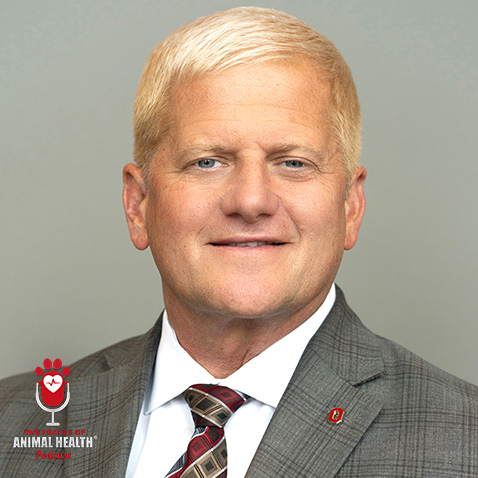
Few careers in veterinary medicine have combined clinical excellence, research, education, and visionary leadership as seamlessly as that of Dr. Rustin Moore. As dean of The Ohio State University College of Veterinary Medicine since 2015, Dr. Moore has helped reshape veterinary education while championing the human-animal bond, One Health initiatives, student wellness, and the future of the profession.
During his appearance on The People of Animal Health Podcast with Stacy Pursell, founder and CEO of The VET Recruiter, Dr. Moore reflected on the experiences that shaped his career—from growing up on a small hobby farm in the hills of West Virginia to leading one of the nation’s premier veterinary colleges. Throughout the conversation, one theme emerged repeatedly: success is built through service, collaboration, and an unwavering commitment to both people and animals.
Growing Up in the Appalachian Hills
Dr. Moore’s love of animals began long before he entered veterinary school. Born and raised in the Appalachian hills of West Virginia, he grew up on a modest 45-acre property that became his own personal laboratory for learning animal husbandry. Interestingly, while his parents were not farmers, he eagerly embraced the farming lifestyle himself.
“I grew up on what I call a hobby farm,” Dr. Moore explained. “My parents did not farm, but I did.”
His childhood included caring for virtually every type of farm animal imaginable. “I had about every imaginable animal possible—from pigs to cattle, horses and ponies, rabbits, chickens, ducks, and a whole lot more,” he added.
His interest wasn’t accidental. Local neighbors who balanced full-time jobs with raising cattle and sheep exposed him to agriculture, while his great-uncle and maternal step-grandfather also raised cattle. Those early influences nurtured a fascination with livestock that quickly evolved into something more. Long before career counseling or aptitude testing entered the picture, young Rustin had already decided what he wanted to become.
“I don’t remember the exact age,” he recalled, “but it was probably by six or seven years old.”
His mother often joked that she had encouraged him to pursue veterinary medicine because it would allow him to afford his dream of farming. Whether or not that conversation happened exactly as she remembered, Dr. Moore laughs that he never seriously considered another profession.
“I wanted to be a veterinarian from a very, very young age, and I never deviated from that.”
That certainty would become one of the defining characteristics of his career.
Building a Career Through Unexpected Opportunities
Although Dr. Moore always knew he wanted to become a veterinarian, the exact path his career would take remained far less certain. “When I entered veterinary school,” he said, “I wanted to be an Appalachian version of James Herriot—a country veterinarian. That’s all I knew.”
Like many veterinary students, however, his interests evolved as he encountered inspiring faculty members and discovered specialties he had never previously considered. By graduation, equine medicine had captured his attention. Following veterinary school, he completed an internship at the University of Georgia before returning to Ohio State for a surgical residency.
“The people I met at Georgia inspired me,” he said. “Somehow I got inspired by the surgeons.”
Those mentors changed everything. Not only did they encourage him to pursue surgery, but they also inspired him to earn a Ph.D., launching a successful career as a clinician-scientist. That combination of clinical practice, research, and teaching would ultimately prepare him for leadership positions he never anticipated.
“I never set out to be a dean,” he admitted. “I didn’t even know what a dean was.”
Instead, each career step opened the door to another.
Leading Through Collaboration
Since becoming dean of The Ohio State University College of Veterinary Medicine in 2015, Dr. Moore has overseen tremendous growth and innovation. Yet he is quick to redirect praise away from himself.
“I’m blessed by having an incredible leadership team and incredible faculty and staff and students,” he said. “Anything we’ve accomplished has been because of a very large group of people dedicated and committed to these initiatives.”
That collaborative mindset has defined his leadership philosophy. Among the college’s most significant accomplishments has been a complete redesign of its veterinary curriculum. Rather than simply updating existing courses, Ohio State embraced competency-based veterinary education, becoming one of the first veterinary colleges in the country to fully implement the framework developed by the American Association of Veterinary Medical Colleges.
The curriculum redesign began with a comprehensive review in 2017 and eventually transformed every aspect of veterinary education at the college. Instead of emphasizing memorization alone, students now develop competency through four integrated learning threads:
- Clinical skills
- Integrative problem solving
- Communication and collaboration
- Professional development
These themes run continuously throughout the curriculum, reinforcing the practical and interpersonal skills veterinarians need throughout their careers. Perhaps most importantly, students gain extensive hands-on experience early in their education.
“Early and frequent hands-on experience really helps build confidence,” Dr. Moore explained.
Preparing Students for the Real World
One of Dr. Moore’s strongest educational philosophies centers around what he calls the “spectrum of care.” Rather than preparing graduates for only referral hospitals or specialty practice, Ohio State trains veterinarians capable of meeting clients wherever they are.
“Our spectrum of care approach is to make sure our students become confident and competent veterinarians who can practice across the spectrum,” he said.
That philosophy recognizes an important reality of veterinary medicine: every client, every patient, and every situation is unique. Some clients pursue highly advanced specialty care. Others need practical, affordable solutions. Veterinarians must be prepared to deliver excellent medicine in either circumstance. To reinforce this philosophy, Ohio State established a standalone Spectrum of Care Clinic.
Students rotate through the clinic during their first three years, learning not only medicine but every aspect of veterinary practice—from client communication and financial discussions to teamwork with veterinary technicians and assistants. By the fourth year, those same students step into the role of primary veterinarian while faculty members observe from behind the scenes.
“The faculty become the coaches,” Dr. Moore explained. “They’re watching and observing while the students function as the doctor.”
This educational model allows students to develop confidence before graduation while receiving real-time mentorship from experienced clinicians.
Supporting Students Beyond the Classroom
For Dr. Moore, educating veterinarians involves much more than teaching anatomy, pathology, or surgery. It also means supporting students as individuals. Recognizing the significant emotional, academic, and financial pressures veterinary students face, Ohio State has dramatically expanded its student support services. Today, students have access to embedded mental health counselors, financial aid advisors, peer tutoring, and an Office of Teaching and Learning dedicated to academic success. One particularly meaningful initiative addresses a problem many people don’t associate with professional students.
“We know that about 15 percent of students are food insecure,” Dr. Moore said.
To help address that need, the college established the Community Cupboard, providing food resources for students facing financial hardship. Scholarships have also become a major institutional priority. When Dr. Moore became dean, philanthropic scholarship funding totaled approximately $370,000 annually. Today, that number exceeds $3.8 million. His long-term goal is ambitious: the college hopes to eventually provide every veterinary student with scholarship support equal to one full year of in-state tuition.
“We’re getting there,” he said, “but we’re not quite there yet.”
Lessons from Leadership
Long before becoming dean, Dr. Moore held numerous leadership positions, including department chair and executive director of Ohio State’s Veterinary Medical Center. Each role expanded his understanding of how veterinary education could better prepare graduates for practice.
Managing one of the nation’s busiest teaching hospitals highlighted an important challenge. Students needed exposure not only to rare referral cases but also to the everyday medical conditions they would encounter after graduation. That realization became another driving force behind Ohio State’s Spectrum of Care model.
“We needed to educate veterinary students on the kinds of cases they would most likely see when they graduate,” Dr. Moore explained.
By combining advanced specialty medicine with practical general practice experience, graduates leave prepared for virtually any career path. Those innovations have also influenced veterinary education nationally through Dr. Moore’s work with the American Association of Veterinary Medical Colleges, where he recently served as president and now serves as immediate past president.
A Passion for Equine Medicine
Before assuming full-time administrative responsibilities, Dr. Moore spent nearly two decades building an internationally respected career in equine surgery, research, and education.
His clinical interests focused primarily on equine lameness and colic—conditions that continue to challenge veterinarians worldwide. Looking back, he credits mentors rather than circumstances for shaping that career.
“The people I met inspired me,” he said.
Those mentors also inspired his interest in research, creating a career that balanced patient care with scientific discovery. Although administrative responsibilities eventually pulled him away from active clinical practice, he remains encouraged by the remarkable progress made in equine medicine.
Advances in diagnostics, surgical techniques, and medical management have dramatically improved survival rates for horses suffering from conditions like colic that once carried much poorer prognoses. While challenges remain, today’s veterinarians possess tools that previous generations could scarcely imagine. For Dr. Moore, that progress reflects one of veterinary medicine’s greatest strengths: a profession that continually evolves through research, innovation, and a commitment to improving animal health.