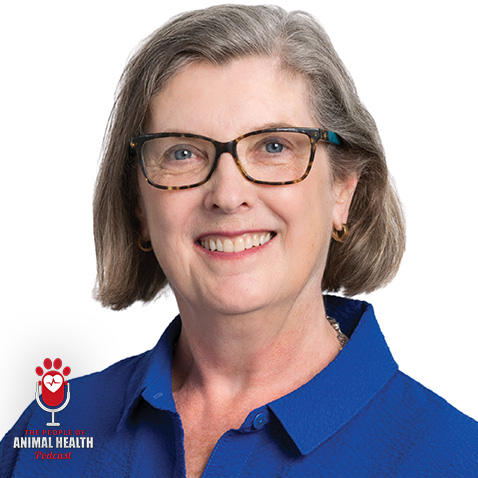
Few leaders have left a broader imprint on the Animal Health industry than Dr. Linda Rhodes. During a remarkable career spanning clinical practice, pharmaceutical research, entrepreneurship, biotechnology, executive leadership, and advocacy, she has consistently challenged conventional thinking while opening doors for future generations of women entering the profession. From becoming one of the very few women practicing large animal medicine during the 1970s to founding successful biotechnology companies and serving as Chief Executive Officer of Aratana Therapeutics, Dr. Rhodes has repeatedly demonstrated that meaningful innovation requires both courage and resilience. She has also become one of the industry’s strongest advocates for recognizing outstanding women through the organization she founded, A Feather in Her Cap, helping ensure that achievements once overlooked now receive the attention they deserve.
During her appearance on The People of Animal Health Podcast with host Stacy Pursell, Dr. Rhodes reflected upon a career filled with unexpected turns, difficult obstacles, and extraordinary opportunities. Rather than following a carefully designed career plan, she embraced each new challenge as it appeared, allowing curiosity and determination to guide her forward. Throughout the conversation, one message emerged repeatedly. Success rarely follows a straight line. Instead, it belongs to those willing to learn continuously, pivot when necessary, and remain open to possibilities that initially seem far removed from their original ambitions. Looking back over more than four decades in Veterinary medicine and Animal Health, Dr. Rhodes has become living proof that some of the most rewarding careers develop precisely because they refuse to remain predictable.
A Childhood Surrounded By Science and Creativity
Dr. Rhodes grew up in Rochester, New York, during an era when the city stood at the very center of the world’s photographic industry. Kodak dominated the local economy, attracting scientists, engineers, and inventors whose work continually pushed technological boundaries. Her own family reflected that culture of innovation. “My dad was going to Rochester Institute of Technology on the GI Bill,” she recalled.
His fascination with photography eventually evolved into an impressive scientific career devoted to color technology. As an inventor, he became one of the co developers of Xerox’s revolutionary color copier, a breakthrough that permanently changed office technology throughout the world. “He was interested in a lot of different things,” Dr. Rhodes said. “His research led him to do work on color and color photography.”
Growing up with a father whose daily life revolved around experimentation, discovery, and invention naturally influenced the way she viewed the world. Scientific curiosity was not merely encouraged inside the Rhodes household. It was celebrated. Questions led to conversations, ideas led to experiments, and intellectual exploration became simply part of everyday family life.
Her mother provided an equally important, although very different, influence. While her father approached the world analytically, her mother expressed herself creatively through pottery, textiles, clothing, and handcrafted artwork. The combination proved especially powerful because Dr. Rhodes learned to appreciate both scientific precision and artistic imagination. “My mother was an artist,” she explained. “She did a lot of creative things.”
Looking back today, she believes those seemingly opposite influences complemented one another beautifully. Scientific thinking encouraged careful analysis, while creativity inspired innovation. Throughout her later career in biotechnology and entrepreneurship, she frequently relied upon both approaches simultaneously, solving highly technical problems while imagining possibilities others had yet to recognize.
Finding Veterinary Medicine on a California Farm
Despite growing up in an intellectually stimulating household, Dr. Rhodes did not immediately pursue Veterinary medicine. During college she majored in mathematics, immersing herself in abstract problem solving while viewing biology with relatively little enthusiasm. “I was a science snob,” she admitted with a laugh. “I was interested in math and physics and chemistry.”
Graduating in 1970 placed her squarely within one of the most culturally transformative periods in American history. The Back to the Land movement attracted countless young people seeking simpler lifestyles centered around agriculture, sustainability, and community living. When friends invited her to spend time on a commune in California, she accepted without realizing the invitation would permanently alter the direction of her life.
What began as a temporary visit evolved into nearly two years living and working on a farm. “They had goats and sheep and horses and chickens,” she remembered.
Those years introduced her to an entirely different way of living. Instead of solving mathematical equations inside classrooms, she spent her days caring for livestock, working outdoors, and learning firsthand how closely people depended upon healthy animals. The experience awakened an appreciation for agriculture that no textbook could have provided.
Eventually, however, reality intervened. “I got tired of being poor,” she laughed. As she searched for a profession capable of combining her scientific interests with her newfound love of animals, one possibility quickly became obvious: Veterinary medicine.
The decision seemed almost perfect because it united every aspect of her personality. Veterinary medicine required scientific reasoning while allowing her to remain outdoors, work with animals, solve challenging problems, and build meaningful relationships with agricultural communities. There remained only one complication. She had never studied biology.
To pursue Veterinary school, she first had to return to complete every prerequisite course she had previously ignored as a mathematics major. Although the additional work required considerable determination, she embraced the challenge enthusiastically before ultimately earning admission to the University of Pennsylvania School of Veterinary Medicine in 1974.
“That launched me into the world of Veterinary medicine,” she reflected.
Breaking into Large Animal Practice
Graduating from Veterinary school represented only the beginning of another significant challenge. Finding a position in large animal medicine. During the late 1970s, opportunities for women interested in dairy practice remained extraordinarily limited. Many employers openly questioned whether women possessed the physical ability or long term commitment required for demanding large animal work, making it difficult for newly graduated female veterinarians to secure positions regardless of qualifications.
“It was very hard to break into large animal medicine then as a woman,” Dr. Rhodes explained.
After navigating a complicated search process, she ultimately accepted a dairy practice position in Ithaca, New York, where she spent approximately five years immersed in bovine medicine. Those years proved both professionally rewarding and physically demanding. Daily life revolved around dairy herds, reproductive management, calving, herd health, and countless hours spent inside barns regardless of weather.
Rather than allowing skepticism from others to discourage her, Dr. Rhodes concentrated on becoming exceptionally skilled. One accomplishment remains especially meaningful even today. She mastered extremely early pregnancy diagnosis in dairy cattle through rectal palpation, allowing producers to identify pregnant cows significantly earlier than many veterinarians considered possible. “I was really proud of it,” she recalled.
Although the achievement may sound highly specialized outside Veterinary medicine, it represented an important advancement for dairy producers because earlier pregnancy diagnosis improved reproductive management while reducing costly delays. “It seems crazy now,” she admitted, “but I was just really proud of it.”
Mastering bovine palpation also reinforced another lesson that remained valuable throughout her career. True expertise develops through repetition. Day after day, case after case, she refined both her technical skills and clinical judgment until difficult procedures gradually became second nature.
From the Barn to the Laboratory
Although Dr. Rhodes genuinely enjoyed dairy practice, another opportunity unexpectedly shifted the trajectory of her career. While spending time at Cornell University teaching bovine palpation, she developed relationships with several faculty members who recognized both her intellectual curiosity and scientific potential. “They offered me a fellowship to do a PhD,” she recalled.
By that point, she felt ready for a different kind of challenge:”I was tired of being in the barn, frankly.”
The fellowship allowed her to exchange daily farm calls for advanced research, scientific investigation, and graduate education while earning a doctorate that dramatically expanded future career possibilities.
After completing her PhD, another major transition followed almost immediately: industry. Rather than returning to clinical practice, Dr. Rhodes joined Merck on the Human Health side before later moving into Animal Health. Once again, however, she entered an environment where women occupied remarkably few leadership positions. “There were some women,” she explained, “but always at the very lowest of levels.”
Although a handful of remarkable pioneers such as Susan Longhofer and Michelle Haven were beginning to establish themselves, executive leadership throughout Animal Health remained overwhelmingly male. Advancement opportunities for women proved extremely limited regardless of qualifications or performance.
Still, Dr. Rhodes remained determined to contribute. Her background combining clinical medicine, advanced scientific research, and practical agricultural experience created an unusually valuable combination for pharmaceutical development. Yet despite her accomplishments, she would soon discover that succeeding inside large corporations required overcoming barriers extending well beyond scientific expertise.
Those challenges would ultimately become the catalyst for the most transformative chapter of her remarkable career.
Turning Setbacks into Entrepreneurial Success
Despite earning advanced scientific credentials and building an impressive reputation inside the pharmaceutical industry, Dr. Linda Rhodes eventually encountered a challenge that many talented women faced during the 1980s and early 1990s: the corporate glass ceiling.
Looking back, she remembers reaching a point where professional advancement seemed to stop regardless of performance, experience, or accomplishments. The situation became even more pronounced after becoming a mother, when assumptions about her priorities quietly altered how others viewed her future within the organization. “Once I had a child and I was a mother,” she explained, “I was really passed over. I was on the mommy track.”
The disappointment extended beyond missing a promotion. She knew she possessed the experience, technical expertise, and leadership ability to contribute at a much higher level, yet opportunities simply failed to materialize. “It felt like a brick wall,” she said.
Many professionals might have accepted those circumstances indefinitely. Dr. Rhodes chose a different path. Rather than continuing to fight a system she believed was limiting her potential, she made the difficult decision to walk away from the security of a large pharmaceutical company. Leaving behind an excellent salary, generous benefits, and a recognizable corporate name required considerable courage because there was no guarantee that entrepreneurship would succeed.
“It wasn’t until I quit big pharma that I really felt I was on the right track,” she reflected.
Her decision surprised many colleagues. At the time, consulting often carried the reputation of being something professionals pursued temporarily while searching for another permanent position. Dr. Rhodes viewed it very differently: “I was pretty serious about building that business.”
That determination eventually led to the creation of AlcheraBio, a contract research organization specializing in Animal Health drug development. The company combined every aspect of her professional background, including Veterinary medicine, scientific research, regulatory affairs, clinical development, and project management, allowing her to help emerging Animal Health companies navigate the complicated process of bringing innovative products to market.
One particular memory still brings a smile. “I remember the first time I did a consulting job, and I got a check in my mailbox,” she said. Receiving payment directly for her own knowledge rather than through a corporate employer represented a profound shift in perspective: “It was just this wonderful feeling that people were going to pay me for what I knew and for my skills.”
That moment confirmed something she had never fully appreciated while working inside large organizations. Her expertise possessed tremendous independent value. “I really felt like I had something valuable to offer,” she said.
Looking back, she now considers entrepreneurship one of the greatest gifts of her professional life because it allowed her to define success on her own terms while creating opportunities that had previously seemed impossible.
Leading Aratana Therapeutics
Building and eventually selling AlcheraBio established Dr. Rhodes as one of the most respected entrepreneurs in Animal Health. Those accomplishments naturally attracted the attention of investors searching for experienced leadership capable of launching ambitious biotechnology ventures. That opportunity arrived through Aratana Therapeutics.
Supported initially by $25 million in venture capital, Aratana sought to bring innovative therapeutics from Human Health into Veterinary medicine at a time when many industry observers questioned whether such an approach could succeed commercially. Dr. Rhodes immediately recognized the potential.
“The CEO position at Aratana was really a good fit for me,” she said.
Unlike previous leadership roles, Aratana allowed her to combine virtually every skill she had developed throughout her career. Her background as a clinician helped her understand unmet medical needs. Years in pharmaceutical development strengthened her expertise in regulatory affairs. Entrepreneurship prepared her to build organizations from the ground up, while previous management experience equipped her to lead talented multidisciplinary teams.
Beginning with little more than venture funding, a scientific vision, and one other employee, she helped transform Aratana into one of the most closely watched Animal Health biotechnology companies in the industry. “We licensed two really excellent drugs that finally made it to the market,” she said.
Eventually, the company completed a successful initial public offering before later becoming part of Elanco Animal Health, validating an approach that many had originally considered risky. Looking back over her remarkable career, Dr. Rhodes identifies becoming Chief Executive Officer of Aratana Therapeutics as her greatest professional accomplishment because it represented the culmination of decades spent preparing for exactly that opportunity.
The journey also reinforced one of the most important lessons she continues sharing with younger professionals. Rather than measuring accomplishment solely through climbing traditional corporate hierarchies, she encourages people to recognize that entrepreneurship, consulting, innovation, and leadership outside conventional structures often provide equally meaningful careers.
“Sometimes taking those risks can really vault you into a very different place,” she said.
Looking Toward the Future of Animal Health
Few professionals have observed the Animal Health industry evolve across as many dimensions as Dr. Rhodes. During her career, she witnessed the transformation from an industry primarily focused on production animals into one driven increasingly by companion animal medicine, biotechnology, venture capital, and scientific innovation. “The big got bigger,” she observed, referring to continuing consolidation among multinational Animal Health companies.
At the same time, she believes another equally important trend has emerged: “The startups have exploded.”
Rather than limiting innovation, consolidation has actually encouraged entrepreneurs to pursue entirely new ideas, creating an environment where venture capital and private equity increasingly recognize Animal Health as an attractive investment sector.
Looking ahead, however, Dr. Rhodes believes the industry’s next transformation will arrive through Artificial Intelligence. From diagnostic imaging and disease prediction to microbiome research and production animal management, she expects AI to reshape virtually every aspect of Veterinary medicine over the coming decade. She also predicts increasing collaboration between Human Health and Animal Health.
Bringing molecules originally developed for people into Veterinary medicine initially seemed unconventional. Today, however, she believes that shared scientific discoveries will increasingly benefit both industries because diseases frequently cross traditional species boundaries. “I think that intersectionality is going to grow pretty dramatically,” she said.
Rather than viewing Human Health and Animal Health as separate scientific worlds, Dr. Rhodes envisions a future where discoveries flow naturally between them, accelerating innovation while improving outcomes for both people and animals.
Preserving History and Building the Future
Although officially retired from full time executive leadership, Dr. Rhodes remains remarkably active pursuing projects that combine her lifelong interests in Veterinary medicine, innovation, and advocacy. Among her most personal endeavors is her memoir, The Lady Cow Vet, chronicling her experiences practicing large animal medicine in Utah while serving predominantly Mormon farming communities.
The accompanying website, LadyCowVet.com, will extend beyond her own story by preserving the history of pioneering women who entered large animal medicine when opportunities remained scarce. “I want it to be a discussion board for women in large animal medicine,” she said.
She is also volunteering with the Michelson Found Animals Foundation to help develop what she believes may become one of the most transformative technologies in companion animal medicine. Rather than requiring traditional spay surgery, the treatment could someday provide lifelong sterilization through a simple injection. “I know it sounds like a pipe dream,” she said, “but it’s coming.”
Just as important has been the creation of A Feather in Her Cap, an organization recognizing outstanding women throughout the Animal Health industry. Year after year, she watched deserving women overlooked for major industry recognition, inspiring her to gather respected colleagues around a simple idea. “What do you guys think?”
The response proved overwhelmingly positive. “We literally made the board of directors from that group,” said Dr. Rhodes.
The inaugural awards ceremony attracted twenty eight nominations, a sold out audience, and enthusiastic support from major Animal Health companies. Perhaps the most satisfying moment came later when previous A Feather in Her Cap honorees began receiving the prestigious Iron Paw Award she had once hoped would better recognize women’s accomplishments. When Dr. Rhodes herself eventually received the Iron Paw Award, she deliberately used the platform to celebrate other women rather than focus solely upon her own recognition.
Instead, she reminded the audience that her success reflected the achievements of countless women who had opened doors before her while inspiring those who would follow.
“I was standing on the backs of a whole group of really underappreciated women leaders,” she said.
A Legacy Built on Courage and Compassion
As her conversation with Stacy Pursell drew to a close, Dr. Rhodes offered wisdom shaped by decades of scientific discovery, entrepreneurial success, personal challenges, and professional leadership: careers rarely unfold exactly as planned. “If somebody had told me I’d be the CEO of an Animal Health startup that would do an IPO,” she laughed, “I would’ve said they were crazy.”
Instead of resisting unexpected opportunities, she encourages professionals to embrace them with curiosity and confidence. She also emphasized another principle that has grown increasingly important throughout her life: compassion. Every colleague carries unseen burdens, whether illness, family responsibilities, personal loss, or professional struggles. Approaching others with empathy creates stronger organizations while making the journey itself more meaningful.
Finally, she reminded listeners never to sacrifice life entirely for professional ambition. “There’s more to life than work,” she said.
Family, friendships, nature, and health. Those experiences deserve attention today rather than someday in the future. Quoting a favorite saying displayed in her home, she summarized a philosophy that beautifully captures both her remarkable career and her approach to life: “The trouble is, you think you have time.”
For Dr. Linda Rhodes, success has never meant merely breaking glass ceilings or building successful companies. It has meant living courageously, embracing change, helping others rise alongside her, and remembering that the most meaningful accomplishments extend far beyond the office. Her appearance on The People of Animal Health Podcast offered an inspiring portrait of a pioneering leader whose influence will continue shaping Animal Health for generations to come.
Listen to Dr. Linda Rhodes’s episode on The People of Animal Health Podcast with Stacy Pursell!