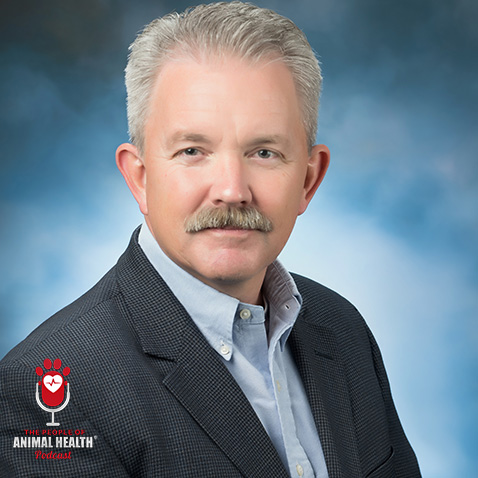
Few leaders have influenced Veterinary medicine from as many different perspectives as Dr. Bob Lester. Throughout a career spanning private practice, corporate leadership, Veterinary education, and entrepreneurship, he has remained guided by one simple philosophy: Veterinary medicine succeeds when it balances purpose with performance.
Today, as co-founder and Chief Medical Officer of WellHaven Pet Hospitals, Dr. Lester continues to champion a people-first approach that empowers Veterinary teams to provide exceptional care while building fulfilling careers. But long before helping launch innovative practice models or shaping Veterinary education, he was a small-town kid in western Oregon who simply loved animals and dreamed of becoming the next James Herriot.
During his appearance on The People of Animal Health Podcast with Stacy Pursell, founder and CEO of The VET Recruiter, Dr. Lester reflected on the experiences that shaped his career, the lessons he learned along the way, and why he believes the best days of the Veterinary profession are still ahead.
Growing Up in Small-Town Oregon
Dr. Lester’s story begins in a small logging community in western Oregon. He grew up as the oldest of four children in a family that, while not wealthy, was rich in the things that mattered most.
“I was the oldest of four kids in a family that had lots of pets, lots of kids, lots of love—but very little money,” he recalled.
His parents emphasized hard work and education, and Dr. Lester became the first member of his family to attend college. Like many future veterinarians, animals played an important role throughout his childhood.
Growing up surrounded by pets made Veterinary medicine seem like a natural career choice. Looking back, he jokes that his path into the profession wasn’t especially unusual.
“I think my answer is pretty boring and typical of a lot of people in our profession,” he laughed.
Yet one influence helped transform childhood curiosity into lifelong ambition.
Inspired By James Herriot
For an entire generation of veterinarians, James Herriot’s books painted an unforgettable picture of Veterinary medicine. Dr. Lester was no exception. As Herriot’s bestselling books gained enormous popularity throughout the 1970s, young Bob eagerly devoured each one.
“I just absorbed all of those,” he said. “That hooked me.”
Inspired by Herriot’s stories of caring for animals while serving rural communities, Dr. Lester sought every opportunity to gain practical experience. He began volunteering at his local Veterinary practice while still in junior high school. By high school, he was cleaning kennels and helping wherever he could.
“I’ve never looked back since,” said Dr. Lester.
At the time, his vision for the future was remarkably clear. He wanted to become exactly what James Herriot had portrayed—a trusted mixed-animal veterinarian serving a small community.
Remarkably, that’s exactly what he did.
Learning the True Role of a Veterinarian
After graduating from Oregon State University and Washington State University, Dr. Lester fulfilled his lifelong dream by opening a mixed-animal practice in a small logging town nestled in the mountains of western Oregon. Initially, he believed his primary responsibility would simply involve caring for animals. The reality proved much broader.
“What I learned,” he explained, “was really the impact and the importance and the prestige of being a Veterinary professional in a small town.”
His practice quickly became an integral part of the community. Beyond treating pets, livestock, and backyard animals, he found himself serving on the school board, participating in the Chamber of Commerce, joining Rotary and Kiwanis, and becoming involved in countless community activities.
Veterinarians, he realized, occupy a unique position of trust. They don’t simply treat patients. They support families, strengthen communities, contribute to public health, and help local businesses thrive.
“My impact as a Veterinary professional was so much bigger than I had imagined coming out of Veterinary school,” he reflected.
That lesson would influence every leadership role that followed.
Understanding Veterinary Medicine’s ‘Double Bottom Line’
Throughout his career, Dr. Lester has frequently spoken about what he calls the Veterinary profession’s “double bottom line.” Unlike many businesses that define success solely through financial performance, Veterinary medicine operates with a much broader purpose.
“Everybody’s familiar with the bottom line,” he explained.
Profitability certainly matters. Healthy businesses create stable careers, invest in better medicine, and serve more clients. But financial performance tells only part of the story.
“We help pets and families,” said Dr. Lester. “We help society. We protect public health. We provide careers.”
In other words, Veterinary medicine succeeds not only by generating revenue but by improving lives. That philosophy—doing well by doing good—has become one of the defining principles of Dr. Lester’s leadership. He believes the profession’s greatest strength lies in combining business success with meaningful service.
Few careers offer the opportunity to improve animal health, support human wellbeing, protect communities, and build rewarding careers simultaneously. For Dr. Lester, that combination makes Veterinary medicine truly unique.
Creating a ‘WellHaven’
That philosophy eventually inspired the creation of WellHaven Pet Hospitals. Even the company’s name reflects its mission.
“It starts with our name,” Dr. Lester explained. “A WellHaven—a safe place.”
Throughout much of Veterinary medicine’s history, professionals have focused almost exclusively on serving others. Veterinarians naturally place patients and clients before themselves. While noble, Dr. Lester believes that mindset isn’t always sustainable.
“We’re self-effacing,” he said. “We look to take care of everybody else’s needs ahead of ourselves.”
WellHaven sought to reverse that sequence. Instead of placing clients first, the organization intentionally prioritizes its own people. If Veterinary professionals feel supported, appreciated, and engaged, they naturally provide better care for pets and stronger service for clients. Only then does financial performance follow.
“If our people are happy,” Dr. Lester explained, “they’ll do the right thing for pets. If we take care of our people, they take care of pets, and then the practice and the bottom line naturally follows.”
This philosophy has produced remarkable results. WellHaven recently achieved an employee Net Promoter Score (eNPS) of 75—an extraordinarily high score compared to many of the world’s most admired employers.
For Dr. Lester, the result validates the organization’s commitment to building a workplace where Veterinary professionals feel valued, supported, and empowered.
Reinventing Clinical Education
One of the more unexpected chapters in Dr. Lester’s career involved returning to academia.
“I never thought my career would wind up back in academia,” he admitted.
After spending more than two decades in private practice and industry, the opportunity to help build Lincoln Memorial University’s College of Veterinary Medicine from the ground up proved too compelling to ignore. His years as both an employer and practicing veterinarian had revealed an important gap in traditional Veterinary education. Graduates possessed excellent medical knowledge but often needed greater confidence gained through hands-on clinical experience.
“What I observed,” he said, “was a real need for professional skills and more hands-on training.”
Rather than relying exclusively on referral teaching hospitals, LMU pioneered a community-based clinical education model. Students completed substantial portions of their clinical training within carefully selected private practices under experienced mentors.
This approach allowed them to encounter the types of cases they would most likely manage after graduation. Traditional teaching hospitals remain invaluable for advanced referral medicine.
However, Dr. Lester pointed out that most graduates ultimately enter primary care rather than specialty referral practice. Students benefit enormously from repeated exposure to routine surgeries, wellness appointments, client communication, and practice management.
“They get so many more repetitions,” he explained.
Those repetitions build something equally important as knowledge—confidence.
Lessons from Banfield and Mars
Another significant chapter of Dr. Lester’s career came through his leadership roles at Banfield Pet Hospital and Mars. He is quick to credit others for Banfield’s extraordinary success.
“I take little credit,” he said.
Instead, he remembers joining an organization founded by fellow classmates who possessed tremendous vision but were simultaneously building something entirely new. “No one had ever built an organization like that before,” Dr. Lester added.
Together, they embraced innovation that would eventually reshape companion animal practice. Banfield became an early adopter of electronic medical records, wellness plans, preventive healthcare protocols, seven-day scheduling, presurgical bloodwork, intravenous catheters, fluid therapy, and comprehensive pain management—many of which were far less common in the 1990s than they are today.
What united those innovations wasn’t technology alone. It was compassion.
“The drive from veterinarians really set the tone,” Dr. Lester said.
Technology supported better medicine, but people remained at the center of every decision.
Why Professional Skills Are Important
Throughout his career, Dr. Lester has consistently advocated for stronger emphasis on communication, leadership, teamwork, and emotional intelligence within Veterinary education. While medical expertise remains essential, he believes professional success depends just as heavily on interpersonal skills.
“When you look at the competencies that correlate with success,” he explained, “they’re not GPA, GRE scores, class rank, or NAVLE scores.”
Instead, long-term success often comes down to communication, leadership, teamwork, and self-awareness. Some individuals naturally possess those abilities and others develop them through education and experience. Fortunately, Veterinary schools increasingly recognize their importance.
“It’s been gratifying,” Dr. Lester said, “to see a real focus on not just clinical skills, but professional skills.”
By preparing graduates to communicate effectively with clients, collaborate with colleagues, and lead teams, Veterinary education continues producing professionals who are better equipped for modern practice.
The Human-Animal Bond Continues to Grow
When asked about the human-animal bond, Dr. Lester described it as the very foundation of modern Veterinary medicine.
“The human-animal bond is really the fuel that’s driven our whole profession,” he said.
He reflected on how dramatically the profession has evolved over the past century. Veterinarians originally focused primarily on horses used for transportation. Later, attention shifted toward livestock production. Today, companion animals occupy an entirely different role. Referencing fellow veterinarian Dr. Marty Becker, Dr. Lester smiled as he described that transformation.
“Pets have moved from the barnyard to the backyard, to the back porch, to the living room, to the bedroom, to under the covers.”
Today, pets accompany families almost everywhere—including restaurants, airplanes, and neighborhood strolls in pet strollers. For someone who grew up with large country dogs, even Dr. Lester admits life has changed. Although he jokes about marrying into a Yorkie-loving family, he now proudly pushes two rescued Yorkshire Terriers through the neighborhood in a stroller. The story captures a larger truth: pets are no longer simply animals.
“They’ve really become part of the family,” said Dr. Lester.
That ever-deepening bond, Dr. Lester believes, will continue shaping the future of Veterinary medicine for decades to come. After decades spent in private practice, corporate leadership, Veterinary education, and entrepreneurship, Dr. Bob Lester remains remarkably optimistic about the future of Veterinary medicine. While many discussions within the profession focus on workforce shortages, burnout, or access to care, he sees something different.
He sees opportunity.
Throughout his conversation on The People of Animal Health Podcast, Dr. Lester repeatedly returned to a simple but powerful message: Veterinary medicine is stronger than ever, and its greatest opportunities still lie ahead. The profession’s future, however, will depend on its willingness to embrace innovation while remaining grounded in the compassion and purpose that have always defined it.
Challenging Conventional Thinking
One of the ways Dr. Lester encourages innovation is through his long-running column, Creative Disruption, where he challenges Veterinary professionals to rethink long-held assumptions. Rather than criticizing the profession, his goal is to encourage thoughtful discussion about how Veterinary medicine can continue evolving.
“I’ve tried to be collegial and solution-oriented,” he explained.
When asked which disruption the profession most needs to embrace, his answer centered on one concept: team-based care. Although Veterinary medicine made significant progress during the COVID-19 pandemic out of necessity, Dr. Lester believes there is still tremendous room for improvement.
“We finally had to start delegating,” he said.
Veterinary assistants, credentialed Veterinary technicians, client service representatives, and other members of the healthcare team possess skills that are often underutilized. By empowering every member of the practice to work at the top of their training, veterinarians can devote more time to complex medical decision-making while expanding access to care. He also supports continued exploration of emerging roles such as the Veterinary Professional Associate (VPA), noting that other healthcare professions embraced team-based models decades ago.
“We’re finally getting it,” he said. “But we’re slow to the party.”
Ultimately, expanding team-based care isn’t simply about efficiency. It’s about helping more animals receive the care they need.
Solving the Access-to-Care Challenge
Perhaps the greatest challenge facing Veterinary medicine today, according to Dr. Lester, is access. Millions of pets never receive Veterinary care. By some estimates, nearly half of America’s pets will not visit a veterinarian this year. Rather than viewing that statistic pessimistically, Dr. Lester sees tremendous potential.
“Those pets are there,” he said. “They deserve the care.”
Meeting that need will require new thinking. Traditional brick-and-mortar practices operating conventional business hours alone cannot fully solve the problem. Instead, Dr. Lester believes the profession must embrace a combination of team-based care, telemedicine, artificial intelligence, innovative practice models, and other emerging technologies.
“There are so many things that can help open the doors,” he explained.
Innovation, in his view, isn’t about replacing veterinarians. It’s about allowing Veterinary professionals to reach more families than ever before.
Giving Back to the Profession
As Dr. Lester’s career has progressed, service has become an increasingly important priority. He has served on numerous professional boards, committees, and advisory councils throughout Veterinary medicine. His motivation is simple.
“The profession has done so much for us,” he said.
He views careers as unfolding in seasons. Early years focus on developing clinical competence. Later stages often involve business leadership and organizational management. Eventually comes an opportunity—and perhaps a responsibility—to give back.
For veterinarians willing to volunteer, mentor others, or participate in professional organizations, the impact can be enormous. Veterinary medicine remains a relatively small profession.
“We don’t look at one another as competitors,” Dr. Lester observed.
Instead, colleagues openly share ideas, best practices, and lessons learned. That collaborative spirit distinguishes Veterinary medicine from many other industries. Because the profession is so interconnected, even small contributions can create lasting change.
“If we’re willing to raise our hand and volunteer,” he said, “you can make such a big difference.”
Family Provides Perspective
Despite an extraordinarily accomplished career, Dr. Lester credits his family with helping him remain grounded. Like many members of the Baby Boomer generation, he spent much of his early career believing professional success should come first. Today, his priorities have shifted.
“Family comes first,” he said.
Career remains important, but it supports life rather than defining it. That perspective reflects a broader generational change he has witnessed throughout the profession. Younger veterinarians increasingly seek healthy integration between professional fulfillment and personal wellbeing. Rather than sacrificing family for career advancement, many intentionally build careers that support meaningful lives outside the workplace.
“I think that’s a healthier world to be in,” Dr. Lester reflected.
He acknowledges that maintaining balance often requires difficult choices. For now, hobbies like golf, gardening, and fishing have temporarily taken a back seat while family and professional responsibilities remain his primary focus. Those interests will return during another season of life.
For the moment, family continues providing the balance and perspective that leadership demands.
The Human-Animal Bond Continues to Grow
When reflecting on the most surprising development during his career, Dr. Lester returned to a familiar theme: “The growth of the human-animal bond.”
Over the decades, he has watched companion animals move from outdoor pets to full-fledged family members. The transformation has been remarkable.
“You ask a kid today what a doghouse is,” Dr. Lester joked, “and they don’t know what a doghouse is.”
Today’s pets sleep indoors, travel with their families, accompany them on airplanes, and increasingly receive levels of medical care once reserved exclusively for humans. Even demographics have shifted.
“There are more four-legged children out there now than two-legged children,” he noted.
As millennials and Generation Z continue strengthening those relationships, Dr. Lester expects the bond between people and animals to become even more significant. For Veterinary medicine, that creates extraordinary opportunities to improve both animal and human wellbeing.
An Optimistic View of the Future
Dr. Lester describes himself simply: “I’m an optimist.” More importantly, he believes optimism is a choice. Despite headlines about workforce shortages and increasing demand, he remains convinced there has never been a better time to enter Veterinary medicine.
“Our future is very bright,” he said.
He views today’s challenges as “issues of abundance”
- Demand for Veterinary services continues growing.
- Pet ownership remains strong.
- Medical advances continue accelerating.
- Public appreciation for Veterinary professionals has never been higher.
The task now is finding better ways to meet that demand. Whether through artificial intelligence, telemedicine, expanded team roles, or entirely new delivery models, innovation will allow the profession to reach more pets than ever before.
“The bond is there,” Dr. Lester said. “We have to break down the barriers.”
Growth Happens Outside Your Comfort Zone
When discussing adversity, Dr. Lester offered an insight shaped by decades of career transitions. Looking backward, every major professional change initially felt uncomfortable. Leaving his beloved small-town mixed-animal practice to join Banfield required enormous courage.
Transitioning from industry to help launch Lincoln Memorial University’s College of Veterinary Medicine felt equally intimidating. Later, leaving academia to co-found WellHaven Pet Hospitals brought yet another leap into uncertainty. Each move involved risk. Each ultimately proved worthwhile.
“The learnings you have through hard times,” he reflected, “only make us stronger.”
Those experiences reinforced one principle he now shares with younger professionals. “We have to get comfortable being uncomfortable,” Dr. Lester added.
Growth rarely occurs while remaining safely within familiar routines. Instead, meaningful progress usually begins with uncertainty.
Daily Habits for Lifelong Success
Unlike many executives, Dr. Lester doesn’t attribute his success to elaborate morning routines or productivity systems. His habits are refreshingly straightforward:
- He starts each day early.
- He prioritizes walking and staying active.
- He reads extensively, especially while traveling.
Professional conferences also play an important role in keeping him energized. Attending meetings such as VMX, Western Veterinary Conference, and other industry gatherings provides opportunities to reconnect with colleagues, exchange ideas, and recharge professionally.
“That just recharges,” he said.
For him, lifelong learning extends well beyond books. Relationships remain equally valuable.
Lessons From Great Books
Books have also shaped Dr. Lester’s thinking throughout different stages of his career. He quoted a familiar saying: “When the student is ready, the teacher will come.”
For him, those teachers often arrived through books. Early in practice ownership, Stephen Covey’s The 7 Habits of Highly Effective People provided foundational leadership principles. Michael Gerber’s The E-Myth transformed his understanding of business ownership.
During Banfield’s remarkable growth, Jim Collins’ Built to Last and Good to Great offered valuable organizational insights. More recently, Patrick Lencioni’s The Five Dysfunctions of a Team reinforced the importance of trust, collaboration, and healthy organizational culture.
Each arrived at precisely the right moment.
Advice to His Younger Self
Looking back across his career, Dr. Lester wishes he had spent less time worrying. Referencing a quote often attributed to Mark Twain, he smiled: “I’ve spent a lot of time worrying about things that never happened.”
Like many leaders, he occasionally lost sleep over hypothetical problems that ultimately never materialized. Today, his advice would be much simpler: “Worry less.”
Enjoy the journey. Most imagined disasters never occur.
The energy spent worrying can almost always be invested more productively elsewhere.
An Abundance Mindset
If Dr. Lester could teach one principle to every Veterinary professional, it would be adopting what he calls an abundance mindset. Veterinarians are trained to question assumptions. Scientific skepticism serves medicine well. However, outside the exam room, excessive skepticism can unintentionally limit innovation.
Instead of responding to new ideas with “Yeah, but…,” he encourages replacing those words with “What if?”
- “What if we tried something different?”
- “What if there’s a better way?”
- “What if innovation helps us reach more pets?”
Those questions create possibilities rather than barriers. “There is so much good going on in this profession,” said Dr. Lester.
Remaining open to change allows Veterinary medicine to continue building upon its remarkable legacy.
A Profession Poised for Its Best Years
As the conversation concluded, Dr. Lester returned to the central message that has defined his career. Veterinary medicine stands at an extraordinary moment:
- Pet ownership continues growing.
- The human-animal bond has never been stronger.
- Medical innovation continues accelerating.
- Demand for Veterinary services exceeds available capacity.
“The way we got here,” he said, “is not the way we’re going to get to the future.”
Future success will require experimentation. Some ideas will fail. Others will transform the profession. The important thing is remaining willing to evolve.
“We’ve got to be open to trying new things,” said Dr. Lester.
For someone who began his career wanting only to become another James Herriot, Dr. Bob Lester has ultimately become something quite different—a visionary leader helping shape the future of Veterinary medicine while never losing sight of the profession’s timeless purpose.
His message is one of optimism, service, and possibility.
If Veterinary medicine continues putting people first, embracing innovation, and remembering its “double bottom line” of doing well by doing good, the profession’s brightest chapter may still be ahead.
Listen to Dr. Bob Lester’s episode on The People of Animal Health Podcast with Stacy Pursell!