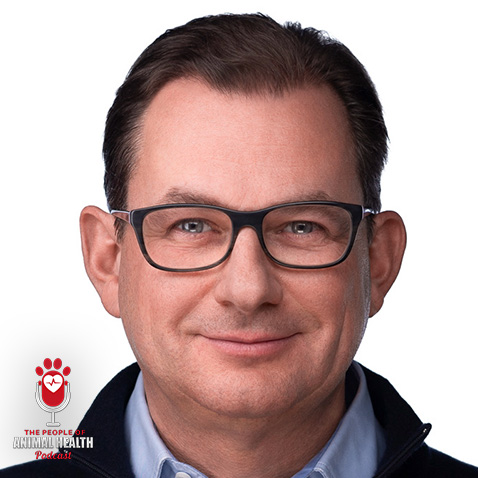
Few leaders embody the increasingly global nature of the Animal Health industry as completely as Dr. Juergen Horn. A veterinarian, scientist, executive, and entrepreneur, Dr. Horn has built a career that spans multiple continents while combining clinical Veterinary medicine, biomedical research, product development, and biotechnology innovation into a singular professional journey. From growing up in a small Bavarian town during the Cold War to leading groundbreaking biologics companies in the United States, he has consistently sought opportunities that allowed him to blend science with practical application while helping accelerate innovation throughout Veterinary medicine.
During his appearance on The People of Animal Health Podcast with host Stacy Pursell, Dr. Horn reflected on a career that has taken him from Germany to Australia, England, Switzerland, and the United States, exposing him to different Veterinary systems, cultures, and approaches to innovation along the way. His story demonstrates that meaningful careers are rarely confined by geography or conventional expectations. Instead, they develop through curiosity, adaptability, and a willingness to step outside familiar surroundings in pursuit of new experiences. Throughout the conversation, one message surfaced repeatedly. The future belongs to people who remain open to learning from different perspectives while continually searching for better ways to improve animal health through science, collaboration, and innovation.
A Bavarian Childhood Shaped By Curiosity
Dr. Horn grew up in Passau, a picturesque town in Bavaria located approximately 130 miles east of Munich near Germany’s border with Austria. Although the city offered beautiful scenery and an outstanding educational system, its location also reflected the political realities of the era. During his childhood, the Iron Curtain remained only a short drive away, making the Cold War a very real part of everyday life even within an otherwise peaceful community.
“I grew up in a small town in Bavaria, in Germany,” Horn recalled. “It was a good childhood and upbringing.”
Unlike many future veterinarians, Dr. Horn did not come from an agricultural family, nor did anyone in his immediate household work in Veterinary medicine. Nevertheless, biology fascinated him from an early age, and sometime during his teenage years he reached a remarkably clear conclusion about his future. “I decided that I wanted to become a veterinarian,” he said.
Interestingly, he still cannot identify exactly what inspired that decision. “I thought quite a lot about what actually triggered that,” Horn admitted. “I honestly don’t know.” One relative, however, decided to ensure that his enthusiasm reflected reality rather than imagination. A distant family member practiced as a rural veterinarian and offered the young student an opportunity to experience the profession firsthand before committing himself to such an ambitious career. “He actually challenged that and took me out for a week,” Horn recalled.
Rather than presenting only the rewarding aspects of Veterinary medicine, the experience exposed him to every side of the profession. Middle of the night calvings, meat inspection responsibilities, and the physically demanding work common to rural mixed animal practice all became part of his introduction to the field. “He did calvings in the middle of the night. He also did meat inspection and things like that,” Horn said. For many teenagers, such demanding work might have discouraged further interest, but for Dr. Horn it had precisely the opposite effect. “I still liked it,” he said, confirming that the experience strengthened rather than diminished his enthusiasm.
That week transformed what had previously been little more than an instinct into genuine certainty. Veterinary medicine matched both his interests and his personality, and from that point forward his professional direction remained remarkably consistent. After completing his formal education, he enrolled in Veterinary school in Munich with complete confidence that he had chosen the profession in which he wanted to spend his life.
Discovering a Bigger World
Although Dr. Horn entered Veterinary school fully expecting to become a practicing clinician, he quickly discovered another passion that would influence every stage of his career. He developed a desire to see the world, experience different cultures, and learn how Veterinary medicine was practiced beyond Germany’s borders. Rather than waiting until graduation to travel, he deliberately sought opportunities to combine international experiences with his Veterinary education.
“I sort of had the urge to see some parts of the world,” Horn explained. “Rather than backpacking, I wanted to do that in the context of my degree.”
That ambition earned him a Rotary Ambassadorial Scholarship, allowing him to spend his fourth year at the University of Sydney in Australia. The experience broadened both his education and his perspective, but Australia represented only one chapter in an increasingly international journey. During his studies he also completed clinical experiences in Spartanburg, South Carolina, where he gained firsthand exposure to companion animal practice in the United States. Later, he traveled to Windsor, England, where another memorable opportunity further expanded his understanding of the profession.
The Veterinary practice where he trained cared not only for companion animals but also for the Royal Dairy Farm and horses associated with the famous racing facilities surrounding Windsor. “It was a very good experience in seeing the life as a veterinarian in England,” Horn said.
Working within that uniquely British environment taught him lessons extending well beyond medicine itself. Every country approached client communication, practice management, agriculture, and clinical decision making somewhat differently, demonstrating that there was rarely only one effective way to solve a problem. Different cultures often arrived at equally successful solutions through entirely different methods, and those experiences encouraged him to remain open minded throughout his career.
As he continued studying and traveling, Dr. Horn realized that he genuinely enjoyed working alongside people from different countries and backgrounds. The idea of spending an entire career operating a single Veterinary practice gradually became less appealing than pursuing opportunities that combined medicine, science, and international collaboration. Without fully realizing it at the time, those experiences were preparing him for a career that would eventually span multiple continents while influencing Animal Health on a global scale.
From Clinical Practice to Scientific Discovery
Following graduation, Dr. Horn initially pursued the career he had envisioned since adolescence. He practiced in Germany within a mixed animal hospital, caring for both companion animals and horses while continuing to strengthen his clinical skills. The experience reinforced his appreciation for Veterinary medicine, but before long another opportunity emerged that would permanently alter the direction of his professional life: research.
Dr. Horn accepted a position at the Royal Veterinary College in London, where he pursued a PhD while working within the Equine Hospital. At the same time, he continued practicing Veterinary medicine by serving as a locum veterinarian throughout southern England, filling in for clinicians during vacations and staffing shortages. “I worked at the Royal Veterinary College and the Equine Hospital,” Horn said.
Those combined responsibilities allowed him to remain closely connected to patient care while simultaneously exploring the scientific questions underlying Veterinary medicine. Instead of concentrating exclusively on diagnosing and treating disease, he became increasingly interested in understanding why diseases developed and how entirely new therapies might someday prevent or eliminate them. “I became more interested in new treatment options and the science behind the treatment options,” Horn explained.
The transition represented far more than an academic exercise. It fundamentally reshaped his long term career aspirations. Although he continued to enjoy practicing Veterinary medicine, he gradually realized that he no longer envisioned spending the remainder of his professional life in one clinic or even one country. International collaboration, scientific innovation, and product development increasingly captured his imagination. “I realized that I enjoyed working in an international environment,” Horn said.
By the conclusion of his doctoral studies, he recognized that his future would likely exist somewhere between science and clinical medicine rather than exclusively within either discipline. He wanted to apply his Veterinary knowledge on a broader scale while remaining deeply connected to research, innovation, and the advancement of Animal Health. That realization positioned him perfectly for the opportunity that would soon arrive.
Finding the Ideal Role at Novartis
As Dr. Horn approached the completion of his PhD, Novartis Animal Health contacted him regarding a technical marketing position at the company’s global headquarters in Switzerland. Looking back, he considers the opportunity almost perfectly aligned with the interests and experiences he had developed throughout his education and early career.
“I saw that as an opportunity to combine my Veterinary expertise with the science training that I had with a PhD,” Horn recalled. “It combined my interest in innovation and international work.”
Joining Novartis introduced him to an entirely different side of Animal Health. Rather than treating individual patients, he now contributed to the development, support, and commercialization of products capable of helping veterinarians throughout the world. “The role at Novartis was a great fit from the get go,” he said. “I learned a lot, and it pushed me outside of my comfort zone.”
One corporate reorganization unexpectedly accelerated his professional development even further. Novartis created a new global Technical Services organization and selected Dr. Horn to lead the function, placing him in charge of an unusually broad portfolio spanning research and development, marketing support, pharmacovigilance, product stewardship, and technical services across both companion animal and food animal products. “This was when I really learned the most about the industry as a whole,” Horn explained.
Perhaps even more importantly, the position introduced him to a leadership philosophy that continues influencing him today. Much of his global team did not report directly to him, meaning success depended upon collaboration, credibility, and influence rather than formal authority. “It was leading by influencing,” Horn said.
As he traveled extensively while working alongside colleagues in different countries, Dr. Horn gained valuable insight into regional markets, customer expectations, regulatory environments, and cultural differences. At the same time, Novartis invested heavily in executive education and leadership development, helping prepare him for increasingly significant responsibilities. “The company provided great support,” Horn recalled.
Those experiences laid the foundation for his next extraordinary opportunity. He would soon move from Animal Health into one of the world’s most innovative Human Health research organizations at the Novartis Institutes for BioMedical Research in Cambridge, Massachusetts. Surrounded by MIT, Harvard Medical School, and a rapidly growing biotechnology ecosystem, Dr. Horn would find himself at the center of biomedical innovation while searching for technologies capable of transforming the future of Animal Health.
Bridging Human Health and Animal Health
Dr. Juergen Horn’s success at Novartis Animal Health led to one of the most influential opportunities of his career when he was invited to join the Novartis Institutes for BioMedical Research in Cambridge, Massachusetts. At the time, Novartis had recently established an ambitious research campus in the heart of one of the world’s most dynamic biotechnology ecosystems, surrounded by institutions such as MIT, Harvard Medical School, and hundreds of emerging biotechnology companies. For Dr. Horn, the move represented far more than a change in geography. It provided an opportunity to observe Human Health innovation where it was happening while identifying technologies that could eventually transform Veterinary medicine.
“It was really a fantastic opportunity and experience to look into human drug discovery,” Horn recalled.
The pace of scientific advancement immediately impressed him. During his time in Cambridge, Novartis hired more than one thousand scientists into the organization, creating an environment defined by constant collaboration, discovery, and entrepreneurial energy. “There was a lot of dynamic there,” he said. Unlike many traditional pharmaceutical organizations that focused primarily on internal research, the Cambridge campus maintained close relationships with universities, startup companies, venture capital firms, and academic laboratories. Every day exposed Dr. Horn to groundbreaking technologies that had the potential to become entirely new classes of medicine.
His responsibility was to evaluate those innovations through a different lens and determine whether they might eventually benefit Animal Health. “My job there was to look for innovation, for opportunities of technologies and products to bring into the Animal Health space,” Horn explained. The experience fundamentally broadened his perspective. Rather than viewing Human Health and Animal Health as separate industries, he increasingly recognized them as complementary scientific communities capable of learning from one another. Advances occurring in Human Health often created opportunities for Veterinary medicine years later, provided someone recognized their potential early enough and understood how to adapt them successfully. “It was a fantastic opportunity to learn about both sides,” he said.
That experience reinforced a belief that would shape the remainder of his career. Rather than waiting decades for discoveries to migrate naturally from Human Health into Animal Health, he became convinced that the industry needed leaders willing to identify promising innovations much earlier and adapt them specifically for Veterinary medicine. The intersection of the two industries represented enormous untapped potential, and Dr. Horn increasingly saw his role as helping bridge that gap.
Why Innovation Needed to Move Faster
Although Dr. Horn greatly appreciated the scientific excellence within large pharmaceutical organizations, one reality continually frustrated him throughout his career: innovation moved too slowly.
Looking back, he believes one of the Animal Health industry’s greatest historical challenges involved the lengthy delay between important discoveries in Human Health and their eventual application within Veterinary medicine. “The one thing that surprised me from the beginning was how long things take to transfer from one area to the other,” Horn said.
He pointed to monoclonal antibodies as perhaps the best example of that delay. More than thirty years separated the introduction of the first monoclonal antibody for Human Health from the arrival of Cytopoint for companion animals. From Dr. Horn’s perspective, that enormous gap represented both a scientific and commercial opportunity that Animal Health had been slow to recognize. “It was always a little bit frustrating for me that it didn’t go faster,” he admitted.
Initially, he assumed the industry’s size and resources would naturally encourage rapid innovation. Large pharmaceutical companies employed exceptional scientists while investing significant resources into research and development. Instead, he discovered an environment where organizations often approached innovation cautiously and where risk tolerance remained relatively conservative. “There was this hurdle to innovate,” Horn explained.
Coming directly from academia, where challenging assumptions and exploring new ideas represented everyday expectations, he found the contrast surprising. “We couldn’t be more agile, more innovative,” he said. Those experiences strengthened his conviction that future Animal Health companies would need to become leaner, more collaborative, and more willing to embrace emerging technologies. Rather than waiting decades for scientific breakthroughs to find their way into Veterinary medicine, organizations could actively identify promising discoveries much earlier and adapt them specifically for Animal Health applications. That philosophy would eventually become central to Dr. Horn’s entrepreneurial vision and ultimately shape the company he would later found.
A New Era for Animal Health
Despite those early frustrations, Dr. Horn believes today’s Animal Health industry bears little resemblance to the one he entered in 2001. “It’s changed dramatically,” Horn said.
For many years, consolidation dominated conversations throughout Animal Health as major pharmaceutical companies combined through mergers and acquisitions. While some observers worried those transactions might reduce competition, Dr. Horn believes another equally significant development emerged alongside consolidation: innovation.
“I think it made room for more innovation,” he explained.
Smaller biotechnology companies began appearing throughout the industry, often founded by experienced executives and scientists who recognized opportunities unavailable within larger organizations. At the same time, investors developed increasing confidence in Animal Health as an attractive sector capable of generating meaningful returns. Together, those developments transformed the industry’s culture and created an environment where innovation was no longer optional but increasingly essential.
“It created an environment that not only allows innovation, actually it requires innovation,” Horn said.
Rather than relying exclusively upon traditional pharmaceutical models, companies began embracing biologics, digital technologies, diagnostics, precision medicine, data analytics, and entirely new business models. “I think we’ve only seen the beginning of that,” he said, expressing confidence that the pace of change will continue accelerating.
Dr. Horn expects those trends to gain even more momentum as growing global demand for animal protein, increasing expectations among pet owners, technological advances, and expanding investment reshape the future of Veterinary medicine. “The growth will be driven by demand,” he said. Importantly, he emphasized that innovation extends far beyond developing new pharmaceutical products. “I don’t mean only new drugs,” Horn explained before pointing to digital health platforms, artificial intelligence, insurance, telemedicine, distribution, and practice management as additional opportunities to improve patient care while strengthening the broader Animal Health ecosystem. “There is a lot of innovation in all of this,” he added.
Building Invetx Around Collaboration
Those beliefs ultimately inspired Dr. Horn to launch Invetx, the biotechnology company he founded to accelerate the development of innovative Veterinary biologics. “I’m the founder and the CEO of an Animal Health biotech company called Invetx,” Horn said.
Unlike traditional pharmaceutical organizations that attempt to perform every function internally, Invetx embraces a highly collaborative business model built around strategic relationships with leading Human Health biotechnology companies possessing advanced discovery technologies. “Our business model is based on partnerships with best in class Human biotech companies,” he explained.
Rather than investing heavily in laboratories, manufacturing facilities, and extensive infrastructure, the company assembled a relatively small but exceptionally experienced internal team while working with outside experts for specialized capabilities. “We built a small, but very experienced in house team,” Horn said. That structure provides several important advantages. It gives the company access to world class scientific expertise, reduces unnecessary infrastructure costs, and allows capital to be directed toward product development instead of maintaining expensive facilities. Most importantly, it allows specialists with deep expertise to focus on the work they understand best. “The work is done by the actual experts,” he explained.
After only two years, the approach had already produced an impressive development pipeline with multiple programs advancing toward proof of concept. “It’s very exciting,” Horn said. For him personally, becoming Chief Executive Officer represented another opportunity to continue expanding his own leadership skills while guiding a company built around the principles that had shaped his career. “It is another challenge for me personally,” he admitted.
Even after decades of executive experience across research, product development, technical services, and global leadership, Dr. Horn continues to view every new responsibility as another opportunity to learn. His commitment to continuous learning, combined with his willingness to embrace collaboration and innovation, has become one of the defining characteristics of both his leadership style and his vision for the future of Animal Health.
Listen to Dr. Juergen Horn’s episode on The People of Animal Health Podcast with Stacy Pursell!