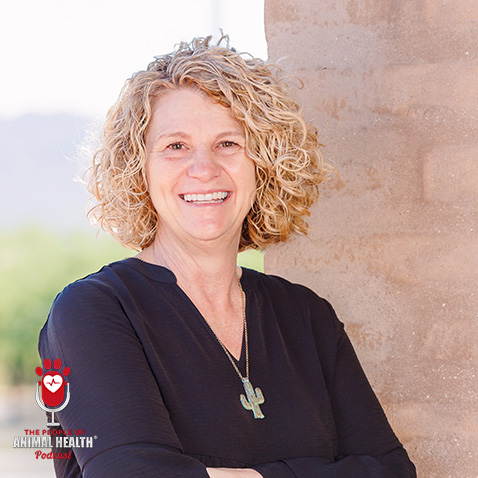
For many veterinarians, success is measured by the quality of medicine they practice or the number of patients they help. For Dr. Christine Staten, success certainly includes those things—but it also means creating a business that allows practice owners, team members, and their families to thrive.
As the owner of Adobe Veterinary Center in Tucson, Arizona, Dr. Staten transformed what began as a one-doctor ambulatory practice into a thriving, two-location, 50-person mixed animal practice. Along the way, she earned an MBA, founded Veterinary MBA to mentor practice owners, became a sought-after speaker on Veterinary leadership and entrepreneurship, and developed a philosophy she calls being “unapologetically unbalanced.”
During her appearance on The People of Animal Health Podcast with Stacy Pursell, founder and CEO of The VET Recruiter, Dr. Staten shared the experiences that shaped both her career and her outlook on life. Her story demonstrates that success in Veterinary medicine doesn’t happen by accident—it comes from continually learning, embracing change, and helping others avoid the mistakes you’ve already made.
Growing Up in Tucson with Animals Everywhere
Unlike many professionals who eventually leave their hometowns, Dr. Staten has spent her entire life serving the very community that raised her. “I grew up right here in Tucson, Arizona,” she said. “I live and work in the community that I grew up in, which is something that I love.”
Her childhood revolved around animals. Raised in an active 4-H environment, she didn’t simply own pets—she immersed herself in raising and showing a remarkable variety of animals.
“We had horses and a bunch of livestock animals,” she recalled. “I raised rabbits, miniature sheep, pygmy goats, dogs, guinea pigs—we showed them all over the country.”
Those experiences taught far more than animal husbandry. Traveling to competitions, caring for livestock, and taking responsibility for animals at a young age instilled discipline, accountability, and confidence.
Although she didn’t realize it at the time, those early lessons would later become invaluable as both a veterinarian and business owner. Interestingly, however, Veterinary medicine wasn’t always part of the plan.
Discovering Veterinary Medicine Almost By Accident
Many veterinarians can point to a childhood dream that began when they were five or six years old. Dr. Staten’s journey was very different.
“I sometimes hate to admit this,” she laughed, “but I did not want to be a veterinarian since I was five years old.”
Instead, she planned to become an obstetrician. She earned a bachelor’s degree in biology, completed the prerequisite coursework for medical school, joined the pre-med club, took the MCAT, and applied to medical schools. At the same time, she worked as a labor and delivery technician, assisting with thousands of births.
Everything appeared to be leading toward a career in human medicine. Then something unexpected happened. During multiple medical school interviews, interviewers kept asking the same question: “Why don’t you want to be a veterinarian?”
Initially, she found the question puzzling. After all, she had never seriously considered Veterinary medicine. But once she returned home, curiosity got the better of her.
“I literally took pen to paper,” she recalled. Her analytical nature immediately took over. She drew two columns—one labeled “Veterinarian” and the other “Physician”—and began listing the advantages and disadvantages of each career. Rather than relying solely on her assumptions, she spent the next week interviewing both veterinarians and physicians. The results surprised her.
“The two big things on my pro list for Veterinary medicine were entrepreneurship and serving my community,” she explained.
She wanted to own a business. She also wanted a career that would allow her to build lasting relationships while making a meaningful difference in people’s lives. Equally important, Veterinary medicine aligned better with the family life she and her husband envisioned.
Medical training would likely require internships, residencies, fellowships, and multiple relocations. Having married young and hoping to raise a large family, that path no longer felt right. Before receiving admission decisions from medical schools, Dr. Staten made a bold decision. She withdrew every application.
“I didn’t even want to know if I got in,” she said. “It would’ve been hard to turn down.”
Instead, she redirected her focus entirely toward Veterinary school. Looking back, she has never questioned that decision.
“I have never looked back,” she said. “It’s the greatest decision.”
Lessons Learned Before Veterinary School
Although she ultimately chose Veterinary medicine, Dr. Staten believes her years in labor and delivery profoundly shaped the veterinarian she would become. Working alongside families during one of life’s most emotional moments taught lessons that extend far beyond medicine.
“Everyone who’s had a baby remembers so many details about the delivery room,” she explained.
Small actions mattered:
- A reassuring smile
- A kind word
- A careless comment
- Even rolling one’s eyes
Those moments often became permanent memories for families. “You have to really be on your game,” she said. “You have to be present.”
One experience proved especially meaningful. Recognizing she felt unprepared to support grieving families experiencing stillbirths, Dr. Staten requested specialized training. “I wanted that experience for the parents to be perfect,” she said.
She intentionally became the hospital’s stillbirth technician because she wanted to provide compassionate care during families’ darkest moments. Although Veterinary medicine presents different circumstances, she sees striking similarities during euthanasia appointments. Families experiencing the loss of a beloved pet often remember every detail of those final moments.
“Every second of that encounter is going to be etched in their brain forever,” Dr. Staten said.
Those early experiences taught her that compassion isn’t simply a personality trait. It’s a professional responsibility.
Growing Adobe Veterinary Center
Following graduation from Colorado State University College of Veterinary Medicine, Dr. Staten eventually purchased a one-doctor ambulatory practice. Over time, that modest beginning evolved into Adobe Veterinary Center—a thriving two-location mixed animal practice employing approximately 50 team members and 10 veterinarians.
The journey, however, was anything but smooth. “If this was a 24-hour podcast,” she joked, “I could tell you all of my growing pains.”
She readily admits she wasn’t prepared for business ownership: “I was not a business person.”
Like many veterinarians, she possessed clinical knowledge but little formal business education. Mentors were difficult to find. Business resources tailored specifically to Veterinary medicine were limited. Professional conferences focused primarily on medicine rather than leadership or entrepreneurship.
“I just muddled through,” she said.
Two books became her primary guides—works by Jim Wilson and Mark Opperman. Beyond that, she learned largely through trial and error: “I made a lot of mistakes.”
She laughed while describing the experience. “I hit a lot of speed bumps, a lot of potholes, fell over a lot of hurdles, took roads that went the wrong direction,” said Dr. Staten.
Although those experiences ultimately taught valuable lessons, she now recognizes they weren’t necessary: “There are better ways to learn.”
That realization eventually inspired her next entrepreneurial venture.
Turning Hard Lessons into Veterinary MBA
After years of navigating business ownership largely on her own, Dr. Staten began thinking about what she wished had existed when she first became a practice owner. The answer became Veterinary MBA.
“The joy of Veterinary MBA,” she explained, “is creating what I wish I would’ve had.”
Rather than allowing other veterinarians to struggle through the same mistakes, she wanted to provide mentorship, community, education, and practical business tools. Her mission isn’t simply teaching finance or management. It’s helping practice owners create businesses that support the lives they actually want to live.
Many Veterinary entrepreneurs become trapped inside practices that depend entirely upon them. Dr. Staten helps them build systems that create greater freedom without sacrificing quality of care.
At its core, Veterinary MBA exists because she believes successful practice ownership should feel sustainable—not overwhelming.
When a Health Crisis Changed Everything
One of the most pivotal moments in Dr. Staten’s career occurred shortly after she turned fifty. A neurologist—who also happened to be one of her horse clients—delivered difficult news; “You cannot do large animal medicine anymore.”
Years of physically demanding work had taken a significant toll on her neck and back. She lived with chronic pain, struggled to sleep, and frequently found herself instinctively supporting her neck with her hand.
Initially, she ignored the advice. Then her first grandchild arrived. One simple moment changed everything. While lowering her three-month-old granddaughter into her crib, she realized she physically couldn’t do it because of the pain.
She knew something had to change. The realization triggered what she jokingly describes as a midlife crisis: “I thought, ‘What do I do with this degree?'”
Large animal medicine had been her passion. If she could no longer practice it the way she loved, what came next? Conversations with her husband helped clarify the answer.
“What do you like most?” he asked.
“I like running the practice,” she replied.
That realization inspired another bold decision. She enrolled in Louisiana State University’s online MBA program while continuing to work full-time. “It was on my bucket list,” she said.
The degree not only strengthened her business knowledge but also helped reveal an entirely new purpose. Instead of focusing exclusively on practicing Veterinary medicine, she realized she could help other veterinarians become stronger business leaders.
Building Better Business Owners
Dr. Staten believes one challenge consistently affects Veterinary practice owners. Most veterinarians are simultaneously clinicians and CEOs. Unlike many entrepreneurs, they remain the primary revenue generators within their businesses. “They love being a veterinarian,” she explained.
Running the business often becomes an exhausting second full-time job. One of her first recommendations sounds deceptively simple: create a dedicated CEO day.
“Maybe it’s a half-day every week,” she said. Most importantly, leave the practice. That dedicated time allows owners to think strategically rather than reacting to daily emergencies:
- Planning
- Vision
- Growth
- Leadership
Without protected time, those priorities rarely receive the attention they deserve. Another challenge she frequently observes is isolation. Practice ownership can feel lonely.
“The overwhelming responsibility,” she explained, “unless somebody else owns a business, they don’t get that.”
From employee concerns to patient care, financial decisions to organizational culture, owners carry burdens few others fully understand. That’s why Dr. Staten strongly encourages owners to build relationships with other practice owners.
“Finding community,” she said, “has been transformative.”
Simply sitting across the table from someone who understands the unique challenges of ownership often provides reassurance that no textbook can offer.
Inspiring the Next Generation
Education remains one of Dr. Staten’s greatest passions. Adobe Veterinary Center regularly hosts more than thirty Veterinary student externs each year while also welcoming pre-Veterinary students eager to explore the profession.
“I love Veterinary students,” she said enthusiastically.
She encourages aspiring veterinarians not to become discouraged by setbacks: “If you don’t get in the first time, apply again. If you don’t pass your NAVLE, take it again.”
Her message remains remarkably consistent. Veterinary medicine offers extraordinary flexibility. Whether graduates pursue clinical practice, industry, research, academia, entrepreneurship, or countless other opportunities, she believes every person can find a place where they belong.
“There is a place for each person in Veterinary medicine,” said Dr. Staten.
Hosting externs also benefits her own practice. Students ask thoughtful questions, bring fresh perspectives, and inspire experienced clinicians to continue learning.
“They teach us some stuff,” she said. “But they also make us better.”
For Dr. Christine Staten, that reciprocal learning environment perfectly captures what Veterinary medicine should be—a profession built on curiosity, mentorship, and continual growth.
For Dr. Christine Staten, Veterinary medicine has never been just a profession. It has become the foundation for a fulfilling life that combines patient care, entrepreneurship, leadership, mentorship, and family. After more than two decades as a practice owner, she remains as enthusiastic about the profession as ever, believing its greatest opportunities still lie ahead.
During the second half of her conversation on The People of Animal Health Podcast, Dr. Staten shared the leadership principles that transformed her practice, her passion for helping fellow practice owners build sustainable businesses, and why she believes every veterinarian can find both success and joy in the profession.
Redefining Balance
One of Dr. Staten’s most memorable philosophies is that she is “unapologetically unbalanced.” At first glance, the phrase sounds contradictory. In reality, it reflects years of learning that perfect work-life balance is neither realistic nor necessary. “I don’t think balance exists,” she explained.
Instead of imagining life as a perfectly balanced scale, she sees it as a series of changing seasons. Some seasons demand more attention at work. Others require complete focus on family. Trying to force equal attention to every priority every day often leads only to frustration.
“If my happiness depends on achieving balance,” Dr. Staten said, “I’m going to be unhappy all the time.”
Her own career illustrates this perfectly. Early in practice, while raising young children, she worked twelve-hour shifts every Friday, Saturday, and Sunday while covering overnight emergency calls. Those weekends were exhausting, but they also gave her Monday through Thursday at home with her family.
Later, when her Veterinary partner suffered a back injury, she carried emergency duty for six straight months: “There clearly wasn’t any balance there.”
Still another season required stepping almost entirely away from work while one of her sons underwent heart surgery. For Dr. Staten, each season required different priorities. Rather than fighting those changes, she embraced them.
“I try to find joy in everything I do,” she said. That mindset allows her to enjoy reading laboratory results while sitting at the beach if that’s what she wants to do. She rejects the notion that work and life must always remain completely separate.
For her, the key isn’t balance. It’s intentionality.
The Power of Delegation
If there is one lesson Dr. Staten wishes more practice owners would embrace, it is learning to delegate. Veterinarians often believe they must personally oversee every detail of their businesses. She once felt exactly the same way: “I took a long time to pass stuff off.”
Even after delegating responsibilities, she admits she sometimes grabbed them right back. Eventually, experience taught her otherwise. Today, she encourages owners to identify their core strengths while allowing others to handle work they either dislike or simply aren’t best equipped to perform.
“I don’t know how to do bookkeeping for my practice,” she admitted. “And that’s okay.” Why?
Because she trusts the professionals handling it. Delegation doesn’t require perfection. “If somebody does it eighty percent as well as I think I would—and I get an evening off—that’s worth it,” she said.
Ironically, she discovered something unexpected: most people weren’t completing tasks at eighty percent. “They were doing them significantly better than I was,” said Dr. Staten.
That realization became liberating. Rather than attempting to control everything herself, she could focus on the work she enjoyed most while empowering others to excel in theirs.
Thinking Like an Entrepreneur
Although Veterinary medicine remains at the center of Dr. Staten’s career, her entrepreneurial curiosity extends far beyond clinical practice. After aggressively paying off student loans and consumer debt using principles popularized by financial educator Dave Ramsey, she and her husband began exploring additional investment opportunities.
“We attacked our debt viciously,” she recalled.
For several years, they dramatically reduced spending, rarely dined out, and focused almost entirely on achieving financial freedom. Once debt-free, they turned their attention to real estate. What began with purchasing a duplex from her parents gradually expanded into student housing, commercial real estate, and an Airbnb located in northern Arizona.
The vacation property serves two purposes. It functions as both an income-producing investment and a family retreat.
“The guests basically pay for us to have our dream vacation home,” she explained.
Real estate has also broadened her understanding of business strategy and tax planning. Owning multiple businesses provides opportunities to legally structure finances more efficiently while creating additional long-term stability.
For Dr. Staten, entrepreneurship has never been about chasing wealth alone. It’s about creating options.
Financial freedom allows greater flexibility to invest in employees, expand services, support family, and pursue meaningful new ventures.
Protecting Practice Culture
After more than twenty-three years as a practice owner, Dr. Staten believes healthy organizational culture doesn’t happen accidentally. In fact, she readily admits she spent the first fifteen years getting it wrong.
Today, she approaches culture very differently; “It is more important to keep the wrong people out than it is to bring more people in.”
One individual whose values don’t align with the practice can disrupt an otherwise exceptional team. That philosophy influences hiring, onboarding, coaching, and accountability throughout Adobe Veterinary Center.
Perhaps the most unique aspect of the practice is its Code of Conduct. Beyond a traditional employee handbook, every team member signs a detailed set of behavioral expectations. Rather than describing rules, each expectation begins with the word “I.”
Examples include statements such as: “I will come to work on time, fed, and ready to work.”
Simple expectations eliminate unnecessary workplace tension before it develops. If concerns arise, coaching becomes straightforward. Instead of criticizing personalities, leaders simply revisit the behavioral expectation everyone previously agreed to uphold.
“We don’t do that here,” has become one of Dr. Staten’s favorite phrases to hear echoed throughout the practice.
Those words don’t come from management alone. They come from team members holding one another accountable. She smiles every time she hears it: “That’s the Adobe way.”
Empowering Employees to Lead
One of Dr. Staten’s greatest leadership transformations involved learning to stop making every decision herself.
She shared one story that perfectly illustrates that growth. Years ago, she selected new uniform shirts for her reception team without asking for their input. When employees returned the catalog with different styles marked, she rejected the suggestion: “I’ve already picked what you’re wearing.”
Today, she cringes when remembering that interaction. Years later, the same reception team requested new office chairs. This time, Dr. Staten simply handed them the company credit card.
“You have two rules,” she said. “The chairs have to match, and everyone has to agree.”
The team spent weekends together visiting furniture stores, comparing options, and selecting exactly what they wanted. Ironically, they spent far less than she would have. More importantly, they loved the outcome because it had become their decision.
That experience reinforced an important leadership lesson. Empowered employees become invested employees. Adobe Veterinary Center now uses a formal system called PAWS—Problems and Workable Solutions.
Rather than merely reporting problems, employees must also recommend solutions. Whether addressing equipment failures, workflow improvements, or client service concerns, team members solve problems instead of simply identifying them.
“Ninety-nine percent of the time,” Dr. Staten said, “we implement their solution.”
Ownership creates engagement. Engagement strengthens culture.
Supporting Families Through Onsite Childcare
Perhaps no initiative better reflects Dr. Staten’s people-first philosophy than Adobe Veterinary Center’s onsite childcare center. She had dreamed about creating one for years. Meeting another veterinarian who successfully operated onsite childcare convinced her it could become reality.
When the practice closed its pet resort, the opportunity finally arrived. During the subsequent renovation, Dr. Staten transformed the space into a fully equipped childcare facility complete with classrooms, a kitchenette, and age-appropriate learning spaces. Most remarkably, childcare is completely free for employees.
“I wanted to support people who wanted to have families,” she explained.
The decision also addressed an important workforce challenge. She repeatedly watched exceptional Veterinary technicians leave the profession after having a second child because childcare costs exceeded the financial benefits of remaining employed: “The math didn’t math.”
Since opening the childcare center, one technician immediately increased from part-time to full-time employment. Another returned after leaving the practice several years earlier. Even one returning veterinarian might easily generate enough additional revenue to offset the childcare investment.
For Dr. Staten, however, the greatest return isn’t financial; “It’s just the right thing to do.”
Innovation Through Transparency
Looking ahead, Dr. Staten continues pursuing innovative ideas within private practice. One upcoming renovation will transform Adobe Veterinary Center’s small animal hospital into a fully transparent facility where clients can observe treatment areas directly from examination rooms. Her inspiration comes from large animal medicine.
“As a large animal veterinarian,” she explained, “everything I do is in front of clients.”
She believes transparency builds trust while showcasing the exceptional care Veterinary teams provide every day. At the same time, she recognizes successful innovation requires thoughtful change management.
Simply installing windows isn’t enough. Employees must also feel psychologically safe. “They need to understand it’s a good thing,” said Dr. Staten.
Supporting people through change remains just as important as implementing the physical changes themselves.
Optimistic About Veterinary Medicine’s Future
Dr. Staten describes herself simply: “I’m an optimist.”
That optimism extends naturally to Veterinary medicine. She believes the profession has become increasingly innovative, collaborative, and adaptable. Corporate Veterinary medicine has challenged private practices to improve mentorship, workplace culture, and employee development.
Practice owners increasingly collaborate rather than compete. Technology continues creating efficiencies. The profession remains financially resilient:
- “We’re recession-proof.”
- “We’re pandemic-proof.”
- “We’re essential.”
She also sees opportunities to rethink traditional practice models. Rather than every hospital maintaining identical equipment, she imagines groups of neighboring practices sharing specialized surgical centers, laboratory services, and advanced diagnostic equipment.
Reducing unnecessary overhead could allow practices to invest more heavily in employee compensation and development. Those ideas reflect her entrepreneurial mindset.
Innovation isn’t simply about technology. It’s about finding better ways to serve patients, teams, and communities.
Time Blocking for Success
When asked about daily habits contributing to her success, Dr. Staten pointed immediately to time management: “I time-block my life.” Every hour serves a purpose:
- Clinical work
- CEO responsibilities
- Family
- Speaking engagements
- Grandchildren
Everything appears intentionally on her calendar. The system helps minimize distractions while allowing her to fully focus on whatever deserves her attention at that moment. For someone who laughingly admits she probably has undiagnosed ADHD tendencies, structure creates freedom.
“It helps me concentrate on one thing at a time,” said Dr. Staten.
Finding Joy Every Day
As the interview concluded, Dr. Staten returned to the message she hopes every Veterinary professional remembers: “Find joy.”
Social media often amplifies negativity, burnout receives attention, and challenges dominate conversations. Yet when she steps back, she sees something entirely different. Veterinarians become trusted members of families. They guide clients through life’s happiest and hardest moments, they improve communities, and they protect both animal and public health.
“We’re invited into people’s most intimate moments,” said Dr. Staten. “What greater privilege could there be?”
Her advice is equally practical. If a workplace has become toxic, don’t assume that’s simply how Veterinary medicine works. Find an environment aligned with your values.
- Build relationships.
- Delegate.
- Empower others.
- Protect your culture.
Most importantly, never lose sight of why you entered the profession. Dr. Christine Staten’s journey—from aspiring obstetrician to successful entrepreneur, mentor, and Veterinary leader—demonstrates that building a rewarding career isn’t about avoiding mistakes.
It’s about learning from them, helping others avoid them, and intentionally creating a life that reflects both your professional ambitions and your personal values. For her, Veterinary medicine has never simply been about caring for animals.
It’s about building businesses that allow people, families, teams, and communities to flourish right alongside them.
Listen to Dr. Christine Staten’s episode on The People of Animal Health Podcast with Stacy Pursell!