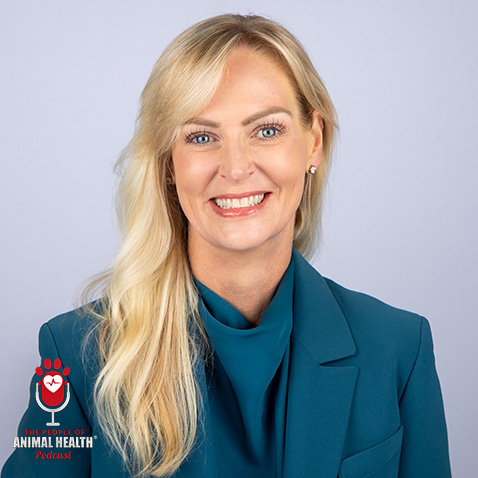
Few Veterinary professionals have built a career that spans private practice, research, industry leadership, and advocacy as successfully as Dr. Christine Royal. Today, as Vice President of the Companion Animal and Equine Business Unit at Merck Animal Health, she leads efforts to deliver innovative solutions that improve pet health, simplify care for owners, and strengthen Veterinary practices across the United States.
But long before she was helping guide one of the industry’s leading organizations, Dr. Royal was simply a young girl growing up in Hollywood, Florida, with a love of animals, a strong work ethic instilled by her family, and a dream of becoming a veterinarian.
During her appearance on The People of Animal Health Podcast with Stacy Pursell, founder and CEO of The VET Recruiter, Dr. Royal shared the experiences that shaped her career, the lessons she’s learned as a leader, and her passion for ensuring the Veterinary profession continues to grow stronger for future generations.
Growing Up With Strong Family Values
Dr. Royal’s story begins in South Florida, where she grew up alongside her brother in a close-knit family whose values continue to influence her leadership today.
“My life started in Hollywood, Florida,” she recalled. “We had multiple dogs along the way, and focusing on family values and our faith really helped shape my life moving forward.”
Her childhood, however, was anything but ordinary. Her father owned a hat manufacturing company—a family business dating back to 1929 that specialized in producing uniform headwear for postal workers, military personnel, marching bands, and other organizations.
“My father was the owner of a hat factory,” she explained. “Around the holidays, we were always watching television to see which hats were going to be the Bailey family’s hats.”
Long before she worked in Veterinary clinics, Dr. Royal spent time working in the factory itself. Those experiences proved invaluable.
“That’s where I absolutely learned I needed an education,” she laughed, recalling repetitive factory work and cleaning machinery.
More importantly, both of her parents emphasized the importance of responsibility, perseverance, and developing a strong work ethic—qualities that would become defining characteristics throughout her professional life. Outside of work, family time revolved around the outdoors. Bird hunting, fishing, conservation, and involvement with the Audubon Society fostered an appreciation for wildlife that complemented her growing love of animals.
Looking back, Dr. Royal sees those early experiences as the foundation upon which her entire career was built.
Discovering Her Calling at Eight Years Old
Like many veterinarians, Dr. Royal knew remarkably early what she wanted to do with her life. The defining moment came when she was just eight years old. After finding a young bird that had fallen from its nest, her mother took her to a local wildlife rehabilitation center. Watching injured wildlife receive expert care left a lasting impression.
“I asked my mom, ‘Who are the people that take care of these animals?'” Dr. Royal remembered.
Her mother’s answer introduced her to a profession she had never previously considered: “She talked to me about becoming a veterinarian.”
From that moment forward, her career goal never changed. It’s a simple story, but one that perfectly illustrates the power of early experiences to shape lifelong passions.
Building a Foundation at Auburn University
Dr. Royal pursued both her undergraduate degree in microbiology and her Doctor of Veterinary Medicine degree at Auburn University. While many students enter Veterinary school focused exclusively on clinical practice, Dr. Royal discovered additional interests through research opportunities.
She participated in projects involving aquaculture and livestock while working with grants funded by both human and animal health companies. Those experiences quietly introduced her to an entirely different side of Veterinary medicine.
“I knew there had to be some type of roles in industry,” she said.
At the time, however, industry remained only a possibility. Following graduation, she entered private practice to begin the clinical career she had envisioned since childhood.
An Unexpected Career Opportunity
Sometimes careers change because of careful planning. Sometimes they change because someone simply recognizes your potential. For Dr. Royal, it was the latter. While working in private practice, her local animal health representative suggested she might thrive in industry.
“He said, ‘I think you’d be really good at a job in industry,'” she recalled.
Curious, she agreed to lunch. “What does it look like?” she asked. “What are the different roles?”
Conversations with both the representative and a friend already working in the industry opened her eyes to possibilities she had never seriously explored. Her first industry position was as a Professional Services veterinarian. Initially, she viewed it as a temporary opportunity.
“I thought this would give me the chance to see thousands of Veterinary practices across the country, learn how other people do things, and then I’d go back into practice better for it.” Dr. Royal said.
Instead, something unexpected happened. She fell in love with the work. The diversity of opportunities surprised her. Industry offered involvement in research, public policy, product development, education, customer relationships, and strategic leadership—all while allowing her to continue practicing relief medicine when possible.
Rather than moving away from Veterinary medicine, she discovered another way to influence it.
Leadership Built Around Customers and Relationships
After beginning her industry career with Novartis Animal Health, Dr. Royal eventually joined Merck Animal Health in 2014, where she has held numerous leadership positions before becoming Vice President of the Companion Animal and Equine Business Unit.
Looking back, one experience stands out as especially transformative. Early in her career, she moved from the field into a home-office role. Although she regularly visited customers, returning to a field-based position reminded her how different daily customer interaction truly is.
“It really reminded me of the importance of keeping our customers and our colleagues at the center of everything that we do,” she explained.
That lesson continues to guide her leadership today. Whether interacting with field representatives, Professional Services veterinarians, or Veterinary practices, she believes leadership begins with understanding the needs of those closest to customers. Relationships matter just as much.
“We can have all the tools and technology,” she said, “but if you don’t have people and those relationships to help drive it, it’s not going to keep us moving forward.”
As her career has progressed, she’s also developed increasing confidence in collaborative leadership. “If I put the right people around me,” she said, “we will figure it out—and we’ll figure it out together.”
Leaving the Profession Better Than She Found It
One statement Dr. Royal has made repeatedly throughout her career is that she wants to leave the Veterinary profession better than she found it. For her, those aren’t simply inspiring words—they’re practical goals. It begins with integrity.
“I think it’s always doing the right thing,” she explained. “Maintaining a high level of integrity.”
Next comes serving both the profession and the patients entrusted to Veterinary care. Beyond that, she believes leaders have a responsibility to advocate continually for Veterinary medicine itself. One area where she’s particularly passionate is professional well-being.
Working alongside numerous partners throughout the profession, Dr. Royal and her team have helped advance research exploring workplace wellness while developing practical resources designed to support Veterinary professionals throughout their careers.
“We’re helping those who are transitioning into our profession have healthy, long careers,” she said.
She also believes the profession should celebrate its successes more often. While acknowledging challenges such as burnout and career transitions, she worries that too much negativity overshadows the tremendous opportunities available within Veterinary medicine.
“We have so many great things going on within our profession,” she said. “We need to make sure we’re sharing the positives.”
Financial sustainability also remains a priority. Dr. Royal emphasized that every member of the Veterinary healthcare team—from veterinarians to credentialed Veterinary technicians and support staff—deserves financial stability. Helping practices improve business performance ultimately benefits everyone involved.
“Our profession needs to become one that is financially stable for everyone who wants to be part of it,” she said.
Helping Veterinary Teams Thrive
Today’s Veterinary practices face increasing pressure. Growing client expectations, workforce shortages, financial concerns, and information overload create daily challenges for practitioners. Dr. Royal believes animal health companies have an important role to play in helping practices succeed. One priority is improving communication.
Merck Animal Health continues developing educational resources that help Veterinary teams communicate clearly with pet owners while supporting discussions around the spectrum of care and individualized treatment recommendations.
“We have to continue developing communication tools that provide clarity,” she explained.
Another important initiative focuses on encouraging preventive Veterinary care. Media campaigns and educational outreach help remind pet owners of the value regular Veterinary visits provide, particularly as misinformation becomes increasingly common online.
“We believe strongly in the medicalization of pets,” Dr. Royal said. “But we have to get people and their pets into the Veterinary clinic in order to have those conversations.”
Improving practice productivity also allows Veterinary teams to spend more meaningful time with clients instead of administrative tasks. Additionally, programs such as instant rebates help improve affordability while supporting client compliance with recommended treatments.
Together, these initiatives help strengthen both patient care and practice sustainability.
Innovation Driving the Future
Innovation represents one of the most exciting aspects of Dr. Royal’s work. She believes Veterinary medicine is entering an era where new technology and groundbreaking products are transforming patient care.
“I think number one, broadly, we’re talking about technology,” she said.
Although Veterinary medicine has sometimes been viewed as cautious about adopting change, she believes practical technologies will continue reshaping practices in meaningful ways. At Merck Animal Health, recent product launches illustrate that momentum. Among them is the NOBIVAC® NXT vaccine platform, offering adjuvant-free vaccines with smaller injection volumes for feline leukemia and canine influenza.
She also highlighted MOMETAMAX® SINGLE, a single-dose otic treatment designed to simplify ear infection management for both veterinarians and pet owners. Perhaps the innovation generating the greatest excitement, however, is BRAVECTO® QUANTUM, a year-long injectable flea and tick preventive.
“This has been the most fun launch I’ve ever had,” Dr. Royal said.
She believes the product addresses one of preventive medicine’s biggest historical challenges: compliance. “We’ve been talking for 20 years about how you fix compliance,” she explained. “This, in one injection, fixes compliance.”
Beyond improving protection for pets, innovations like these strengthen Veterinary practices by bringing preventive care back into the clinic while improving client adherence to treatment recommendations. For Dr. Royal, that combination—better patient outcomes, stronger Veterinary practices, and improved client experiences—represents exactly the kind of innovation that will continue moving the profession forward.
As Veterinary medicine continues to evolve, Dr. Christine Royal believes the profession stands at an exciting crossroads. Advances in technology, new treatment options, changing client expectations, and an ever-deepening human-animal bond are creating opportunities unlike anything previous generations of veterinarians have experienced.
During her conversation on The People of Animal Health Podcast, Dr. Royal shared her optimism for the future while also emphasizing that the profession’s continued success will depend on strong leadership, collaboration, and a willingness to embrace change.
Technology Will Continue Transforming Veterinary Medicine
When asked what trends will shape Veterinary medicine over the next decade, Dr. Royal immediately pointed to technology.
“I think we will continue to change and adopt technology,” she said.
From practice management software and artificial intelligence to increasingly sophisticated diagnostics, technology is rapidly becoming woven into every aspect of Veterinary care. Although Veterinary medicine has historically earned a reputation for being somewhat cautious when adopting new technology, Dr. Royal believes that mindset is changing.
“I think maybe our profession has a little bit of a reputation of being change-averse,” she acknowledged. “However, we’ve got to talk about it, and it has to be practical and easy.”
The key, she explained, is ensuring that technology solves real-world problems instead of simply adding complexity. Artificial intelligence, workflow automation, and improved diagnostics all have the potential to make Veterinary teams more efficient, allowing them to spend more time doing what matters most—building relationships with clients and caring for patients.
At the same time, she believes practices must continue focusing on the fundamentals. Following the dramatic increase in pet ownership during the COVID-19 pandemic, Veterinary visits have largely returned to pre-pandemic levels. That means sustainable practice growth depends on strengthening client relationships rather than relying on extraordinary market conditions.
“We need to communicate the value of what we’re offering to the pet owner,” she explained.
Educating clients about preventive care, reinforcing the importance of regular Veterinary visits, and demonstrating the value of professional medical guidance remain essential priorities.
Staying Connected to Clinical Practice
Despite her executive leadership responsibilities, Dr. Royal maintains active Veterinary licenses in multiple states. Remaining clinically connected is more than a professional credential—it helps her stay grounded in the realities facing practitioners every day.
“I love my profession,” she said. “I love my colleagues and the opportunity to have conversations around how they’re doing.”
Those conversations provide valuable insight into emerging challenges, whether they’re medication shortages, workflow inefficiencies, staffing concerns, or changing client expectations. Rather than making decisions from behind a desk, Dr. Royal believes effective leadership begins with listening. She wants to understand what keeps veterinarians awake at night, what obstacles they encounter, and what resources would make the greatest difference in their practices.
That customer-centered approach has remained consistent throughout her career and continues shaping decisions at Merck Animal Health.
Sharing Knowledge Through Multiple Platforms
Beyond her leadership responsibilities, Dr. Royal has built a reputation as a researcher, conference speaker, and media contributor. Each platform provides a unique opportunity to strengthen connections between veterinarians and pet owners.
“They provide unique opportunities for us to bridge through the Veterinary world to the pet owner world,” she explained.
Research presentations help communicate emerging scientific discoveries. Television appearances and public outreach simplify complex Veterinary topics for pet owners.
Professional conferences foster collaboration while creating opportunities to hear directly from colleagues. Although speaking engagements allow her to share expertise, she believes the conversations afterward often prove even more valuable.
“Sometimes,” she said, “the questions people ask are the most powerful part.”
Listening remains every bit as important as teaching.
Family Keeps Everything in Perspective
Outside of work, Dr. Royal finds balance by focusing on family. Today, much of that revolves around her two daughters, whose athletic schedules keep both parents busy throughout the year.
“They pretty much drive a lot of what we do,” she laughed.
Weekends often involve lacrosse tournaments, travel, and dividing responsibilities between different playing fields. While those activities require significant time, they also provide opportunities to disconnect from work and be fully present.
One recent experience became an unexpected reminder of that lesson. When the principal at her youngest daughter’s school asked if she would serve as a cabin mom during a school camping trip, she enthusiastically agreed. Only afterward did she realize she would be supervising fourteen seventh-grade girls—by herself.
“My learning was that I should ask questions before saying yes,” she joked.
Despite the challenge, the experience became one of the year’s most rewarding moments. It allowed her to strengthen her relationship with her daughter while spending meaningful time with her friends. The experience also reminded her that even busy leaders benefit from occasionally viewing the world through a child’s eyes.
Sometimes, she noted with a smile, twelve-year-olds teach adults just as much as adults teach them.
Embracing New Opportunities
Throughout her career, Dr. Royal has repeatedly accepted opportunities that initially felt outside her comfort zone. Her advice to young veterinarians considering careers in industry—or any new professional challenge—is straightforward.
“Always be open to opportunities,” she said.
Too often, she believes, people immediately dismiss possibilities because they seem unfamiliar or intimidating. Self-doubt and imposter syndrome frequently become unnecessary barriers. Instead, she encourages professionals to ask questions, stay curious, and trust their abilities.
“Believe in yourself,” she said.
One lesson she’s learned repeatedly is that saying “yes” often comes before having every answer. Whether accepting a leadership role, changing careers, or volunteering for an unfamiliar project, growth usually occurs after stepping outside familiar territory.
“Our profession is one with high empathy, compassion, and willingness to help each other,” she explained. “There will always be someone who can help you.”
For veterinarians considering transitions into industry, she also offered practical advice. Employers want candidates running toward new opportunities—not simply running away from dissatisfaction. Understanding why you want to make a change and clearly communicating the value you bring becomes critical during that process.
Celebrating the Human-Animal Bond
When asked what has surprised her most during her Veterinary career, Dr. Royal didn’t hesitate. “The growth of the human-animal bond,” she answered.
Watching pet owners continually deepen their relationships with animals remains one of the profession’s greatest rewards. “It just makes my heart smile,” she said.
She described Veterinary medicine as an emotional profession, one where practitioners experience life’s happiest moments alongside families while also helping them navigate heartbreaking losses. Rather than viewing that emotional connection as a weakness, she embraces it as one of Veterinary medicine’s greatest strengths.
One particularly moving experience involved hearing a presentation about providing Veterinary care for pets owned by individuals experiencing homelessness. The profound connection between those owners and their animals reinforced everything she loves about the profession.
“Nothing is more powerful than that human-animal bond,” she said.
For Dr. Royal, it serves as a constant reminder of why Veterinary medicine matters.
A Bright Future for the Profession
Looking toward the future, Dr. Royal remains overwhelmingly optimistic. “I think the future is bright,” she said.
Challenges certainly exist, but she believes the profession has consistently demonstrated its ability to adapt and evolve. The key, however, is working together.
“If we don’t advocate for our profession,” she warned, “outside forces will change that dynamic for us.”
She encourages veterinarians at every stage of their careers to become involved in organized Veterinary medicine through local Veterinary Medical Associations, the American Veterinary Medical Association, and other professional organizations. New graduates, in particular, should never underestimate the value of their voices.
“Your voice matters,” she emphasized.
The future of Veterinary medicine will be shaped by those willing to participate in it.
Daily Habits That Create Success
When discussing her own success, Dr. Royal credits simple daily habits rather than complicated productivity systems. One of those habits is making lists. Every morning begins by identifying the day’s highest priorities.
“I make a list of the critical things that I need to do in order to be successful,” said Dr. Royal.
Those lists help maintain focus while ensuring she finishes each day with a sense of accomplishment. She also embraces technology to improve efficiency. Internal AI tools help streamline many daily responsibilities, allowing her to focus more time on leadership and people.
“As much as I’ve tried to put more hours into the day,” she joked, “that doesn’t seem to happen.”
Working smarter, rather than simply working longer, has become increasingly important.
Finding Strength Through Adversity
One of the most personal moments of the interview came when Dr. Royal discussed a significant health challenge she experienced during the past year. After developing severe facial pain during a business trip, she spent months seeking answers before finally receiving a diagnosis of atypical trigeminal neuralgia, a rare and extremely painful neurological condition.
The experience proved both physically and emotionally exhausting. After consulting multiple specialists, she eventually found effective treatment through pain management.
“It has been a really humbling experience,” she reflected.
Beyond the physical symptoms, the diagnosis challenged her emotionally. As a leader, she initially struggled with sharing such a personal vulnerability.
“I thought people might think differently about me,” she admitted.
Ultimately, however, opening up created meaningful connections with others facing similar challenges. She hopes sharing her story reminds others that everyone faces obstacles, many of which remain invisible.
Leading With Empathy and Servant Leadership
If Dr. Royal could offer one piece of advice to her younger self, it would be simple: “Believe in yourself.”
Like many high achievers, she spent years battling self-doubt and imposter syndrome. Greater confidence, she believes, would have allowed her to spend less time second-guessing herself and more time trusting her abilities. She also hopes others embrace empathy.
“Don’t jump to conclusions,” she advised.
Instead, she encourages people to genuinely listen before forming opinions. Understanding another person’s perspective often changes everything. Her leadership philosophy has also been strongly influenced by Simon Sinek’s Leaders Eat Last, which emphasizes servant leadership and psychological safety.
Putting people first, creating environments where individuals feel heard, and empowering others to succeed have become central principles throughout her career.
A Final Message
As the conversation drew to a close, Dr. Royal returned to the purpose that first inspired her to become a veterinarian as an eight-year-old girl visiting a wildlife rehabilitation center.
“I believe we have a bright future in animal health,” she said.
That future depends on remembering why Veterinary professionals chose this path in the first place. Whether working in clinical practice, industry, education, or research, every veterinarian has an opportunity to advocate for animals, advance the profession, and support colleagues.
“Your voice matters,” Dr. Royal said. “Your opinion matters.”
It is a fitting message from a leader who has built her career by listening, serving, mentoring, and embracing innovation.
As Veterinary medicine continues to evolve, Dr. Christine Royal remains committed to ensuring that its future is every bit as bright as the profession she dreamed of joining as a child—and leaving it stronger than she found it.
Listen to Dr. Christine Royal’s episode on The People of Animal Health Podcast with Stacy Pursell!