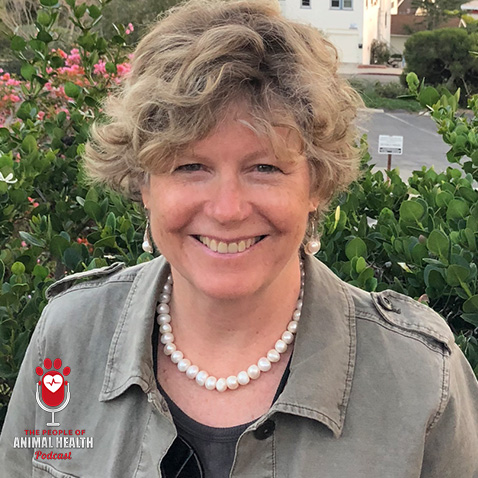
Few veterinarians have shaped the intersection of technology and Animal Health as profoundly as Dr. Kerri Marshall. Throughout a career that has spanned equine practice, research, corporate Veterinary medicine, pet insurance, technology startups, and executive leadership, she has consistently pursued one overriding mission: improving the lives of animals by making Veterinary care more accessible, more connected, and more effective. Along the way, she has become one of the profession’s most recognized innovators, earning the Kansas City Animal Health Corridor’s prestigious Iron Paw Award, receiving the VMX Veterinarian Innovation Award, and even being described by one former chief executive as “the Steve Jobs of Veterinary Medicine.”
Those accomplishments, however, tell only part of the story. During her appearance on The People of Animal Health Podcast with host Stacy Pursell, Dr. Marshall revealed that every career decision she has made traces back to two deeply personal passions. The first is an endless curiosity about how technology can solve difficult problems. The second is a lifelong commitment to eliminating economic euthanasia so that financial limitations no longer determine whether beloved animals receive lifesaving care. Together, those passions have led her to continually reinvent herself while remaining firmly rooted in the profession she has loved since childhood.
Growing Up in a Veterinary Hospital
For Dr. Marshall, Veterinary medicine was never simply a career option. It was home.
Although her family moved several times during her earliest years, they eventually settled in Lompoc, California, where both of her parents practiced Veterinary medicine. Her father focused primarily on large animals while her mother cared for companion animals, creating a uniquely balanced practice that exposed young Kerri to virtually every aspect of the profession.
“My parents were both veterinarians,” she recalled. “Dad did the large animal. Mom did a small animal practice.”
Unlike many children who occasionally visited their parents’ workplaces, Dr. Marshall essentially grew up inside the Veterinary hospital. Long before attending Veterinary school herself, she had already experienced nearly every role within a busy practice.
“I think I’ve done every single job there is to do in the veterinary hospital.”
- Reception
- Cleaning kennels
- Helping with patients
- Observing procedures
Each experience gradually deepened both her understanding of Veterinary medicine and her appreciation for the extraordinary commitment required to care for animals every day. Looking back today, she considers herself exceptionally fortunate.
“The fact that I still love it all this time,” she said, “it’s really special.”
One childhood memory remains especially vivid because it revealed something fundamental about her personality.
At just five years old, her father brought her along on a farm call involving a post-mortem examination of a cow. Standing beside the fence with curly hair falling into her face, she watched intently while adults around her wondered whether such an experience might frighten a young child.
Most expected horror. Instead, they found fascination. “I’ll never forget that,” she said.
Rather than focusing on how unsettling the scene appeared, Dr. Marshall became captivated by the opportunity to understand why the animal had died. That instinct—to ask questions, investigate causes, and solve problems rather than simply react emotionally—would later define both her Veterinary career and her approach to innovation.
“I think that curiosity,” she reflected, “and wanting to help animals by understanding… helped you with surgery and everything else you have to do in this career.”
Choosing Veterinary Medicine Anyway
Ironically, growing up with two veterinarian parents initially made Dr. Marshall determined to pursue something completely different.
“Because both my parents were veterinarians,” she admitted, “I always said I was going to pharmacy or something else.”
Like many children of successful professionals, she wondered whether forging her own path might allow her to establish an identity separate from her family’s accomplishments.
Everything changed during a series of rides with renowned equine veterinarian Dr. Dick Mansmann while he worked on what would become the influential textbook Equine Medicine and Surgery. Horses had always been one of Dr. Marshall’s greatest passions, and accompanying Mansmann on calls offered an entirely new perspective on equine medicine.
“I don’t know,” she recalled. “I just decided this is what I want to do.”
The realization surprised even her. Rather than resisting the profession because her parents had chosen it first, she recognized that Veterinary medicine genuinely matched her own interests, abilities, and aspirations.
“I’m not going to worry about doing the same thing my parents do,” she remembered thinking. “I’m just going to go for it.”
That decision reflected another lesson she continues encouraging others to embrace today. “If you really love it,” she said, “you should do what your heart says anyway.”
After completing undergraduate studies at the University of California, Santa Barbara, Dr. Marshall enrolled at Washington State University’s College of Veterinary Medicine, where she concentrated primarily on equine medicine while preparing for a career she believed would keep her working with horses indefinitely.
At the time, she had no way of imagining that her greatest impact on Animal Health would eventually come through technology rather than traditional clinical practice.
Learning the Realities of Practice
Following graduation from Veterinary school in 1985, Dr. Marshall entered equine practice exactly as she had planned. Her first position took her to McCall, Idaho, where she cared primarily for horses and large animals while experiencing the rewards and challenges of rural Veterinary medicine.
She loved the medicine. She loved the animals. She loved the beautiful mountain scenery surrounding her practice. Yet something continually troubled her: quality of life.
“I was always struggling a little bit in my career with quality of life,” she explained.
Like countless veterinarians, she discovered that clinical practice often demanded extraordinary personal sacrifices. Emergency calls interrupted evenings. Long hours stretched into weekends. Professional responsibilities frequently overshadowed personal time.
“You just get so immersed in it,” she said, “that you forget other pieces of your life.”
Rather than accepting those conditions as inevitable, Dr. Marshall began asking questions that would shape the remainder of her career:
- Could Veterinary medicine operate differently?
- Could technology remove unnecessary burdens?
- Could better systems improve life for both veterinarians and clients without compromising patient care?
Those questions remained largely unanswered during her earliest years in practice, yet they quietly planted the seeds for everything that followed. After practicing in Idaho, she returned briefly to California to work alongside her parents. At first, taking over the family practice appeared to offer an ideal long-term solution.
Reality proved somewhat different. “Three Marshalls in one practice is too many Marshalls,” she laughed.
All three possessed exceptionally strong personalities, making the arrangement less sustainable than anyone had anticipated. Fortunately, her father offered advice that would become one of the defining principles of her career.
“When I left their practice,” she remembered, “my dad said, ‘Well, you always have this in your back pocket. So go out there and try things.'”
That encouragement gave her permission to explore opportunities beyond traditional private practice without fearing she had somehow abandoned Veterinary medicine. Instead, she was simply discovering new ways to contribute.
Expanding Her Horizons
Determined to broaden both her clinical experience and her understanding of Animal Health, Dr. Marshall accepted several relief positions before making another significant move to the University of California, Davis Primate Center. Looking back, she describes the decision as one of the boldest she had made to that point in her career: “It was probably the most adventurous move.”
Working within biomedical research exposed her to an entirely different side of Veterinary medicine. Rather than treating privately owned animals, she helped support research programs involving nonhuman primates while observing groundbreaking scientific work firsthand.
“It taught me a lot about animals and research and how they’re cared for,” said Dr. Marshall.
Among the many projects occurring at the center were studies connected to Dr. David Ho’s pioneering AIDS research, work that would later influence treatments benefiting millions of people worldwide. For Dr. Marshall, the experience reinforced something she already believed deeply. Veterinarians play indispensable roles wherever animals are involved.
“I believe the veterinarian has such a crucial role there,” she said.
Although she valued the scientific environment, another interest increasingly captured her attention: business. She realized she enjoyed thinking about organizational growth, operational improvement, and new ways to deliver Veterinary care almost as much as practicing medicine itself.
“I have this tremendous desire to run a business,” she said.
The university setting, while intellectually stimulating, offered fewer opportunities to pursue those interests. Soon another opportunity appeared that would permanently redirect her career.
Discovering the Future at Banfield
While working at UC Davis, Dr. Marshall reconnected with Veterinary school classmate Dr. Scott Campbell, who had recently launched an ambitious company then known as VetSmart. Curious, she visited one of its Sacramento locations. Walking through the doors became one of the defining moments of her professional life: “I just looked at things.”
Inside the pet store stood something unlike almost any Veterinary hospital she had previously encountered:
- Clean, modern facilities
- Preventive care
- Convenient access for clients
- Most importantly, electronic medical records
“I have terrible handwriting,” she joked, remembering years spent watching her veterinarian parents complete handwritten medical records late into the evening. “I just thought there’s got to be better.”
The technology immediately fascinated her, but another realization proved equally powerful. Clients were already there.
Rather than spending years attempting to attract new customers to an independent practice, Banfield positioned Veterinary care directly where pet owners naturally shopped, dramatically increasing opportunities to educate families while expanding access to preventive medicine. “I thought this is an amazing opportunity,” said Dr. Marshall.
She immediately recognized possibilities that many others had not yet imagined.
Joining what would become Banfield Pet Hospital launched the longest and perhaps most influential chapter of her career. Over the next sixteen years, Dr. Marshall held twelve different positions spanning clinical practice, operations, hospital leadership, recruiting, innovation, and technology implementation. Each role expanded her understanding of how large organizations could improve Veterinary medicine while providing new opportunities to tackle increasingly complex challenges.
Perhaps most importantly, Banfield introduced her to technology not as an interesting accessory, but as an essential tool capable of fundamentally improving the practice of Veterinary medicine. Initially, she resisted.
“I always felt like I’d been pulled into technology kicking and screaming,” she said.
Eventually, however, she realized technology represented the perfect intersection of everything she cared about most:
- Better medicine
- Better client experiences
- Better quality of life for Veterinary teams
- And better outcomes for animals
That realization would ultimately transform Dr. Kerri Marshall from an equine practitioner into one of the Animal Health industry’s most influential technology visionaries.
A Mission to End Economic Euthanasia
Although Dr. Kerri Marshall spent sixteen years helping transform Banfield Pet Hospital into one of the most influential organizations in Veterinary medicine, another challenge increasingly occupied her thoughts: rconomic euthanasia.
Throughout her years in clinical practice, she had repeatedly witnessed heartbreaking situations in which loving pet owners simply could not afford recommended treatment. Those conversations remained among the most emotionally difficult aspects of Veterinary medicine because the medical solution often existed while the financial means to pursue it did not. “I never got over economic euthanasia,” she explained.
No matter how much technology improved or how efficiently hospitals operated, that fundamental problem continued affecting both veterinarians and families: “It haunted me.”
As she evaluated where she could make the greatest long term impact, Dr. Marshall became convinced that financial accessibility represented one of the profession’s most important opportunities for innovation. That conviction eventually led her to Trupanion. Joining the rapidly growing pet insurance company allowed her to pursue a mission that aligned perfectly with everything she had experienced throughout her career.
“I realized this was another way to help pets,” said Dr. Marshall.
Rather than replacing excellent Veterinary medicine, pet insurance strengthened it by allowing veterinarians and clients to focus first on medical decisions rather than financial limitations. Instead of immediately asking what owners could afford, Veterinary teams could begin by discussing what the patient actually needed. For Dr. Marshall, that subtle difference carried enormous significance. “It lets veterinarians practice medicine,” she said.
She also emphasized that pet insurance should never be viewed as an isolated solution. Wellness plans, financing options, savings accounts, preventive care, and insurance each address different aspects of the financial challenges families encounter throughout a pet’s lifetime.
Rather than competing against one another, these tools complement one another by creating a broader system that improves access to care while strengthening the relationship between veterinarians and pet owners.
Her years at Trupanion reinforced another important realization: technology alone never solves problems. Instead, technology becomes powerful only when it helps people make better decisions while improving outcomes for animals.
Building the Connected Veterinary Ecosystem
Following her work at Trupanion, Dr. Marshall continued expanding her influence across Animal Health by helping organizations connect technology, clinical medicine, and business strategy in entirely new ways.
She worked with Compassion First, National Veterinary Associates, and numerous startup companies developing innovative software, diagnostics, genetics, and digital health platforms designed to strengthen Veterinary medicine. “I love startups,” she said.
Their energy reminded her of Banfield’s earliest years when bold ideas routinely challenged traditional assumptions about how Veterinary care should be delivered. At the center of all those opportunities remained one guiding principle: everything should work together.
For too many years, Veterinary hospitals relied upon disconnected technologies that forced doctors and technicians to enter the same information repeatedly into separate systems:
- Medical records
- Practice management software
- Laboratory information
- Imaging
- Pharmacy
- Insurance
- Scheduling
- Client communication
Each often operated independently despite serving the same patient. Dr. Marshall envisions something entirely different: “I’ve always believed there should be one connected ecosystem.”
Instead of forcing Veterinary teams to navigate multiple disconnected platforms, information should move effortlessly between systems, reducing administrative burdens while allowing clinicians to devote more time to patient care.
Artificial Intelligence will play an increasingly important role within that ecosystem. Rather than replacing veterinarians, Dr. Marshall believes AI will enhance clinical decision making by organizing information, identifying trends, supporting diagnostics, and reducing repetitive administrative tasks. “It should help us become better,” she said.
She expects genetics to become equally transformative. As genomic testing becomes more affordable and sophisticated, veterinarians will gain opportunities to predict disease risks, personalize preventive care, and intervene earlier than ever before.
For Dr. Marshall, these developments represent far more than technological progress. They represent better medicine, better client experiences, and healthier lives for animals.
Learning to Lead Through Change
Throughout the interview, Stacy Pursell asked Dr. Marshall about the leadership lessons she accumulated while moving between clinical practice, corporate Veterinary medicine, technology companies, and entrepreneurial ventures.
One challenge appeared consistently: Resistance to change. “I learned early that change is really hard for people,” said Dr. Marshall.
Even when new technologies clearly improved efficiency or patient care, many professionals understandably hesitated because change often creates uncertainty before delivering benefits. Rather than becoming frustrated, Dr. Marshall gradually learned that successful leaders spend as much time helping people understand change as they do implementing it: “You have to bring people along.”
That philosophy shaped her work introducing electronic medical records, wellness plans, digital technologies, and numerous other innovations throughout her career. Listening became equally important.
“The best ideas don’t always come from the executive office,” said Dr. Marshall. Instead, they come from:
- Technicians
- Receptionists
- Associates
- Practice managers
Each often recognized operational opportunities long before senior leadership did. Consequently, Dr. Marshall developed a leadership style centered around curiosity rather than certainty: “I ask a lot of questions.”
That same curiosity also influenced her personal development. Throughout her career she benefited tremendously from mentors including Dr. Scott Campbell, Banfield founder and visionary leader John Payne, and Trupanion founder Darryl Rawlings. Each offered different perspectives.
Scott Campbell demonstrated how bold thinking could fundamentally reshape Veterinary medicine. John Payne challenged people to think strategically while never losing sight of culture and purpose. Darryl Rawlings reinforced the importance of remaining relentlessly focused on solving meaningful customer problems.
“They all stretched my thinking,” said Dr. Marshall.
Rather than attempting to imitate any single mentor, Dr. Marshall combined lessons from each while developing her own authentic leadership style.
Living in the Future
One former chief executive once jokingly described Dr. Marshall as “the Steve Jobs of Veterinary Medicine.” Although she laughed about the comparison during the interview, the description captured something important about how she approaches both life and leadership: “I tend to live in the future.”
Rather than concentrating primarily upon existing limitations, she naturally imagines possibilities that have not yet become reality.
Sometimes those ideas arrive years before technology catches up. Occasionally they seem unrealistic. Many eventually become commonplace. “I’ve always been looking around the corner,” said Dr. Marshall.
Maintaining that perspective requires balance, however. Dr. Marshall deliberately invests time in habits supporting both physical and mental health, including regular exercise, meditation, meaningful relationships, and consistent sleep: “I’ve learned those things matter.”
Early in her career she often sacrificed personal well being while trying to accomplish everything professionally. Experience gradually taught her otherwise.
“If you don’t take care of yourself,” she explained, “you really can’t take care of anyone else.”
She also continues learning constantly through books, conferences, conversations, and emerging technologies because she believes curiosity remains one of the most valuable professional characteristics anyone can cultivate. “I never want to stop learning,” she said.
Looking Toward a Brighter Future
As her conversation with Stacy Pursell concluded, Dr. Marshall reflected on the extraordinary changes she has witnessed throughout Veterinary medicine.
- Paper records became electronic health records.
- Independent practices evolved into sophisticated hospital networks.
- Pet insurance expanded dramatically.
- Artificial Intelligence entered clinical discussions.
- Genetics advanced from research laboratories into everyday practice.
Yet despite all those developments, her deepest motivation remains exactly what it was while growing up inside her parents’ Veterinary hospital: helping animals.
“I still wake up every day thinking about how we can make life better for pets.” said Dr. Marshall.
She believes the Veterinary profession stands at the beginning rather than the end of its technological transformation. Better connectivity, predictive medicine, digital health, wearable devices, Artificial Intelligence, and integrated financial solutions will collectively strengthen Veterinary medicine while making care more accessible than ever before.
“We have incredible opportunities ahead,” said Dr. Marshall.
Those opportunities, however, require leaders willing to challenge conventional thinking while remaining grounded in compassion. Technology should never replace the veterinarian. Innovation should never overshadow relationships. Business success should always support better patient outcomes.
Throughout her remarkable career, Dr. Marshall has consistently demonstrated that those objectives reinforce rather than contradict one another. By combining clinical experience with entrepreneurial thinking, technological curiosity, and an unwavering commitment to eliminating barriers to care, she has helped redefine what is possible within modern Animal Health.
Her appearance on The People of Animal Health Podcast offered listeners far more than the story of an accomplished veterinarian. It revealed the mindset of an innovator who refuses to accept preventable limitations, continually asks how Veterinary medicine can become better, and believes the profession’s brightest days still lie ahead. As long as leaders like Dr. Kerri Marshall continue imagining the future while working tirelessly to build it, that optimism appears remarkably well founded.
Listen to Dr. Kerri Marshall’s episode on The People of Animal Health Podcast with Stacy Pursell!