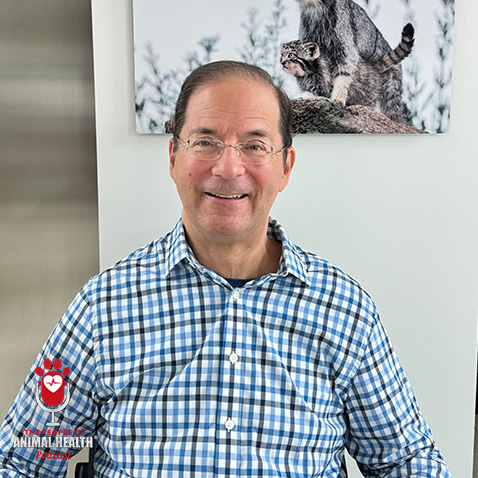
Few executives have left a more lasting mark on the animal health industry than Jon Ayers. During his tenure as Chairman and CEO of IDEXX Laboratories, he helped transform the company from a successful diagnostics business into the global leader in Veterinary diagnostics, software, and information management. Under his leadership, IDEXX grew from approximately $380 million in annual revenue to more than $2.4 billion, delivering a remarkable 40-fold return for shareholders while fundamentally changing how veterinarians diagnose disease and care for patients.
Yet numbers alone fail to tell the full story. Behind IDEXX’s extraordinary growth was a leader who consistently looked around corners, identified emerging trends before others recognized them, and made bold strategic decisions that reshaped not only his company but also Veterinary medicine itself. During his appearance on The People of Animal Health Podcast with Stacy Pursell, founder and CEO of The VET Recruiter, Ayers reflected on the experiences that shaped his leadership philosophy, the unconventional path that brought him into animal health, and the importance of embracing uncertainty as an opportunity rather than an obstacle. His story illustrates that transformative leadership rarely follows a straight line. Instead, it often emerges from a willingness to step into unfamiliar territory, learn quickly, and make thoughtful decisions rooted in long-term vision.
Growing Up Curious in Rural Connecticut
Ayers spent his childhood in Wilton, Connecticut, long before the area became the affluent suburb many people recognize today. At the time, it was a rural community surrounded by woods, providing the perfect environment for a naturally curious child.
“I grew up in the woods of Connecticut,” he recalled. “I enjoyed exploring the woods.”
That curiosity became one of the defining characteristics of his youth. Rather than waiting for someone to teach him new skills, he simply pursued whatever interested him. Over the years, he taught himself an eclectic collection of talents, including bicycle repair, ballroom dancing, and even bartending. While those hobbies may seem unrelated to the career he would eventually build, they reflected an underlying mindset that would remain constant throughout his life—a willingness to experiment, solve problems independently, and continually expand his knowledge.
Looking back, Ayers recognizes that curiosity became one of his greatest professional advantages. Every new challenge represented an opportunity to learn rather than something to fear. That mindset would later allow him to enter unfamiliar industries, assume leadership roles outside his previous experience, and confidently navigate periods of extraordinary change.
Two Experiences That Changed Everything
Although his childhood fostered independence, Ayers identifies two teenage experiences that fundamentally shaped the way he approaches life.
The first occurred when he was just fifteen years old, when his parents arranged for him to spend an entire summer living with a French family. At the time, he had completed only two years of high school French, leaving him with a limited vocabulary, a dictionary, and little confidence in his ability to communicate.
Within days of arriving, however, he found himself thrust into an even greater challenge. The family’s son invited him on a French scouting expedition into the Pyrenees Mountains—a multi-week outdoor adventure where virtually no one spoke English.
Every morning camp leaders explained the day’s activities in rapid French while the other boys listened attentively and enthusiastically. Ayers understood almost none of it. “I had no idea what they were saying,” he admitted.
Rather than becoming discouraged or asking to return home, he learned by observing those around him. He watched how others responded, pieced together conversations, and gradually became comfortable functioning in an environment where nearly everything was unfamiliar.
He ultimately remained in France for nearly three months. When he returned home, his host family told him they had expected him to leave early. Many previous exchange students had become homesick and asked to return home before the summer ended. Ayers never seriously considered it. Instead, he discovered something important about himself. He could thrive even when circumstances initially felt overwhelming.
The second defining experience came shortly afterward, when family friends encouraged him to transfer midway through his junior year of high school from his local public school to Phillips Exeter Academy, one of the nation’s most academically demanding preparatory schools.
The timing could hardly have been more challenging. Most students had already spent years adapting to Exeter’s rigorous curriculum while simultaneously preparing for college admissions. Ayers suddenly found himself competing alongside classmates who seemed far better prepared.
“I was pretty overwhelmed at first,” he acknowledged.
Once again, however, he relied on the same approach that had served him well in France. He observed. He adapted. He worked relentlessly until he caught up. By the time he graduated, he had earned admission to Yale University. Those two experiences established a pattern that would define his career. “I became very comfortable jumping into situations that are brand new and figuring them out,” he said.
That philosophy would prove invaluable many times over.
An Eclectic Career Builds an Unusual Skill Set
Unlike many CEOs who spend their careers climbing the ladder within a single industry, Ayers intentionally sought diverse experiences across multiple disciplines.
He earned a degree in biochemistry before beginning his professional career at IBM during the early days of the computer revolution. Working in technical sales and customer support introduced him to both emerging technology and the importance of understanding customer needs.
After earning his MBA from Harvard Business School, he joined Bain & Company, where he developed a strong foundation in corporate strategy and competitive analysis. From there, he transitioned into investment banking at Morgan Stanley, focusing on mergers and acquisitions. The role exposed him to corporate finance, valuation, and capital markets, providing insights that would later prove invaluable when leading a publicly traded company.
Eventually, Ayers sought operating experience, joining United Technologies and later becoming President of Carrier Corporation. Each career move appeared dramatically different from the last. Looking back, however, he sees them as complementary rather than disconnected:
- The science background helped him understand technology.
- IBM taught him about software and information systems.
- Strategy consulting sharpened his long-term thinking.
- Investment banking strengthened his financial discipline.
- Operating leadership taught him how to execute.
At the time, he couldn’t have predicted how perfectly those experiences would eventually converge.
An Unexpected Opportunity at IDEXX
When Ayers first entered the animal health industry, he had no previous experience in Veterinary medicine. He was, as he jokingly described it, “between jobs.” After completing his leadership role at Carrier, he was recruited by IDEXX’s Board of Directors, which was searching for a successor to founder David Shaw.
The Board recognized that IDEXX had evolved beyond the entrepreneurial stage. The company possessed tremendous innovation capabilities but required a leader capable of building a scalable global organization. Although Ayers lacked direct animal health experience, he brought something equally valuable. He knew how to build businesses.
“They took a risk on me,” he said.
His scientific background in biochemistry also helped establish credibility with IDEXX’s technical teams, even though he readily acknowledges it didn’t make him an expert in Veterinary diagnostics overnight. Instead, he relied on the approach that had guided him since adolescence: “I dove in and started to figure things out.”
That willingness to learn quickly became one of his greatest strengths as CEO. Rather than assuming previous success guaranteed future results, Ayers immersed himself in understanding Veterinary medicine, diagnostics, laboratory science, software, customer behavior, and competitive dynamics.
He spent the first several years learning every aspect of the business before making some of the strategic decisions that would eventually define his tenure.
Betting on Innovation
When Ayers arrived at IDEXX, the company had already built a strong reputation for innovation. Through a combination of acquisitions and internal product development, it had established meaningful positions in diagnostics, pharmaceuticals, and software.
Yet Ayers believed the organization needed greater strategic focus. His conversations with Wall Street analysts reinforced that conviction. “They said, ‘You’re going to be valued based on growth,'” he recalled.
Rather than pursuing growth primarily through acquisitions, Ayers concentrated on creating sustainable organic growth. That decision led IDEXX to dramatically increase investment in research and development while doubling down on the company’s greatest competitive advantage—diagnostics.
He also recognized something many others overlooked: diagnostics and software naturally complemented one another. “The product of diagnostics is information,” he explained.
Diagnostic testing generates data. Software organizes, analyzes, and delivers that information in ways that help veterinarians make better clinical decisions. Together, the two businesses created a powerful ecosystem that competitors would struggle to replicate.
Conversely, pharmaceuticals represented a relatively small portion of IDEXX’s portfolio and lacked the strategic advantages enjoyed by diagnostics. Recognizing this, Ayers ultimately made the difficult decision to exit the pharmaceutical business entirely. Instead of trying to compete across multiple unrelated categories, IDEXX would become the undisputed leader in Veterinary diagnostics and information management.
That focus became one of the defining characteristics of the company’s growth strategy.
Creating a New Standard of Care
Ayers believes IDEXX succeeded not simply because it developed innovative products, but because it fundamentally changed how veterinarians viewed diagnostics. Rather than considering laboratory testing only after obvious clinical signs appeared, veterinarians increasingly incorporated diagnostics into routine preventive care, wellness visits, and earlier disease detection.
“We both created that wave and rode that wave,” he reflected.
The company invested heavily in educating practitioners about the clinical value of diagnostics while simultaneously developing increasingly sophisticated in-clinic analyzers, reference laboratory services, and software platforms. Each innovation reinforced the others. As veterinarians adopted more diagnostics, they generated more clinical information.
That information increased the value of software. Software, in turn, made diagnostics easier to integrate into everyday practice. The resulting ecosystem strengthened customer relationships while creating recurring revenue streams that supported continued investment in innovation.
The Bold Decision That Changed Everything
Among the many strategic decisions Ayers made during his tenure, one stands above the rest. In 2014, IDEXX fundamentally changed how it reached customers by transitioning from a hybrid distribution model to a fully direct sales organization throughout the United States. The move was controversial.
Longtime distribution partners understandably opposed the change. Externally, many questioned whether IDEXX had made a costly mistake. Implementation proved challenging, creating approximately eighteen months of uncertainty as the new model took shape. From the outside, success appeared anything but guaranteed. Inside the company, however, Ayers remained unwavering.
“We knew it was going to work,” he said.
The rationale was straightforward. Selling directly would allow IDEXX to build stronger relationships with Veterinary practices, understand customer needs more deeply, and provide more consistent service. Instead of relying on intermediaries, the company could interact directly with veterinarians, helping them maximize the value of IDEXX’s expanding portfolio of diagnostics, software, and laboratory services.
The short-term disruption eventually gave way to remarkable long-term results. Once the transition stabilized and customers adjusted to the new model, growth accelerated dramatically.
The decision became one of the most important catalysts in IDEXX’s history, helping fuel another extended period of exceptional performance while further strengthening the company’s leadership position within Veterinary diagnostics. For Ayers, the experience reinforced an important lesson that had guided him throughout his career.
Transformational growth often requires difficult decisions that appear uncomfortable in the short term but create extraordinary opportunities over the long run. Leaders willing to commit fully to those decisions—and patiently execute them despite temporary turbulence—position their organizations to achieve results that would otherwise remain out of reach.
After spending nearly two decades transforming IDEXX Laboratories into one of the most successful companies in animal health, Jon Ayers could have easily retired and reflected on an extraordinary career. Instead, life presented him with an entirely different challenge. In 2019, a devastating cycling accident left him a quadriplegic, instantly changing nearly every aspect of his daily life. Yet, true to the mindset that had defined his career, Ayers approached his recovery the same way he had approached every unfamiliar challenge before it: by assessing the situation honestly, focusing on what remained possible, and figuring out how to move forward.
During the second half of his conversation on The People of Animal Health Podcast, Ayers discussed the lessons he learned through recovery, how he found renewed purpose in wildlife conservation, and why he believes the animal health industry’s greatest opportunities are still ahead. Throughout the discussion, he demonstrated that while circumstances may change dramatically, leadership is ultimately defined not by titles or physical abilities, but by the willingness to continue making a meaningful contribution.
Discovering a New Mission Through Panthera
Following his retirement from IDEXX, Ayers initially remained involved as a member of the company’s Board of Directors. At the same time, however, another passion had begun to occupy more of his attention.
“I’ve always loved cats,” he explained.
That lifelong fascination eventually expanded beyond domestic pets into a deep interest in wild felines. Curious about the many species living around the world, Ayers began researching wild cats several years before his accident. The more he learned, the more captivated he became by their biology, habitats, and the growing conservation challenges they faced.
His interest naturally led him to Panthera, the global organization dedicated exclusively to the conservation of the world’s wild cat species. Initially, he supported the organization financially. As his involvement grew, Panthera’s leadership recognized that he could contribute far more than philanthropy.
He joined the Board of Directors and almost immediately assumed responsibility for chairing its Finance Committee. Before long, founder Tom Kaplan proposed something even more significant. Without first asking Ayers privately, Kaplan informed the Board that Jon would become the organization’s next Board Chair. Only afterward did he ask whether he had overstepped. Ayers laughed when recalling the exchange: “He said, ‘Tell me if I went too far.'”
Rather than feeling overwhelmed, Ayers viewed the opportunity as something profoundly meaningful. After the accident, he had understandably questioned how he could continue contributing professionally. Panthera’s confidence in his leadership provided the answer. “It rebuilt my confidence,” he reflected.
Instead of focusing on what he had lost physically, he redirected his energy toward helping an organization whose mission deeply inspired him. Over the next several years, Panthera nearly doubled in size while expanding its conservation efforts around the world.
Bringing Business Discipline to Conservation
One of the most interesting aspects of Ayers’ work with Panthera is the way he has applied corporate leadership principles to wildlife conservation. He quickly observed that nonprofit organizations often possess tremendous passion and scientific expertise but may lack formal strategic planning, operational management, and performance measurement.
“Generally speaking,” he explained, “people in nonprofits don’t really understand strategy, finances, [or] administration.”
That observation wasn’t intended as criticism. Rather, it reflected the reality that many nonprofit leaders understandably devote most of their attention to advancing their mission. Ayers saw an opportunity to complement that expertise with business discipline.
One example involved lion conservation. Panthera had invested substantial resources protecting lions from poaching, habitat loss, and human conflict. Yet Ayers asked a deceptively simple question: How do we know whether these efforts are actually increasing lion populations?
Unlike tigers, whose unique stripe patterns make individual animals relatively easy to identify, lions present a greater monitoring challenge because their appearance is much more uniform. Even so, Ayers believed measuring outcomes remained essential.
“If we’re going to do all this conservation,” he said, “we need to have an objective.”
In business terms, organizations track key performance indicators. Conservation should be no different. Protecting habitat, strengthening local relationships, and reducing poaching all matter greatly. But ultimately, success should also be measured by whether lion populations remain stable or increase over time.
That emphasis on measurable outcomes has strengthened Panthera’s ability to evaluate the effectiveness of its conservation programs while ensuring resources are directed toward initiatives producing the greatest impact.
Why Cats Deserve Greater Attention
Ayers’ passion for felines extends well beyond wildlife conservation. Following his departure from IDEXX’s Board, he also joined the CATalyst Council, an organization dedicated to improving feline health and Veterinary care.
Serving as Chair of its Feline Market Insights Committee, he immediately recognized another opportunity. Veterinary medicine, he believes, has historically lacked comprehensive market data. “We’ve got very poor data,” he observed.
Without reliable information, industry leaders often struggle to understand changing client behavior or identify emerging trends before they become obvious. One of the committee’s first priorities involved separating feline data from canine data rather than treating companion animal medicine as a single market.
The results proved revealing. While overall Veterinary visits have declined in recent years, cat visits tell a remarkably different story. “They’ve been growing since 2023,” Ayers noted.
That finding challenged assumptions many industry observers had accepted regarding declining demand. Instead, it demonstrated that cats represent a distinct market with unique growth dynamics, client behaviors, and healthcare opportunities.
Understanding those differences will become increasingly important as feline ownership continues expanding worldwide.
Addressing the Cost of Veterinary Care
Although Ayers remains optimistic about Veterinary medicine’s future, he also believes the profession must confront one significant challenge: affordability. Research conducted through the CATalyst Council revealed that Veterinary inflation has substantially outpaced overall consumer inflation since the COVID-19 pandemic.
While general consumer prices increased approximately 25 percent, Veterinary service costs rose roughly 45 percent during the same period. That difference has meaningful consequences.
“It’s priced a lot of pet owners out of the market,” Ayers explained.
His research suggests cost has become one of the primary reasons many middle-income families postpone or forgo Veterinary visits altogether. Importantly, Ayers does not criticize veterinarians for these increases. Practices have faced rising labor costs, equipment expenses, pharmaceuticals, and inflation across nearly every aspect of their operations.
Nonetheless, the economic reality remains. Many pet owners simply cannot absorb repeated price increases.
Recognizing this challenge represents the first step toward finding solutions that preserve both practice sustainability and patient access.
Artificial Intelligence Will Transform Veterinary Medicine
When asked where the next major disruption in animal health will originate, Ayers answered immediately: artificial intelligence. In his view, AI will reshape Veterinary medicine more dramatically than almost any other industry.
“We wrote a paper on this,” he explained, describing fifteen different reasons why Veterinary medicine is particularly well positioned to benefit from AI technologies.
Among the most significant factors are the industry’s heavy reliance on information, medical decision-making, diagnostics, client communication, and documentation. Unlike highly regulated areas of human healthcare, Veterinary medicine also enjoys greater flexibility to adopt innovative technologies more rapidly. Ayers estimates that on a scale of one to ten, with ten representing industries most likely to experience transformational change through AI, Veterinary medicine ranks approximately a nine.
“I don’t believe most people still understand that,” said Dr. Ayers.
He anticipates AI supporting nearly every aspect of Veterinary practice, including medical record generation, diagnostic interpretation, client communication, workflow optimization, preventive care recommendations, and operational efficiency. Rather than replacing veterinarians, these technologies will allow them to focus more time on patient care while reducing administrative burdens.
Most importantly, Ayers believes AI will eventually help lower the cost of Veterinary services. That, in turn, could dramatically improve access to care for millions of pets currently receiving little or no Veterinary attention.
Looking Beyond Consolidation
Ayers also reflected on one of the industry’s defining trends over the past two decades: practice consolidation. Initially, he underestimated the movement. He questioned whether combining independent practices could truly generate meaningful operational advantages.
Over time, however, he recognized several powerful forces driving consolidation:
- Many practice owners sought retirement opportunities.
- Private equity firms recognized favorable valuation dynamics.
- Access to capital accelerated acquisitions.
Yet Ayers now believes the most rapid period of consolidation has largely passed. Future growth, he suggests, will depend less on acquiring additional practices and more on operating existing organizations effectively. That challenge should not be underestimated. Veterinarians value professional autonomy.
“They’re very proud of that independence,” he observed.
Successfully leading large Veterinary organizations therefore requires balancing operational consistency with the clinical independence practitioners understandably value.
Learning from Adversity
Perhaps the most inspiring portion of the interview came when Ayers reflected on recovering from his accident. Rather than dwelling on what had changed, he intentionally focused on gratitude. During rehabilitation, he developed a daily practice of identifying five things for which he remained thankful.
Those initially included simply being alive, retaining full cognitive function because his helmet prevented traumatic brain injury, and receiving unwavering support from his family. Over time, gratitude became a habit.
“It’s actually pretty easy to think of all the grateful things,” he said.
Another lesson came from fellow quadriplegics he met during rehabilitation. One individual’s perspective particularly resonated. “I used to be able to do 20,000 things,” the man explained. “Now I can do 2,000.”
Instead of mourning the 18,000 activities he had lost, he chose to focus on the thousands still available. That philosophy profoundly influenced Ayers’ own recovery. Like poker, he said, life requires playing the hand you’re dealt.
Energy spent wishing circumstances were different accomplishes little. Progress begins by honestly accepting reality and making the most of the opportunities that remain.
Health Comes Before Everything Else
Reflecting on his career, Ayers wishes he had discovered one lesson much earlier: health must always come first. Despite leading one of the world’s most successful animal health companies, he admits he neglected his own wellbeing for many years.
That changed dramatically at age fifty-four. After becoming an empty nester, he committed himself to improving his physical health through cycling, healthier eating, and regular exercise. The transformation proved remarkable. He lost approximately sixty pounds.
Initially, he worried dedicating more time to health might negatively affect his career. The opposite occurred. “I had more energy,” he said.
He became more resilient under stress, more productive, and better equipped to lead. Even after his accident, that commitment to health continues. Although physical exercise now looks very different, he remains deeply invested in nutrition, mental wellbeing, and lifelong learning about healthy living.
For Ayers, health isn’t simply another priority. It is the foundation supporting every other aspect of life.
Seeing Around Corners
When discussing leadership, Ayers returned repeatedly to one concept: seeing around corners. Throughout his career, he invested significant time understanding not only his own company but also customers, competitors, financial markets, technology, regulation, and broader industry dynamics.
Rather than viewing industries as static, he studied them as constantly evolving ecosystems. One book that profoundly influenced his thinking was The Origin of Wealth, which examines industries through the lens of biological evolution. That perspective encouraged him to ask different questions:
- Why is an industry structured the way it is?
- What forces are changing it?
- Where will those forces lead next?
By understanding those dynamics, leaders position themselves to recognize opportunities long before they become obvious.
“I think that’s part of being a leader,” said Dr. Ayers.
Investing in the Future of Animal Health
As the conversation concluded, Ayers expressed tremendous optimism about the future of animal health. Despite temporary challenges involving visit declines and affordability, he remains convinced the profession continues benefiting from powerful long-term trends. People love their pets. That reality has remained remarkably consistent across cultures and throughout history.
“It is a great industry to be in,” he said.
For those aspiring to leadership, his advice extends beyond mastering their current responsibilities:
- Study customers.
- Understand the medicine.
- Learn the industry’s economics.
- Explore emerging technologies.
- Develop strategic thinking.
Leadership requires looking beyond today’s responsibilities toward tomorrow’s possibilities.
Jon Ayers’ remarkable career demonstrates exactly what that mindset can achieve. Whether transforming IDEXX into an industry powerhouse, helping reshape wild cat conservation, or challenging Veterinary medicine to embrace artificial intelligence and greater accessibility, he has consistently shown that meaningful leadership begins with curiosity, is strengthened by resilience, and ultimately succeeds by creating lasting value for others.
His story serves as a powerful reminder that while industries evolve, technologies change, and unexpected challenges arise, the leaders who continue learning, adapting, and seeing around corners will always be the ones who help shape the future.
Listen to Jon Ayers’s episode on The People of Animal Health Podcast with Stacy Pursell!