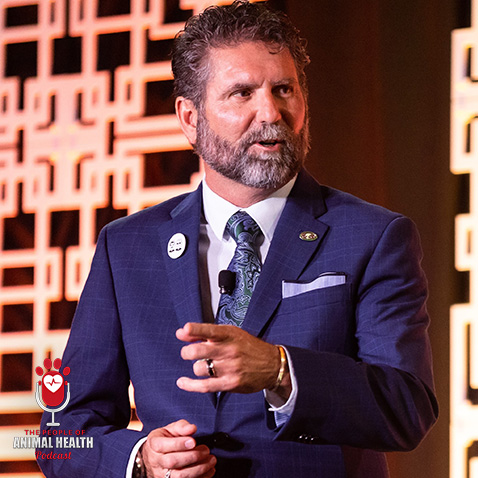
Few people have experienced the Veterinary profession from as many different perspectives as Dr. Craig Prior. During a career spanning more than four decades, he has been a small animal practitioner, emergency clinician, practice owner, entrepreneur, consultant, VMG facilitator, educator, speaker, media spokesperson, and one of the profession’s leading advocates for companion animal parasite prevention. Along the way, he has helped countless Veterinary practices become stronger businesses while mentoring veterinarians who are navigating the increasingly complex intersection of exceptional medicine, client communication, and financial success.
During his appearance on The People of Animal Health Podcast with host Stacy Pursell, Dr. Prior reflected upon a career filled with unexpected turns, difficult obstacles, valuable lessons, and remarkable opportunities. His conversation demonstrated that successful Veterinary careers are rarely built through careful planning alone. Instead, they often develop because people remain willing to embrace unexpected opportunities, learn continuously, and communicate effectively with everyone they encounter. Throughout the interview, Dr. Prior returned repeatedly to the importance of resilience, business knowledge, and communication, themes that have shaped every chapter of his professional life. His story also illustrates how experiences that initially appear unrelated to Veterinary medicine can ultimately become the foundation for extraordinary success.
From Australia’s Sunshine Coast to Veterinary School
Dr. Prior’s journey began in Southeast Queensland, Australia, an area affectionately known for its banana growing industry. Smiling as he described his upbringing, he explained that people from the region are sometimes called “banana benders,” a nickname that reflects the area’s agricultural heritage and the easygoing culture that helped shape his early years.
Growing up near Brisbane offered an idyllic childhood filled with warm weather, beautiful beaches, and abundant opportunities to enjoy the outdoors. Looking back, Dr. Prior remembers those years with tremendous appreciation because they provided an environment where life felt both simple and rewarding. Although few people growing up in that part of Australia could have predicted the remarkable international career awaiting him, the values developed during those formative years would remain with him throughout his life.
Unlike many veterinarians who describe dreaming about animals from their earliest memories, Dr. Prior’s path into Veterinary medicine emerged through a combination of family influence and circumstance. Australia followed a different educational model than the United States, requiring students to determine their professional direction while still in high school. At only sixteen years of age, he faced the daunting challenge of deciding what he wanted to do for the rest of his life. “That’s a tough thing to put on a sixteen year old,” he recalled.
Although uncertain about his exact destination, he knew one thing with confidence. He wanted a career in medicine, an interest he credits largely to his mother. “I think that was really planted in my head by my mother,” he explained.
Students applying to Australian universities listed several career preferences, and Dr. Prior selected medicine, dentistry, and Veterinary medicine. Rather than feeling strongly committed to one specific path, he decided to accept whichever program admitted him first. “Veterinary medicine took me first,” he said with a laugh. “I said yes.”
At the time, his reasoning seemed perfectly logical. Experience would soon teach him otherwise.
“Little did I know,” he reflected, “that really, as a veterinarian, you’re in the people business.” That realization eventually became one of the central themes of both his clinical career and his consulting work because exceptional Veterinary medicine begins long before a patient enters an examination room. It begins with earning the trust and confidence of the owner standing beside that patient.
A Gap Year That Changed Everything
Like many Veterinary students, Dr. Prior eventually reached a point where the demanding pace of professional education became emotionally exhausting. Partway through Veterinary school at the University of Queensland, he recognized that burnout had begun replacing enthusiasm. Rather than forcing himself forward until failure became inevitable, he made a decision that would ultimately transform both his career and his personal life.
“I realized that I was really burnt out,” he explained. “It was time to get an attitude adjustment.”
After approaching the dean and requesting permission to take a gap year, he received approval to step away from his studies temporarily. That decision created an opportunity he never could have anticipated. A close friend encouraged him to apply for a position representing Australia at the 1982 World’s Fair in Knoxville, Tennessee. Although the job had absolutely nothing to do with Veterinary medicine, it offered something equally valuable. It would allow a young Australian student with very little money to travel internationally while serving as an ambassador for his country.
Out of applicants from across Australia, Dr. Prior became one of only twenty four people selected.
For six months, he worked inside the Australian Pavilion greeting visitors, answering questions, and introducing tourists to Australian culture. At first glance, the experience appeared completely unrelated to his future profession. Looking back today, however, Dr. Prior describes it as one of the most important educational experiences of his entire career. “There is no better experience for learning how to communicate with people than doing that,” he said.
Day after day, thousands of visitors walked through the pavilion representing different backgrounds, personalities, and communication styles. Every conversation required him to think quickly, build rapport, answer questions clearly, and make strangers feel welcome. “It set me up for absolute success in Veterinary medicine,” he explained, “because I learned how to communicate well.”
That lesson continues shaping his philosophy more than forty years later. “What do you do as a veterinarian?” he asked during the interview. “Your number one career is communication.”
Without effective communication, clinical expertise alone accomplishes very little. “If you don’t communicate well with that client,” he observed, “you’ll never get to touch the animal.”
The World’s Fair therefore became much more than a travel opportunity. It became an intensive course in interpersonal communication, a skill that would later distinguish him as a practitioner, business owner, consultant, and educator.
Love, Determination, and a New Country
The World’s Fair also introduced Dr. Prior to the person who would permanently alter the course of his personal life. While working in Knoxville, he met Cindy, a nursing student at the University of Tennessee who had accepted a summer position at the fair. Their relationship developed quickly, but maintaining it afterward proved anything but simple.
Today’s technology makes international relationships relatively effortless through video calls, email, and instant messaging. During the early 1980s, however, those conveniences did not exist. As Dr. Prior humorously recalled, they had only three practical options.
The first was traditional mail, which often required ten to fourteen days each way between Australia and Tennessee. The second involved expensive long distance telephone calls costing approximately six dollars per minute on landline telephones. The third option consisted of purchasing international airline tickets that cost thousands of dollars.
“We did that for a couple of years,” he remembered, “until I ran out of money and realized it was cheaper to get married and stay in one place.”
The comment drew laughter during the podcast, but it reflected the reality of maintaining an international relationship during that era. After marrying, the couple returned to Australia so Dr. Prior could complete Veterinary school. Cindy later returned to Tennessee to finish her nursing education while he completed his final year before permanently relocating to the United States following graduation.
Moving to America represented another major turning point, but becoming licensed as a veterinarian proved considerably more difficult than simply crossing an ocean.
Overcoming Obstacles With Persistence
When Dr. Prior arrived in the United States during the mid 1980s, the Educational Commission for Foreign Veterinary Graduates program was still in its infancy. Navigating licensing requirements required patience, persistence, and considerable determination. At one point, he encountered a requirement instructing him to complete English speaking lessons despite growing up in Australia, where English had always been his primary language.
“I said, ‘What do you think we speak in Australia? Swahili?'” recalled Prior. The response he received surprised him even more. “I don’t know,” the representative answered. “What do you speak in Australia?”
Rather than quietly accepting an unnecessary requirement, Dr. Prior respectfully challenged the policy. His efforts ultimately helped convince program administrators to exempt applicants from English speaking countries who had completed their education in English. That change benefited not only him but also future international veterinarians pursuing American licensure.
Additional obstacles followed when local licensing authorities questioned whether foreign trained veterinarians should even be allowed to practice. Dr. Prior recalled facing significant resistance from individuals who openly preferred that he return to Australia rather than establish a career in Tennessee.
Instead of allowing those experiences to discourage him, he completed every requirement, earned his license, and began practicing Veterinary medicine in middle Tennessee. Looking back today, those early challenges reinforced lessons that would later define his professional philosophy: persistence matters.
Opportunities often emerge through adversity. Most importantly, success belongs to those who refuse to surrender when the path becomes unexpectedly difficult. Those experiences laid the foundation for a career that eventually expanded far beyond clinical practice into business ownership, consulting, education, and national leadership within the Veterinary profession.
Building a Practice While Learning the Business
After completing the lengthy licensing process and establishing himself in Tennessee, Dr. Craig Prior discovered something that countless veterinarians have learned over the years. Graduating from Veterinary school prepares doctors to practice medicine, but it does not necessarily prepare them to operate a successful business. As his career progressed from associate veterinarian to practice owner, he suddenly found himself responsible for hiring employees, managing finances, making marketing decisions, developing workplace culture, and planning for long term growth. Those responsibilities became an education every bit as significant as his clinical training.
Looking back, Dr. Prior acknowledged that many of the lessons shaping his career came not from textbooks but from experience. “Veterinary school taught us how to be veterinarians,” he explained, “but it really didn’t teach us how to be business owners.” Rather than allowing that gap to become a permanent obstacle, he committed himself to learning everything he could about leadership, financial management, and organizational development, recognizing that exceptional medicine depends upon healthy businesses that can invest in employees, technology, and patient care.
That curiosity eventually expanded into a second professional passion. While continuing to practice medicine, Dr. Prior became increasingly interested in helping other veterinarians avoid many of the mistakes he had experienced himself. He understood firsthand how overwhelming practice ownership could become when clinical responsibilities collided with business decisions, and he wanted to help colleagues build organizations capable of delivering both outstanding medicine and long term financial stability.
Helping Practice Owners Become Better Leaders
Those interests naturally led Dr. Prior to Veterinary Management Groups, where he began facilitating peer groups composed of Veterinary practice owners from across North America. The organization’s philosophy immediately resonated with him because it reflected something he had discovered throughout his own career. Even highly accomplished leaders benefit from surrounding themselves with trusted colleagues who are willing to share ideas, challenge assumptions, and offer honest feedback.
Running a Veterinary hospital can often feel isolating because owners carry responsibilities that employees rarely see. Difficult personnel decisions, financial pressures, succession planning, and strategic investments frequently become burdens that practice owners handle quietly. VMG creates an environment where those conversations can happen openly among peers facing remarkably similar circumstances.
“We’re there to help each other become better business owners,” Dr. Prior explained. “You don’t have to invent everything yourself because somebody else has probably already solved that problem.” That collaborative philosophy encourages members to exchange financial benchmarks, management strategies, operational improvements, and leadership experiences that ultimately strengthen every participating practice.
For Dr. Prior, facilitating those discussions represents another extension of his lifelong commitment to education. Whether mentoring individual veterinarians or guiding experienced practice owners, he enjoys helping people discover practical solutions while encouraging them to view challenges from fresh perspectives.
Why Communication Always Comes First
Although the conversation covered leadership, business management, and practice ownership, one subject surfaced repeatedly throughout the interview: communication.
Dr. Prior believes communication remains the single most important skill veterinarians develop because virtually every aspect of successful practice depends upon earning trust before providing medical care. The communication lessons he learned while representing Australia at the 1982 World’s Fair continue influencing his work more than four decades later because those months taught him how to connect with complete strangers, answer difficult questions, and make people feel comfortable within moments of meeting them.
“What do you do as a veterinarian?” he asked during the interview. “Your number one career is communication.”
That observation reflects a reality many veterinarians gradually discover during practice. Clients rarely evaluate doctors solely by diagnostic ability because they cannot personally assess medical expertise. Instead, they judge veterinarians by how clearly they explain recommendations, how carefully they listen, and how effectively they build confidence during emotionally stressful situations.
“If you don’t communicate well with the client,” Dr. Prior explained, “you’ll never get to touch the animal.” Outstanding medicine therefore begins long before a physical examination or surgical procedure. It begins with conversations that establish trust, demonstrate empathy, and help owners understand both the problem and the recommended solution.
That philosophy also extends to leadership inside Veterinary hospitals. Employees respond best when expectations are communicated clearly, feedback remains constructive, and leaders consistently explain not only what decisions are being made but also why those decisions matter. According to Dr. Prior, organizations with strong communication generally enjoy stronger cultures, healthier financial performance, and higher levels of employee satisfaction because misunderstandings become opportunities for discussion rather than sources of frustration.
Preparing Veterinarians for a Changing Profession
Having practiced through decades of extraordinary change, Dr. Prior remains optimistic about the future of Veterinary medicine while acknowledging that today’s graduates face challenges unlike those encountered by previous generations. Educational debt continues rising, client expectations have grown considerably, technological innovation has accelerated, and practice ownership has become increasingly complex. Yet he believes those challenges are balanced by equally remarkable opportunities because society has never valued companion animals more highly than it does today.
Rather than encouraging young veterinarians to focus exclusively on clinical excellence, Dr. Prior hopes they will also invest time developing leadership skills, financial literacy, business knowledge, and emotional intelligence. Veterinary medicine has evolved into a profession where medical expertise alone no longer guarantees long term success. Doctors who understand people, communicate effectively, and appreciate the business realities supporting excellent patient care position themselves to become influential leaders within both their practices and the broader Animal Health industry.
He also encouraged new graduates to remain lifelong students. “Never stop learning,” he said, emphasizing that graduation represents the beginning rather than the conclusion of professional education. Every difficult case, every client conversation, every management challenge, and every interaction with colleagues offers another opportunity to improve.
A Career Shaped By Unexpected Opportunities
Perhaps the most remarkable aspect of Dr. Prior’s professional journey is that many of its defining moments emerged unexpectedly. A temporary break from Veterinary school led him to the World’s Fair, where he developed communication skills that transformed his career while also meeting the woman who would become his wife. Immigration challenges strengthened his resilience while helping improve licensing procedures for future international graduates. Practice ownership introduced him to business leadership, eventually opening doors to consulting, speaking, facilitation, and national influence that extended far beyond clinical medicine.
None of those experiences appeared on a carefully constructed career roadmap. Instead, they developed because Dr. Prior consistently embraced opportunities to learn, adapt, and grow, even when those opportunities initially appeared unrelated to Veterinary medicine itself.
Looking back, he recognizes that flexibility often proves just as valuable as careful planning. Careers evolve because people remain curious enough to pursue new experiences while trusting that seemingly unrelated chapters may eventually connect in meaningful ways.
Wisdom Earned Through Four Decades of Service
As his conversation with Stacy Pursell concluded, Dr. Craig Prior left listeners with insights that extend far beyond Veterinary medicine. His career demonstrates that professional success is rarely determined by technical ability alone. Instead, lasting success grows from resilience, effective communication, thoughtful leadership, continuous education, and a genuine commitment to helping others succeed.
Whether reflecting on his childhood in Australia, the unexpected lessons learned at the World’s Fair, the perseverance required to establish a career in the United States, or the satisfaction he now finds helping Veterinary practice owners become stronger leaders, Dr. Prior consistently emphasized that relationships remain at the heart of everything veterinarians do. Medicine may bring clients through the door, but communication, trust, and compassion are what inspire them to return.
His appearance on The People of Animal Health Podcast offered listeners far more than a retrospective on an accomplished career. It provided a thoughtful reminder that the Veterinary profession continues rewarding those who remain curious, embrace change, communicate with purpose, and never lose their enthusiasm for learning. After more than forty years in practice, Dr. Prior’s passion for both Veterinary medicine and the people who make it possible remains as strong as ever, offering an inspiring example for every professional preparing to write the next chapter of their own career.
Listen to Dr. Craig Prior’s episode on The People of Animal Health Podcast with Stacy Pursell!