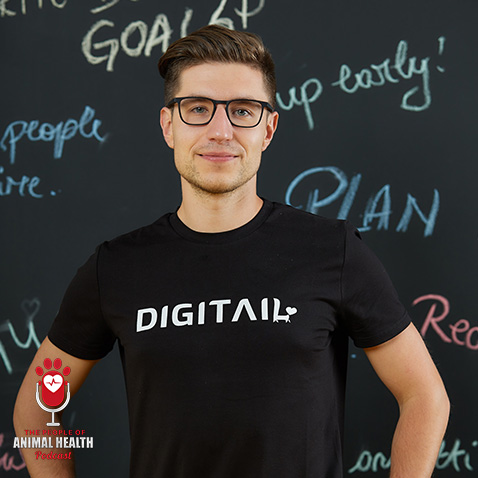
Innovation often begins with a simple question. For Sebastian Gabor, that question emerged not in a boardroom or a technology conference but inside a Veterinary clinic while caring for his first dog. A handwritten sticky note containing post visit instructions, followed by confusion surrounding duplicate vaccinations, revealed a problem that countless veterinarians had simply learned to accept. The professionals caring for pets were deeply committed to their patients, yet the technology supporting their work remained decades behind what modern healthcare should provide. Rather than accepting those frustrations as inevitable, Gabor saw an opportunity to help an entire profession spend less time behind computer screens and more time caring for animals.
During his appearance on The People of Animal Health Podcast with host Stacy Pursell, Gabor shared the entrepreneurial journey that ultimately led him to cofound Digitail, an all in one Veterinary practice management platform now serving more than 1,400 Veterinary practices and over one million pets worldwide. His story stretches far beyond software development. It is a story about resilience, family, purpose, leadership, and a determination to solve meaningful problems that improve people’s lives. Throughout the conversation, Gabor repeatedly emphasized that technology should never replace veterinarians. Instead, it should remove unnecessary burdens so they can focus on the work they entered the profession to do.
Lessons Learned Growing Up in Romania
Gabor’s entrepreneurial mindset was shaped long before he founded his first company. Growing up in Romania during a period of significant economic transition exposed him to both financial security and financial hardship, experiences that fundamentally influenced the way he approaches business and life.
His parents came from professional backgrounds. His mother was a physician, while his father worked as an engineer before the family entered pharmaceutical distribution within the human healthcare sector. During those early years, life felt comfortable, and Gabor remembers being fortunate enough that his parents could provide almost anything a young child wanted.
“If I wanted the Lego, they would buy me the Lego,” he recalled with a smile.
That stability, however, did not last. As the family business encountered financial difficulties and eventually declared bankruptcy, everything changed. Instead of enjoying financial security, Gabor watched his parents struggle to provide basic necessities. One memory remains especially vivid. The family needed money for food, and his parents emptied the savings from his childhood piggy bank simply to help make ends meet.
Looking back, Gabor recognizes that those difficult experiences became some of the greatest lessons of his life. “I think that taught me that in life, the most important things are family, friends, and the connections that you have,” he explained. “Money can come and go.”
Rather than becoming discouraged by those hardships, he developed a perspective that continues guiding both his personal life and his leadership philosophy. Financial success certainly matters, but relationships endure far longer than material possessions. That belief would later influence how he built companies, selected cofounders, hired employees, and approached customers throughout his entrepreneurial career.
Building Businesses By Solving Problems
After completing high school, Gabor left Romania to study business in Barcelona, Spain. Like many young professionals, he could have remained abroad after graduation, pursuing opportunities in one of Europe’s largest business centers. Instead, he chose to return home, a decision many of his classmates questioned. “I had my grandparents, I had my family back home,” he explained while describing the motivation behind his return.
Back in his hometown of Iasi, Gabor noticed something missing. Although the city included nearly half a million residents, relatively few cultural, charitable, or community events brought people together. Rather than waiting for someone else to create those opportunities, he and several friends established a nonprofit organization dedicated to organizing social gatherings, sporting events, cultural activities, and charitable initiatives that supported young people pursuing artistic and creative careers.
That experience became his first exposure to organizational leadership. Coordinating volunteers, attracting participants, solving logistical challenges, and building something from nothing reinforced an entrepreneurial instinct that would soon shape the rest of his career.
Unexpectedly, the next opportunity arrived through a phone call from a former business school friend. The friend wanted to build a mobile application and believed Romania’s engineering talent could help make the project possible. “I had nothing to do with this industry,” Gabor admitted.
His friend responded with a simple observation. “You’re from Romania, right? You have a lot of engineers.”
That conversation led to the creation of IT Gambit in 2012, the first technology company Gabor cofounded. What began as a relatively modest software development business eventually expanded into an organization employing nearly one hundred engineers while building products for internationally recognized companies including Disney and Hasbro.
Looking back, Gabor credits those early years with teaching him how technology could solve practical problems while improving experiences for millions of people. More importantly, they convinced him that entrepreneurship offered an opportunity to create meaningful impact rather than simply build profitable companies.
Failure Often Teaches the Greatest Lessons
Although Gabor’s early entrepreneurial ventures achieved considerable success, they also included painful setbacks that continue influencing the way he leads Digitail today. One of his earliest startups centered on a traffic sharing application that experienced astonishing initial growth. Within less than two weeks, the application attracted more than two hundred thousand active users, briefly becoming one of the most popular applications available.
Success arrived almost overnight. Unfortunately, so did failure. “Do you want to guess how long it takes to lose all of them?” he asked Stacy Pursell during the interview.
The answer surprised even seasoned entrepreneurs: “Less than two days.”
The rapid collapse occurred because neither Gabor nor his cofounders devoted their full attention to the project. Instead, they attempted to manage several different ventures simultaneously, leaving insufficient focus for the application that had suddenly achieved extraordinary momentum. That painful experience produced one of the defining principles guiding his leadership today. “If you really believe in something,” he explained, “you need to put your heart and soul and focus on only one thing.”
To illustrate the lesson, Gabor compared entrepreneurship to Olympic competition. No one expects Usain Bolt to become the world’s fastest sprinter while simultaneously training to become an elite swimmer, baseball player, and cyclist. Excellence requires concentration, discipline, and complete commitment to a single objective. That realization fundamentally changed how he approached future ventures, including Digitail.
A second lesson emerged through another startup involving food technology. Although the concept itself showed promise, the founding team gradually realized they occupied different stages of life and possessed different levels of commitment. Eventually, they chose to separate professionally, reinforcing another important insight.
“The people that you have with you in a startup,” Gabor observed, “are very important.”
Shared commitment matters every bit as much as innovative ideas because building successful companies requires years of persistence through inevitable highs and lows. Those lessons directly influenced how he assembled the Digitail leadership team, surrounding himself with individuals equally passionate about improving Veterinary medicine through technology.
The Sticky Note That Started Everything
Despite building successful technology companies, Gabor had never considered entering Animal Health until becoming a first time pet owner in 2017. Like many new pet parents, he arrived at his Veterinary clinic with numerous questions and relatively modest expectations regarding the overall experience. He anticipated waiting on hold while scheduling appointments, spending additional time in the reception area, and receiving only limited opportunities to ask questions during the consultation itself.
Those expectations proved accurate. What surprised him came afterward. As the appointment concluded, Gabor still had several questions about caring for his dog. The veterinarian clearly wanted to help but also needed to move quickly to the next patient. Instead of providing detailed written instructions or digital follow up information, the doctor grabbed a sticky note and scribbled three brief recommendations by hand.
“He took a sticky note and started writing three bullet points,” Gabor remembered. “The handwriting I still don’t get today.”
The veterinarian had done everything possible within an outdated system, but Gabor immediately recognized that technology should have made the entire experience dramatically better for both the clinician and the client.
A second incident reinforced that conclusion. After already receiving a vaccination, Gabor received another phone call reminding him to return for the same procedure. Because the records had not been managed effectively, his dog ultimately received the vaccine twice. Rather than blaming the Veterinary team, Gabor became curious. “What systems are you using?” he began asking Veterinary clinics.
The answers surprised him even more than the sticky note.
Many hospitals still relied entirely on paper records, while most others used practice management systems originally developed during the 1990s. Even those legacy systems frequently required clinics to purchase separate software for appointment reminders, client communication, inventory management, and numerous other functions that failed to communicate effectively with one another. After conducting extensive research, Gabor discovered that approximately eighty percent of Veterinary hospitals still relied upon outdated technology.
That realization became the foundation for Digitail.
Working closely with approximately thirty Veterinary clinics during the earliest stages of development, Gabor and his team set out to build a modern, integrated practice management platform designed specifically to reduce administrative burdens while giving Veterinary professionals more time to spend with patients and clients.
“It was shocking,” he admitted, “how much you need to build to build a really good practice management system.”
Nevertheless, the mission remained clear from the very beginning. Technology should simplify Veterinary medicine rather than complicate it, allowing passionate professionals to focus their attention where it belongs, caring for animals instead of struggling with outdated software.
Building Digitail Around Veterinarians Instead of Software
As Digitail evolved from an idea into a rapidly growing technology company, Sebastian Gabor remained committed to one guiding principle. The platform would not be designed around what software engineers believed Veterinary hospitals needed. Instead, every feature would begin with conversations inside Veterinary practices, where doctors, technicians, receptionists, and practice managers could describe the frustrations they experienced every day. By listening first and building second, Digitail sought to eliminate unnecessary administrative work while preserving the human relationships that define exceptional Veterinary medicine.
That approach required patience because modern Veterinary hospitals manage an extraordinary number of responsibilities simultaneously. Medical records, scheduling, inventory, client communication, laboratory integration, billing, prescriptions, reminders, and reporting all compete for a team’s attention throughout the day. Many clinics relied upon multiple software systems that failed to communicate with one another, forcing employees to repeat tasks, enter identical information several times, and spend valuable minutes navigating between disconnected programs. Rather than simply replacing one legacy practice management system with another, Gabor wanted Digitail to become a comprehensive platform that unified those responsibilities into a single, intuitive experience.
“We worked with around thirty Veterinary clinics from day one,” he explained, emphasizing that veterinarians themselves shaped the platform’s earliest development. Those relationships allowed the company to understand how different practices operated while ensuring new features solved genuine problems instead of creating additional complexity.
Listening closely to customers also reinforced another important lesson. Veterinary professionals were not asking technology companies to transform them into software experts. They simply wanted tools that disappeared into the background, allowing them to spend more time practicing medicine and less time navigating inefficient workflows. Every improvement therefore had a single objective. Give Veterinary teams more opportunities to focus on animals and the families who love them.
Scaling a Company While Staying True to Its Mission
Like many successful startups, Digitail experienced periods of rapid growth that created both excitement and new challenges. Expanding from a small founding team into an international organization serving more than one thousand Veterinary hospitals required building processes, hiring talented employees, and maintaining a culture capable of growing alongside the business. Those responsibilities extended far beyond writing software because every new employee influenced the company’s ability to deliver on its promise to customers.
Reflecting on that growth, Gabor acknowledged that scaling a business often requires founders to reinvent themselves repeatedly. The leadership skills needed for a five person startup differ dramatically from those required to guide a company employing dozens or even hundreds of people. Entrepreneurs who succeed over the long term must therefore remain students, continually adapting their management style while trusting talented colleagues to assume greater responsibility as the organization expands.
That willingness to evolve has become one of Gabor’s defining leadership characteristics. Rather than attempting to control every decision personally, he believes successful leaders create environments where capable people can perform at their highest level while remaining united around a shared mission. Building great technology requires exceptional engineers, but creating a lasting company requires equally strong collaboration, communication, and trust.
Throughout the interview, he returned several times to the importance of surrounding yourself with people who genuinely believe in the mission. Looking back on earlier startups, he recognized that technical ability alone never guarantees success if founders possess different priorities or varying levels of commitment. “The people that you have with you in a startup are extremely important,” he observed, because building a company demands years of perseverance through challenges that no business plan can fully anticipate.
Artificial Intelligence as a Tool Rather Than a Replacement
One of the most fascinating portions of Gabor’s conversation with Stacy Pursell focused on artificial intelligence and its rapidly expanding role within Veterinary medicine. While AI has generated enormous excitement across countless industries, Gabor believes much of the public conversation overlooks the practical ways the technology can improve daily life inside Veterinary hospitals.
Rather than replacing veterinarians, he sees AI eliminating repetitive administrative work that contributes significantly to stress and burnout. Documentation, medical note generation, client summaries, administrative communication, and routine workflows all consume valuable time that clinicians would often prefer to spend examining patients, discussing treatment options with owners, or collaborating with colleagues. AI offers an opportunity to automate many of those repetitive responsibilities while allowing Veterinary professionals to remain focused on higher value clinical decision making.
“We don’t want AI to replace veterinarians,” Gabor explained. “We want AI to remove the repetitive work so veterinarians can spend more time doing what they love.” That distinction remains central to Digitail’s philosophy because the company views technology as an enhancement to professional expertise rather than a substitute for it.
He also emphasized that Veterinary medicine depends upon qualities artificial intelligence cannot replicate. Clinical judgment, empathy, trust, and compassionate communication remain uniquely human responsibilities that develop through education, experience, and meaningful relationships with clients. Technology may organize information more efficiently, but it cannot comfort a worried pet owner or guide difficult medical decisions with the same understanding and emotional intelligence as an experienced veterinarian.
Fighting Burnout By Reducing Administrative Burdens
Burnout remains one of the greatest challenges facing the Veterinary profession, and Gabor believes technology companies have an important responsibility to address that issue thoughtfully. Throughout the interview, he spoke with genuine admiration for Veterinary professionals who dedicate themselves to caring for animals despite demanding schedules, emotional cases, staffing shortages, and increasing client expectations.
After spending years observing Veterinary hospitals, he concluded that many frustrations originate not from practicing medicine but from everything surrounding medicine. Endless documentation, disconnected software systems, repetitive administrative tasks, and inefficient workflows gradually consume hours that clinicians would rather devote to patients or personal time outside the hospital.
Digitail therefore approaches software development through a simple question: How can this feature give veterinarians more time?
- Sometimes that means reducing documentation.
- Sometimes it means simplifying communication.
- Sometimes it means allowing information to flow automatically between different parts of the practice.
Regardless of the specific solution, the objective remains remarkably consistent. Every minute saved through better technology becomes another minute available for patient care, professional collaboration, or personal wellbeing.
Gabor believes those seemingly small improvements accumulate significantly over time. Saving only a few minutes during each appointment eventually creates hours of additional capacity every week, reducing stress while improving the overall experience for both Veterinary teams and pet owners.
Lessons From Ironman Competition
Outside the technology world, Gabor pursues another challenge requiring remarkable discipline and resilience; ironman triathlon competition.
Completing races that include swimming, cycling, and marathon running demands months of preparation, physical endurance, and mental toughness. Although the sport appears unrelated to entrepreneurship, Gabor sees striking similarities between the two experiences because neither rewards occasional bursts of effort. Instead, success depends upon consistent preparation, disciplined execution, and the willingness to continue moving forward even when progress feels painfully slow.
Training for Ironman events has reinforced lessons that influence his leadership every day. Large goals become achievable only when divided into smaller, manageable steps completed consistently over time. Difficult moments are inevitable, but persistence often matters more than speed. Most importantly, sustainable success requires balancing ambition with long term health because exhaustion ultimately benefits neither athletes nor entrepreneurs.
Those principles have shaped Digitail’s growth from its earliest days. Rather than chasing every opportunity simultaneously, Gabor encourages deliberate progress supported by thoughtful planning and continuous learning. Building a meaningful company resembles completing an endurance event far more than winning a sprint.
A Vision for The Future of Veterinary Medicine
As the interview concluded, Gabor expressed tremendous optimism about the future of Veterinary medicine despite acknowledging the challenges currently facing the profession. Advances in artificial intelligence, cloud computing, automation, and digital communication create opportunities that previous generations of veterinarians could scarcely imagine. Yet he believes the profession’s future will be defined not by technology itself but by how thoughtfully technology supports the people delivering care.
Throughout the conversation, one theme remained remarkably consistent. Every innovation should strengthen relationships rather than weaken them. Software should simplify communication between Veterinary teams and clients. Artificial intelligence should reduce administrative burdens while allowing doctors to spend more time practicing medicine. Digital platforms should improve collaboration rather than creating additional complexity.
Looking back on the handwritten sticky note that first inspired Digitail, Gabor recognizes how a seemingly ordinary moment ultimately transformed his career. What began as frustration with an outdated process became a mission to modernize Veterinary medicine through technology designed around the needs of clinicians rather than the limitations of legacy software.
His appearance on The People of Animal Health Podcast revealed much more than the story of a successful entrepreneur. It illustrated how curiosity, resilience, thoughtful leadership, and genuine empathy can combine to create solutions that improve an entire profession. By listening carefully to veterinarians, remaining committed to continuous innovation, and never losing sight of the human relationships at the heart of Animal Health, Sebastian Gabor continues helping Veterinary professionals reclaim what matters most: more time to care for animals and the people who love them.
Listen to Sebastian Gabor’s episode on The People of Animal Health Podcast with Stacy Pursell!