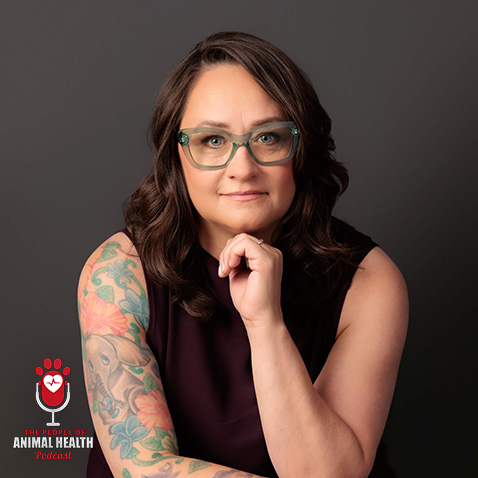
When Gigi Tsontos accepted the role of Chief Executive Officer of Not One More Vet in 2024, she stepped into an organization with a deeply meaningful mission and a growing influence throughout the Veterinary profession. While she did not come from a clinical Veterinary background, she brought something equally important to the role: more than two decades of experience in social work, mental health, nonprofit leadership, and organizational development. Those experiences, combined with a lifelong love of animals and an unwavering commitment to serving others, uniquely prepared her to help address one of the Veterinary profession’s most pressing challenges.
During her appearance on The People of Animal Health Podcast with host Stacy Pursell, Tsontos shared a journey shaped by family, community, global service, compassion, and resilience. Her story demonstrates that meaningful leadership often develops through experiences that initially appear unrelated. Every chapter of her career, from growing up in rural Kansas to serving in the Peace Corps and leading nonprofit organizations dedicated to helping vulnerable populations, contributed to the perspective she now brings to supporting Veterinary professionals across the world. Throughout the conversation, one message consistently emerged as the foundation of her work and the mission of Not One More Vet.
“You are not alone.”
That simple phrase has become far more than a slogan. It represents both a promise and a philosophy that guides every aspect of the organization’s efforts to improve mental health and wellbeing throughout the Veterinary profession.
Growing Up in Kansas With a Love for Animals
Tsontos describes her childhood with genuine warmth and gratitude. Born in Garden City, Kansas, she spent her earliest years surrounded by a close knit farming community where animals naturally became part of everyday life. Both of her grandparents operated farms, giving her regular opportunities to interact with livestock while also developing an appreciation for the veterinarians who cared for those animals. “My life was wonderful,” she recalled while reflecting on those early years.
Like many children who grow up in agricultural communities, animals were not simply pets. They were members of the family and an important part of daily life. At just two years old, she selected her own dog, named him herself, and enjoyed his companionship throughout much of her childhood. Those experiences created an enduring connection to animals, even though she never envisioned becoming a veterinarian herself.
Growing up in western Kansas also exposed her to the remarkable versatility of Veterinary medicine. She watched veterinarians care for both large and small animals, observing firsthand the important role they played throughout rural communities. While those experiences planted an appreciation for the profession, her own interests gradually developed in another direction.
Her family later relocated to Wichita, where she continued enjoying a supportive environment surrounded by siblings, extended family, and strong community connections. Looking back, Tsontos considers herself fortunate to have grown up in a place where relationships, service, and compassion were woven naturally into everyday life.
“I feel super privileged to have started here in Kansas,” she said. “And now I’m back, which is amazing because I never knew that I would come back.”
Discovering a Calling in Service
Although Veterinary medicine remained an important part of her childhood experiences, Tsontos ultimately discovered her professional calling in social work and mental health. Even as a young adult, she felt drawn toward careers centered on helping people navigate difficult circumstances while building healthier, stronger communities.
That desire eventually led her to pursue social work, a profession that perfectly aligned with her natural inclination toward service. Throughout the interview, she repeatedly emphasized that helping others has never simply been a career choice. It has been a personal philosophy guiding nearly every major decision she has made. “I’ve always been a very service oriented person,” she explained.
That commitment extended well beyond her professional responsibilities. Volunteering became a consistent part of her life, reinforcing the belief that meaningful service often occurs outside traditional employment. Whether supporting local organizations or participating in larger humanitarian efforts, she continually sought opportunities to make a positive difference.
One experience in particular profoundly shaped both her worldview and her leadership philosophy: The Peace Corps. Long before leading national nonprofit organizations, Tsontos fulfilled a lifelong dream by joining the Peace Corps and serving in Mali, West Africa. Although she entered the experience hoping to contribute to local communities, she quickly realized that the greatest lessons would come from listening rather than teaching. “I learned so much about humans in Peace Corps,” she reflected.
Living within a completely different culture challenged many assumptions while reinforcing an important truth that continues guiding her leadership today: “We’re all the same, but we’re all different.”
Those words capture the balance she observed while working across cultures. Every community possesses unique traditions, beliefs, and ways of approaching mental health, yet people everywhere share many of the same emotional needs. Regardless of language, geography, or culture, individuals seek belonging, connection, hope, and understanding during difficult moments.
That realization became one of the defining influences on her understanding of mental health. “I really do see myself as someone who experiences the world through other people’s vantage points,” she explained. “Mental health is one of those vantage points.”
Finding the Perfect Opportunity
Following her Peace Corps service, Tsontos continued building an accomplished career leading organizations focused on social services, behavioral health, and community wellbeing. Over more than twenty years, she developed expertise in nonprofit leadership, organizational strategy, public administration, leadership coaching, and clinical social work.
Despite those accomplishments, one personal passion remained separate from her professional life: animals. Throughout adulthood, she maintained a household filled with pets while continuing to volunteer and advocate for animal welfare whenever possible. At one point, she and her husband shared their home with six four legged companions. “I’ve always been doing something with animals of some kind,” she said.
Eventually she found herself wondering whether those two passions might someday intersect. “I’d love to figure out how to mesh my love for being a social worker with my love for animals,” she added.
That opportunity arrived unexpectedly. Late in 2023, an executive search announcement repeatedly appeared in her inbox. The position was Chief Executive Officer of Not One More Vet. Initially, she almost ignored it. “I better open this and look and see what it is,” she remembered thinking.
Within moments, she knew she had discovered something extraordinary: “I immediately fell in love with the mission.”
Supporting the mental health of Veterinary professionals represented the perfect intersection of everything she cared about most. Her expertise in behavioral health could directly benefit people dedicating their lives to caring for animals. The opportunity seemed almost too good to be true. During the interview process, she questioned whether she possessed enough Veterinary knowledge to deserve the position. “I remember the interview process and thinking, gosh, I’m probably not even qualified,” she said.
Yet she also recognized something equally important: “I don’t know that much about Veterinary medicine except that I love the people who do Veterinary medicine.”
That perspective ultimately became one of her greatest strengths because she approached the profession with curiosity, humility, and genuine admiration for the people serving it. When the telephone rang on a Sunday with the job offer, she assumed the timing meant bad news. “My husband’s like, ‘You got a call on a Sunday. You’re getting the job.'” He was right.
Looking back today, Tsontos describes accepting the position as one of the most fulfilling decisions of her career. “This is probably the job besides Peace Corps that I’ve loved the most in my life,” she said.
Understanding Why Veterinary Mental Health Matters
After joining Not One More Vet, Tsontos immersed herself in learning everything possible about the Veterinary profession. Although she already appreciated veterinarians as an animal owner, she soon developed a much deeper understanding of the emotional complexity accompanying their work.
She quickly realized that Veterinary medicine differs fundamentally from many other healthcare professions because clinicians routinely face decisions unlike those encountered in human medicine. Veterinarians dedicate years of education to preserving life, yet financial limitations, quality of life concerns, client wishes, and ethical considerations frequently require conversations surrounding euthanasia or alternative treatment options.
“The Veterinary industry is a unique industry,” she explained.
Those repeated experiences create what mental health professionals often describe as microtraumas. Individually they may appear manageable, but collectively they accumulate over months and years, contributing to compassion fatigue, emotional exhaustion, and burnout. At the same time, Veterinary professionals possess characteristics that often intensify those pressures. According to Tsontos, they are remarkably intelligent, deeply empathetic, scientifically curious, and highly driven individuals who consistently strive for excellence while carrying tremendous emotional responsibility.
“They love the work that they do,” she observed. “They love animals. They’re interested in science. They’re interested in medicine.”
Those qualities make them exceptional caregivers. They also make them vulnerable when support systems fail to keep pace with the emotional demands of the profession. Recognizing those realities reinforced her conviction that improving Veterinary mental health requires much more than encouraging individuals to become more resilient. It requires creating healthier systems, stronger workplace cultures, and organizations willing to prioritize wellbeing alongside clinical excellence.
For Tsontos, helping build those systems has become both a professional responsibility and a deeply personal mission.
Creating Systemic Change Across the Profession
As Gigi Tsontos settled into her role as Chief Executive Officer of Not One More Vet, she quickly recognized that improving mental health throughout the Veterinary profession required far more than offering support after someone reached a crisis point. Immediate assistance certainly remains essential, but lasting progress depends upon addressing the systems, workplace cultures, and organizational practices that contribute to emotional exhaustion long before individuals begin struggling.
That perspective reflects decades of experience leading behavioral health organizations, where she learned that meaningful change rarely comes from asking individuals to become tougher. Instead, organizations must examine the environments in which people work, the expectations placed upon them, and the resources available to help them thrive.
“I really think about systems,” Tsontos explained. “How do we create systems that help people be successful?” Rather than placing responsibility entirely upon individual veterinarians, she believes leaders throughout the profession must consider how scheduling, staffing, communication, leadership development, and workplace culture influence long term wellbeing.
This systems based perspective has shaped the evolution of Not One More Vet. While peer support, educational resources, and crisis assistance remain critically important, the organization also collaborates with Veterinary hospitals, industry organizations, educational institutions, and corporate leaders to encourage broader conversations about psychological safety, healthy workplaces, and sustainable careers. Tsontos believes those conversations represent one of the profession’s greatest opportunities because preventing burnout is ultimately more effective than responding after it has already taken hold.
She also emphasized that meaningful cultural change requires participation from every level of an organization. Practice owners, managers, technicians, veterinarians, customer service representatives, and industry executives all influence the daily experiences of Veterinary professionals. When everyone shares responsibility for creating healthier workplaces, lasting improvement becomes far more achievable than when mental health is viewed solely as an individual concern.
Witnessing the Power of Community
One of the aspects of Not One More Vet that has impressed Tsontos most deeply is the remarkable willingness of Veterinary professionals to support one another. Although the profession faces significant emotional challenges, she has also discovered an extraordinary culture of generosity, empathy, and shared purpose that continues inspiring her every day.
The organization’s peer support network provides a powerful example of that spirit. Veterinary professionals volunteer their time to help colleagues navigating grief, burnout, compassion fatigue, workplace challenges, and countless other personal or professional struggles. Those conversations often remind participants that they are not facing difficult circumstances in isolation, an understanding that can dramatically change someone’s outlook during particularly challenging periods.
“You are not alone,” Tsontos said repeatedly throughout the interview because those four words capture the very heart of Not One More Vet’s mission. Whether someone needs immediate emotional support, financial assistance, educational resources, or simply another Veterinary professional willing to listen without judgment, the organization strives to ensure that help remains available.
She also shared how meaningful it has been to witness the impact of the organization’s grant programs, which provide financial assistance to Veterinary professionals experiencing unexpected hardship. Those grants frequently arrive during moments when recipients feel overwhelmed by circumstances beyond their control, allowing them to focus on healing rather than worrying about immediate financial pressures.
For Tsontos, the grants represent much more than financial assistance. “They’re hope,” she explained.
Receiving support reminds people that someone cares, someone understands, and someone believes they deserve help during difficult moments. Although financial assistance may address an immediate need, the emotional message often carries even greater significance because it reinforces the profession’s commitment to caring for its own members.
Leading With Compassion and Authenticity
Throughout the conversation with Stacy Pursell, Tsontos consistently demonstrated a leadership philosophy grounded in authenticity rather than authority. She does not believe leaders must possess every answer before accepting responsibility. Instead, they must remain willing to learn, ask thoughtful questions, and create environments where talented people feel comfortable contributing their expertise.
That mindset proved especially valuable as she entered the Veterinary profession from outside clinical practice. Rather than pretending to understand every aspect of Veterinary medicine immediately, she approached the role with curiosity and humility while relying upon the knowledge of veterinarians, technicians, board members, volunteers, and staff members who had dedicated years to advancing the organization’s mission. “I ask a lot of questions,” she admitted with a smile.
Instead of viewing questions as signs of weakness, she considers them essential leadership tools because they communicate respect while encouraging collaboration. Every conversation becomes another opportunity to understand the profession more deeply, strengthen relationships, and make better decisions on behalf of the Veterinary community.
Her leadership style also reflects an important lesson learned throughout her years in social work. Every individual carries experiences that influence how they view the world, respond to stress, and interact with others. Effective leaders therefore take time to understand those experiences before making assumptions or rushing to judgment.
“I really try to see the world through someone else’s eyes,” she explained. That perspective allows her to approach difficult conversations with empathy while creating space for honest dialogue, an approach that has become increasingly important as Not One More Vet continues expanding its programs and influence throughout the Animal Health industry.
Looking Toward a Healthier Future
Although Tsontos acknowledges that significant work remains, she expresses genuine optimism about the future of Veterinary mental health because awareness continues growing throughout the profession. Conversations that once occurred only quietly between trusted colleagues now happen openly at conferences, within Veterinary hospitals, inside educational institutions, and across industry organizations committed to supporting clinician wellbeing.
She believes that cultural shift represents meaningful progress because lasting change begins when people feel comfortable discussing mental health without fear of judgment or professional consequences. As more organizations prioritize psychological wellbeing alongside clinical excellence and financial performance, healthier workplaces become increasingly attainable.
Technology, education, leadership development, and collaboration will all contribute to that future, but Tsontos believes the profession’s greatest strength already exists within its people. Veterinary professionals enter the field because they genuinely care about animals, science, medicine, and helping others. Those same qualities that sometimes contribute to emotional exhaustion also provide the foundation for building stronger, more compassionate organizations when supported appropriately.
She hopes future generations of Veterinary professionals will enter workplaces where seeking support feels as natural as seeking continuing education, where leaders openly discuss wellbeing alongside business performance, and where every member of the team understands that asking for help reflects wisdom rather than weakness.
A Mission Centered on Hope
As her conversation with Stacy Pursell concluded, Gigi Tsontos reflected on the remarkable journey that brought her from rural Kansas to international service in the Peace Corps, decades of nonprofit leadership, and ultimately to leading one of the Veterinary profession’s most influential mental health organizations. Looking back, every chapter of her career now appears connected by a common thread: service.
Whether helping communities in Mali, supporting families through behavioral health programs, leading nonprofit organizations, or advocating for Veterinary professionals, her greatest motivation has always been creating environments where people feel seen, supported, and empowered to succeed.
That commitment aligns perfectly with the mission of Not One More Vet. The organization certainly provides resources, education, grants, peer support, and crisis assistance, but its deeper purpose extends beyond any individual program. It seeks to remind every Veterinary professional that their wellbeing matters just as much as the wellbeing of the animals they care for each day.
“You are not alone,” Tsontos repeated because those words communicate hope during moments when hope can feel difficult to find.
Her appearance on The People of Animal Health Podcast offered listeners much more than the story of an accomplished nonprofit executive. It highlighted the growing recognition that caring for the people within Veterinary medicine is essential to the future of the profession itself. Through thoughtful leadership, genuine compassion, and an unwavering belief in the power of community, Gigi Tsontos continues helping create a future where Veterinary professionals receive the same care, understanding, and support they dedicate every day to the animals and families who depend upon them.
Listen to Gigi Tsontos’s episode on The People of Animal Health Podcast with Stacy Pursell!