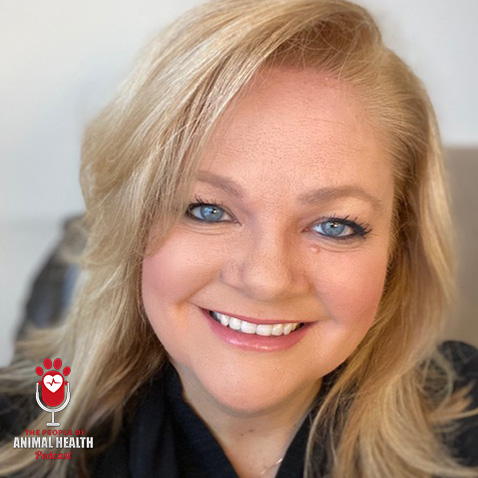
Few careers illustrate the extraordinary diversity of opportunities within the Veterinary profession better than that of Dr. Heather Case. Over the course of her professional life, she has practiced mixed animal medicine, pursued advanced training in preventive medicine, served on Capitol Hill as a congressional fellow, coordinated Veterinary disaster response following Hurricane Katrina, led national initiatives in organized Veterinary medicine, and, for more than a decade, served as Chief Executive Officer of the International Council for Veterinary Assessment. In that role, she oversees the North American Veterinary Licensing Examination, better known as the NAVLE, helping ensure that every newly licensed veterinarian entering practice across the United States and Canada meets rigorous standards for competency and public protection.
During her appearance on The People of Animal Health Podcast with host Stacy Pursell, Dr. Case reflected upon the experiences, mentors, and unexpected opportunities that shaped her career. Her story demonstrates that while many veterinarians begin their journey with a childhood dream of caring for animals, their professional path can evolve in ways they never imagined. Throughout the conversation, one theme emerged repeatedly. Remaining curious, embracing opportunities, and saying yes to experiences outside one’s comfort zone can open doors that simply could not have been predicted. Looking back over her remarkable career, Dr. Case acknowledged that almost every major turning point resulted not from careful long term planning, but from following genuine curiosity wherever it happened to lead.
A Childhood Dream Born on a Minnesota Farm
Dr. Case grew up in Eden Prairie, Minnesota, a suburb of Minneapolis, in a family that balanced suburban life with deep agricultural roots. Her mother worked as a nurse, her father was an executive in the trucking industry, and she was the youngest of three children. Although she did not grow up on a farm herself, both of her parents had been raised on dairy farms in western Minnesota, giving her frequent opportunities to spend time with her grandparents and immerse herself in rural life.
Those visits quickly became some of her favorite childhood experiences. “I felt like I wished I had grown up on a farm,” she recalled, explaining that she spent as much time there as possible whenever the opportunity arose. The dairy farms became places where she developed an appreciation not only for animals but also for the important role veterinarians played within agricultural communities.
Her calling to Veterinary medicine arrived at an astonishingly young age. While visiting her maternal grandparents, she discovered a kitten that had been injured. Holding the frightened animal in her arms, she turned to her grandmother with a simple question that would ultimately shape the rest of her life: “Who takes care of the kitties?”
Her grandmother explained that veterinarians cared for sick and injured animals, just as physicians cared for people. “At that moment,” Dr. Case remembered, “I knew I wanted to be a veterinarian and I never wavered.”
Unlike many childhood aspirations that gradually change over time, hers remained remarkably consistent. From that day forward, every educational decision moved her toward Veterinary medicine with unwavering determination. Looking back today, she considers herself one of those fortunate veterinarians who truly felt called to the profession from the very beginning. She also smiled while remembering another aspect of her childhood: “I was a horse crazy kid.”
Like many future equine veterinarians, horses became an enormous part of her life, and she was fortunate enough to own one while growing up. At that stage, she fully expected horses to remain the focus of her professional career forever.
Discovering That Veterinary Medicine Offers Endless Possibilities
After graduating from the University of Minnesota College of Veterinary Medicine, Dr. Case continued pursuing her lifelong passion by completing an equine focused internship in large animal medicine and surgery at the Ontario Veterinary College. Everything about her educational journey pointed toward becoming an equine practitioner, and she entered the next stage of her career expecting to spend decades caring almost exclusively for horses.
Life, however, had other plans. Following her internship, circumstances led her to accept a position within an eleven doctor mixed animal practice in rural Minnesota. Although she initially viewed the practice primarily as an opportunity to continue working with horses, she quickly discovered that the variety of mixed animal medicine offered rewards she had never anticipated. “I didn’t realize how much I would enjoy mixed animal practice,” she admitted.
Instead of treating only equine patients, her days soon included cattle, companion animals, fair animals, and virtually every species common to rural Veterinary practice. One appointment might involve a valuable horse, while the next focused on a dairy cow, a family dog, or even “the turkey for the fair,” as she laughingly described it during the interview.
That diversity broadened her clinical confidence while teaching her to think quickly across multiple species and medical situations. It also strengthened skills that would later prove especially valuable in disaster response, public health, and leadership positions where flexibility and rapid decision making became essential. Dr. Case also reflected upon another notable aspect of those early practice years. “I was the only woman in the practice of eleven doctors,” she said.
Although she mentioned the fact matter of factly rather than dramatically, it illustrates how significantly the Veterinary profession has evolved over the past several decades. At the time, female veterinarians remained far less common in many mixed animal practices, making her professional accomplishments all the more significant.
One Conference That Changed Everything
Like many young veterinarians, Dr. Case spent her first several years after graduation almost entirely focused on becoming the best clinician she could be. The demands of mixed animal practice left little time for organized Veterinary medicine despite her active involvement as a student.
Everything changed approximately six years into practice. One day she noticed an announcement from the Minnesota Veterinary Medical Association seeking a recent graduate to attend the AVMA Veterinary Leadership Conference in Chicago. Interested, she immediately telephoned the association office. Unfortunately, the position had already been filled. Rather than ending the conversation, however, the executive director paused before offering an unexpected response. “I really like your initiative,” she told Dr. Case. “Let me see if I can do something.”
Shortly afterward, she called back with remarkable news. A second opportunity had been created specifically because she admired Dr. Case’s initiative. That simple act of encouragement became one of the defining moments of her career. “It really shaped me,” Dr. Case reflected, remembering not only the opportunity itself but also the importance of someone recognizing potential she had not yet fully seen in herself.
Attending the AVMA Leadership Conference exposed her to an entirely different side of Veterinary medicine. Instead of focusing exclusively on clinical practice, she suddenly found herself surrounded by leaders from every corner of the profession, including specialty organizations, Veterinary colleges, regulatory bodies, state associations, and national organizations. For a mixed animal practitioner from rural Minnesota, the experience felt transformational. “It was life changing,” she said.
During that conference she met Dr. Daniel Lafontaine, a nationally respected food safety veterinarian who immediately challenged her assumptions about her future. “Young lady,” he asked, “have you ever thought about a career in public health?” Her answer was immediate: no. At least, not really. She admitted she barely understood what Veterinary public health actually involved because her education had largely centered on clinical medicine. That conversation planted the first seed.
Later during the same trip another unexpected conversation expanded her perspective even further. While riding to the airport, another attendee casually mentioned that the University of Minnesota had recently established a new preventive medicine residency focused on public health. “I didn’t know about it,” she admitted.
But curiosity had been awakened. Instead of dismissing the suggestion, she investigated the opportunity after returning home. That decision would completely reshape the direction of her professional life.
Following Curiosity into Public Health
Dr. Case ultimately became a member of only the second class within the University of Minnesota’s preventive medicine residency through the Center for Animal Health and Food Safety. Entering the program dramatically expanded her understanding of what veterinarians contribute beyond traditional clinical practice. “I really started to see that there was more to this world of public health than I could ever have imagined,” she explained.
The residency introduced her to food safety, science policy, disease prevention, emergency preparedness, and numerous interdisciplinary collaborations linking Veterinary medicine with human health. Those experiences reinforced something she continues emphasizing today. Veterinarians possess remarkably broad expertise that extends well beyond treating animals.
The residency also created another opportunity that initially appeared unrelated to her long term career. She volunteered for the Veterinary Medical Assistance Teams, newly organized disaster response units supported by the American Veterinary Medical Association. Having transitioned from busy mixed animal practice into residency training, she finally possessed enough scheduling flexibility to participate in disaster response training.
The timing proved extraordinary. While attending one of the team’s earliest training sessions during late August of 2005, Hurricane Katrina made landfall. Almost immediately, training became deployment.
Instead of simply learning how disaster response worked, Dr. Case suddenly found herself participating in one of the largest disaster relief efforts in American history. Although she could not have known it at the time, that deployment would reveal leadership qualities that others recognized before she recognized them herself while permanently changing the trajectory of her career.
Hurricane Katrina Revealed a New Direction
When Hurricane Katrina struck the Gulf Coast in August 2005, Dr. Heather Case was still early in her preventive medicine residency and had only recently become involved with the Veterinary Medical Assistance Teams. What began as a routine training opportunity quickly transformed into one of the defining experiences of her professional life. Instead of simply learning disaster response principles in a classroom, she suddenly found herself participating in one of the largest emergency response efforts in United States history, working alongside professionals from multiple disciplines under extraordinarily difficult conditions.
Looking back, Dr. Case described Hurricane Katrina as a pivotal moment because it demonstrated how broadly veterinarians can contribute during public emergencies. While many people naturally associate veterinarians with companion animal care, disasters require expertise in animal evacuation, disease prevention, food safety, shelter management, public health, and coordination among numerous governmental and nonprofit organizations. Those responsibilities demand clinical knowledge, but they also require communication, organization, adaptability, and leadership under pressure.
“It really opened my eyes,” Dr. Case explained, reflecting on how disaster response expanded her understanding of the Veterinary profession’s role within society. The experience also revealed abilities she had not fully recognized in herself. Working under rapidly changing circumstances required quick decision making, collaboration with unfamiliar teams, and the confidence to lead despite tremendous uncertainty. Those lessons would continue influencing every stage of her career long after the immediate disaster response had concluded.
The deployment also reinforced another important realization. Veterinary medicine extends far beyond individual patients because veterinarians contribute directly to protecting communities, strengthening public health systems, and safeguarding the relationship between people and animals during moments when both are especially vulnerable.
Discovering a Passion for Public Policy
As Dr. Case completed her residency, another unexpected opportunity emerged that once again shifted the direction of her career. She became an American Association for the Advancement of Science Congressional Science Fellow, an experience that placed her on Capitol Hill where she worked directly with legislators and policymakers while applying scientific expertise to national policy discussions.
For many veterinarians, Washington, D.C., feels worlds away from daily clinical practice. Dr. Case initially felt much the same way. However, she quickly discovered that legislators desperately needed professionals capable of translating complex scientific issues into practical information supporting informed public policy decisions. “It was fascinating,” she recalled. “I learned how policy gets made.”
The fellowship demonstrated that veterinarians possess perspectives uniquely suited to many legislative issues because their education spans medicine, epidemiology, food safety, agriculture, environmental health, toxicology, and public health. Those interdisciplinary experiences allow veterinarians to approach policy questions from angles few other healthcare professionals can provide.
Working within Congress also strengthened her appreciation for collaboration. Effective public policy rarely develops through individual effort alone. Instead, meaningful progress depends upon listening carefully, understanding different perspectives, building consensus, and communicating scientific information in ways that policymakers without technical backgrounds can understand clearly.
Those communication skills, first developed during years in mixed animal practice and strengthened throughout disaster response, once again proved essential. Regardless of whether the audience consisted of pet owners, legislators, or fellow professionals, Dr. Case recognized that expertise carries its greatest value only when people understand and trust the information being presented.
Leading the International Council for Veterinary Assessment
After serving in several leadership positions within organized Veterinary medicine, including important roles at the American Veterinary Medical Association, Dr. Case accepted what would become one of the most influential positions of her career when she became Chief Executive Officer of the International Council for Veterinary Assessment.
The organization occupies a critically important role within the profession because it develops and administers the North American Veterinary Licensing Examination, ensuring that newly licensed veterinarians demonstrate the knowledge and clinical reasoning necessary to enter independent practice safely.
Although many veterinarians remember the NAVLE primarily as one of the most stressful examinations of their careers, Dr. Case hopes they also recognize the broader purpose it serves.
“Our mission is really about protecting the public,” she explained. “We want to make sure that every veterinarian entering practice has demonstrated competency.” That responsibility carries enormous significance because Veterinary professionals care not only for companion animals but also for food producing species, public health, wildlife, research animals, and countless other areas directly affecting society.
During her tenure, the International Council for Veterinary Assessment implemented several important changes designed to improve both the examination process and the overall candidate experience. Expanding testing windows created greater flexibility for students balancing demanding academic schedules, while additional transparency surrounding examination development helped strengthen confidence throughout the profession.
Dr. Case also discussed the organization’s decision to commission an independent audit of the examination process, emphasizing that maintaining public trust requires organizations to evaluate themselves honestly and continually seek opportunities for improvement. “We welcomed the independent review,” she said because transparency ultimately strengthens both the organization and the profession it serves.
Leadership Built on Curiosity and Service
Throughout her conversation with Stacy Pursell, Dr. Case consistently returned to several leadership principles that have guided her remarkable career. Perhaps most important among them is remaining open to opportunities that initially seem unrelated to carefully constructed career plans.
Looking back across decades of professional accomplishments, she readily acknowledged that many of her most meaningful experiences resulted from simply saying yes when unexpected opportunities appeared. Had she declined the AVMA Leadership Conference invitation, she might never have discovered preventive medicine. Without that residency, Hurricane Katrina, public policy, organized Veterinary medicine, and the International Council for Veterinary Assessment may never have entered her professional life.
“I’ve always tried to stay open to opportunities,” she reflected.
She also emphasized the importance of mentors throughout her journey. Individuals such as Dr. Daniel Lafontaine recognized potential that she had not yet fully identified herself, encouraging her to explore new directions while providing guidance during pivotal moments. Those relationships reinforced her own commitment to mentoring younger veterinarians whenever possible because today’s encouragement may shape tomorrow’s leaders.
Another consistent theme involved lifelong learning. Dr. Case never viewed graduation as the conclusion of her education. Instead, every career transition required mastering unfamiliar subjects while remaining humble enough to ask questions and learn from experts in entirely different disciplines.
That willingness to remain a student has allowed her to navigate careers in clinical practice, preventive medicine, disaster response, public policy, association leadership, and professional regulation with equal enthusiasm.
Looking Toward the Future of Veterinary Medicine
Although the Veterinary profession continues evolving rapidly, Dr. Case remains optimistic about its future because she believes veterinarians possess broader opportunities than ever before. Traditional clinical practice will always remain essential, but emerging fields including public health, One Health, regulatory medicine, policy, research, technology, education, and organizational leadership continue expanding the profession’s influence throughout society.
She hopes young veterinarians recognize those possibilities while remaining flexible enough to embrace unexpected opportunities throughout their careers.
“Don’t be afraid to say yes,” she advised, because careers often develop in ways impossible to predict during Veterinary school. Remaining curious, building meaningful relationships, seeking mentors, and continually expanding one’s perspective frequently leads to opportunities that never appear on an original career plan.
Her own professional journey illustrates that lesson perfectly. What began with an injured kitten on her grandparents’ dairy farm eventually expanded into leadership roles affecting thousands of Veterinary professionals across North America. Every chapter built naturally upon the previous one, even when the connection became clear only years later.
A Career Defined By Purpose
As Dr. Heather Case concluded her conversation on The People of Animal Health Podcast, listeners were reminded that the Veterinary profession offers far more possibilities than many students initially imagine. Her career has encompassed clinical medicine, mixed animal practice, preventive medicine, disaster preparedness, congressional policy, organized Veterinary medicine, and national leadership, yet every position has remained connected by a common purpose: strengthening the profession while protecting both animal and public health.
What makes her journey especially compelling is that none of those accomplishments resulted from pursuing prestigious titles or carefully orchestrated career milestones. Instead, they emerged because she remained curious enough to explore unfamiliar opportunities, courageous enough to leave comfortable roles behind, and committed enough to serve wherever her knowledge could create the greatest impact.
“I never could have planned this career,” she admitted, a reflection that perfectly captures the remarkable path she has traveled.
Dr. Case’s appearance on The People of Animal Health Podcast offered much more than the story of an accomplished Veterinary leader. It demonstrated that meaningful careers often unfold through unexpected conversations, supportive mentors, challenging experiences, and a willingness to continue learning long after formal education ends. Her example encourages every Veterinary professional to remain open to new possibilities because the next opportunity may lead somewhere far beyond anything they originally imagined.
Listen to Dr. Heather Case’s episode on The People of Animal Health Podcast with Stacy Pursell!