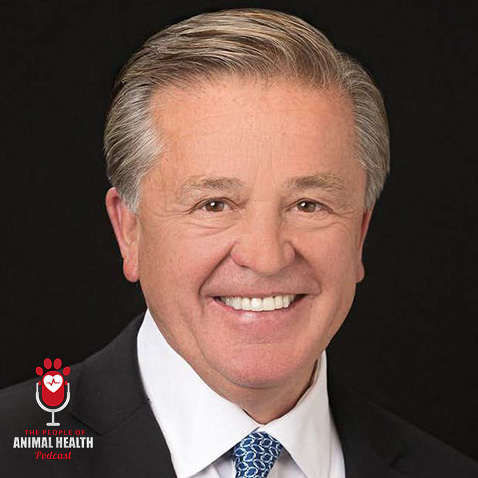
Few leaders have influenced the Animal Health industry across as many dimensions as Dennis Steadman. During a career spanning more than 35 years, he has helped build global corporations, co founded one of the industry’s most significant mergers, launched successful startup companies, guided innovative technologies to market, mentored future executives, and demonstrated that sound business principles remain remarkably consistent regardless of a company’s size. Whether leading Merck AgVet’s international operations, helping create Merial, or building Velcera into a company ultimately acquired for $160 million, Steadman has repeatedly proven that lasting success comes from creating value for customers while remaining grounded in integrity, hard work, and long term thinking.
During his appearance on The People of Animal Health Podcast with host Stacy Pursell, Steadman reflected upon the experiences that shaped his career from a dairy farm in western Pennsylvania to the executive offices of some of the Animal Health industry’s most influential organizations. Throughout the conversation, he shared stories filled with humor, practical wisdom, and hard earned lessons about leadership, entrepreneurship, economics, and perseverance. Although his accomplishments span multinational corporations and successful startups alike, one theme emerged consistently. Great careers are built by people who solve meaningful problems, treat others well, and remain focused on creating value before expecting rewards in return.
From a Dairy Farm to Big Dreams
Dennis Steadman’s story begins on a small family dairy farm in western Pennsylvania, where hard work was not merely encouraged but absolutely essential. The farm would likely be considered too small to survive economically by modern standards, yet it provided something far more valuable than financial wealth. It taught discipline, responsibility, and perseverance through the daily realities of agricultural life. “I grew up on a small family dairy farm in western Pennsylvania,” he recalled.
With five boys supplying the labor, the family maintained a demanding schedule centered around milking cows every twelve hours, every day of the year. There were no weekends, no holidays, and no opportunities to postpone responsibilities because livestock required constant attention regardless of weather, illness, or personal plans. “We learned to work hard milking cows every twelve hours, 365 days a year,” he said.
Those experiences shaped Steadman’s outlook long before he entered the business world. Farm life taught him that success rarely results from shortcuts or convenience. Instead, it develops through consistency, reliability, and doing necessary work even when conditions become uncomfortable.
One particularly memorable moment arrived when he was about twelve or thirteen years old. While pitching manure inside the barn, an unhappy cow suddenly swatted him across the face with its tail. Covered with manure and thoroughly frustrated, the young farm boy climbed out of the trench, wiping his face while making a declaration that would ultimately define his future. “I don’t know what I’m going to do when I grow up,” he remembered thinking, “but I’m going to wear a suit.”
Although humorous in hindsight, the experience marked an important turning point. Rather than spending his entire career performing physically demanding farm labor, Steadman began imagining a future where he could remain connected to agriculture while contributing through business leadership instead. That realization eventually led him to Penn State University, where he majored in business before discovering a particular passion for economics. “I loved economics,” he explained.
Combining business education with agriculture proved to be an ideal fit. He ultimately completed both undergraduate and graduate studies in agricultural economics, equipping himself with analytical tools that would influence every major decision throughout his professional life. Looking back today, he still credits those academic years with teaching him to evaluate opportunities through an economic lens while never forgetting the practical lessons first learned on the family farm.
Building a Career Through Economics
After completing graduate school, Steadman accepted a position with Chase Econometrics, a division of Chase Manhattan Bank specializing in economic forecasting and business consulting. The role introduced him to an extraordinary variety of industries while allowing him to apply agricultural economics in practical business settings. “I was a senior agricultural economist,” he explained.
His clients represented virtually every segment of agribusiness, including farm equipment manufacturers, seed companies, crop protection organizations, construction businesses, and Animal Health companies. Rather than becoming narrowly specialized early in his career, Steadman developed a broad understanding of how agricultural markets functioned while helping executives make informed strategic decisions.
Each consulting project required gathering data, identifying patterns, forecasting future conditions, and translating complicated economic information into practical recommendations that business leaders could actually use.
One assignment proved especially significant: Merck AgVet. During the mid 1980s, Chase Econometrics completed a consulting engagement for the Animal Health division of Merck. Shortly afterward, Steadman received an unexpected telephone call. “I was recruited into Merck,” he said.
The transition marked his first true immersion into the Animal Health industry and permanently altered the direction of his career. What began as an economic consulting assignment soon evolved into a lifelong commitment to Animal Health. Steadman joined Merck as Director of Economic and Marketing Research, bringing analytical thinking to an organization increasingly focused on strategic growth. Even during those early interviews, however, his confidence and ambition stood out. “I remember interviewing with the president of the division,” he recalled.
When asked where he hoped to be five years later, his response surprised everyone in the room: “‘I’d like your job.'”
Looking back, Steadman laughs at what he now describes as youthful naivete, yet the answer also reflected genuine confidence rather than arrogance: “I always felt like I had something to contribute.”
That mindset had developed long before joining Merck. Growing up on the farm taught him to believe that hard work, integrity, and treating people well generally produced positive results. Throughout his career, those simple principles continued guiding his leadership regardless of organizational size or title. “I was confident, not cocky,” said Steadman.
Rather than worrying excessively about career advancement itself, he concentrated on solving problems, creating value, and helping organizations succeed. Promotions followed naturally because people consistently trusted him with increasing responsibility.
Leading Around the World
Steadman’s responsibilities within Merck expanded steadily as he demonstrated both strategic insight and leadership ability. Eventually, he accepted international assignments overseeing business operations throughout Australasia, Japan, Hong Kong, China, and surrounding markets, exposing him to vastly different cultures, customer needs, regulatory environments, and commercial strategies.
Those experiences broadened his understanding of Animal Health far beyond North America while reinforcing another important lesson: fundamental business principles remain remarkably consistent. Although countries differ culturally, economically, and politically, organizations still succeed by creating value for customers while building trust with employees and stakeholders. Following his international assignments, Steadman returned to the United States to lead Merck AgVet’s domestic business during one of the industry’s most transformative periods. His timing proved extraordinary.
In 1997, Merck and Rhone Merieux combined their Animal Health businesses to create Merial, establishing what became the largest Animal Health company in the world. Steadman played a central role throughout the process. “We created Merial,” he said.
Although corporate mergers often require years before achieving operational stability, Steadman and a remarkably small leadership team accomplished something many industry observers considered nearly impossible. “By January first of 1998, in only five months, we had a fully integrated operating organization in the United States,” he said.
- Payroll
- Sales compensation
- Marketing
- Customer service
- Product portfolios
- Staffing
Every essential business function had been successfully integrated despite combining two major organizations with different cultures, systems, and operating procedures. “It was exhausting,” Steadman admitted.
It was also immensely rewarding because the successful integration established a strong foundation for one of the most influential companies in Animal Health history. Still, despite the satisfaction of helping create Merial, another challenge continued calling to him: entrepreneurship. Building global corporations had taught him how large organizations succeed. Now he wanted to discover whether he could build something entirely his own.
Betting on Entrepreneurship
Although Dennis Steadman had already achieved what many professionals would consider the pinnacle of an Animal Health career through his leadership at Merck AgVet and his role in creating Merial, he remained energized by an entirely different challenge; building companies from scratch.
In 2001, after helping establish one of the world’s largest Animal Health organizations, Steadman stepped away from corporate leadership and entered the unpredictable world of entrepreneurship. Unlike large multinational companies with established infrastructure and dependable cash flow, startup businesses require founders to embrace uncertainty almost every day. Success depends upon vision, resilience, and an unwavering belief that today’s obstacles can eventually become tomorrow’s opportunities. “I started out on my own doing entrepreneurial things in 2001,” he explained.
Among those ventures, none would prove more significant than Velcera, a company launched with venture capital and ambitious plans to introduce innovative companion animal products into an increasingly competitive marketplace. Like virtually every startup, however, the early years brought challenges that few outsiders ever witnessed. “There were more than one occasions when we were running out of cash,” Steadman recalled.
Those moments tested not only financial discipline but also emotional resilience. Investors expected results, employees depended upon leadership, and promising technologies still required additional development before generating meaningful revenue. More than once, the company appeared to stand on the edge of failure. Many entrepreneurs experience similar moments when the future seems frighteningly uncertain. Steadman refused to surrender. “Just perseverance and never saying die,” said Steadman
Again and again, the company recovered. Financing arrived, products advanced, customers responded, and momentum gradually returned. Looking back, Steadman now appreciates those difficult periods almost as much as the successful ones because they reinforced lessons impossible to learn during easier times. Ultimately, Velcera achieved precisely the outcome every entrepreneur hopes for. In 2013, Perrigo acquired the company for $160 million in cash, rewarding employees, founders, and investors whose persistence carried the organization through years of uncertainty. “We sold the company for $160 million in cash,” said Steadman.
For Steadman, however, the financial outcome represented only part of the accomplishment. Creating something entirely new, overcoming repeated adversity, and watching an idea mature into a successful business provided a satisfaction unlike anything he had experienced inside larger corporations.
“There really isn’t anything that beats being an entrepreneur,” said Steadman.
Creating Value Through Simple Principles
Throughout his conversation with Stacy Pursell, Steadman repeatedly returned to a remarkably straightforward philosophy that has guided every stage of his career. Create value first. Everything else follows. Unlike leaders who sometimes complicate business decisions unnecessarily, Steadman believes economics often provides surprisingly clear guidance. Organizations exist to create value for customers. When they accomplish that objective successfully, financial success naturally follows.
“If you add value to a marketplace, you’re going to extract value back,” said Steadman.
Although simple, that principle has shaped every company he has helped build. The challenge, he believes, is that organizations sometimes overcomplicate issues whose solutions are actually quite obvious. “I’m surprised sometimes how complicated companies or individuals can make pretty simple, fundamental issues,” he said.
Rather than becoming distracted by internal politics, unnecessary analysis, or organizational complexity, Steadman encourages leaders to identify the essential objective before deciding upon the most rational path forward: “The right thing to do is usually pretty apparent.”
Making those decisions may still require courage, they may involve risk, and they may encounter resistance. Yet clarity often emerges once leaders focus upon the underlying economics rather than organizational distractions. That perspective also explains why Steadman has consistently succeeded in organizations of dramatically different sizes. Whether working inside Merck, helping create Merial, leading startups, or serving as an investor, the same principle remained true.
Deliver genuine value, customers respond, and businesses prosper.
Watching Animal Health Transform
Having spent more than three decades inside the Animal Health industry, Steadman has witnessed extraordinary changes across virtually every segment of the profession. Some developments fundamentally reshaped business models, while others reflected broader societal changes influencing Veterinary medicine itself. When he first joined Merck AgVet, companion animal represented only a small portion of the company’s overall business. “Our business was ninety percent livestock and ten percent companion animal,” said Steadman.
By the time he departed Merial, however, the situation had changed dramatically. “My North American business was exactly two thirds companion animal,” he said.
Importantly, livestock had not declined. Instead, companion animal experienced extraordinary expansion driven by increasing pet ownership, advancing medical technology, and society’s growing willingness to invest in animal healthcare. Steadman remains equally optimistic about livestock, although he acknowledges that food animal production faces more complicated economic, regulatory, and societal pressures.
Another remarkable transformation involved company size. When Merial launched in 1997, becoming the first Animal Health company exceeding one billion dollars in annual revenue represented a historic milestone. Today, organizations of that scale no longer dominate the industry. Distribution models evolved as well. Steadman proudly recalled introducing the sales agency concept during Merial’s earliest years, an innovation that initially generated concern but ultimately strengthened distribution throughout Animal Health.
Perhaps the most encouraging transformation, however, involves leadership diversity. “The role of women in our industry has really changed,” said Steadman.
During the early years of his career, women occupied relatively few senior positions. Today, their leadership has become increasingly visible throughout Animal Health.For Steadman, stronger organizations emerge when different perspectives contribute to better decisions.
Continuing to Build the Future
Although officially retired for several years, Dennis Steadman quickly discovered that retirement simply did not suit his personality. “I’m supposed to be retired,” he laughed, “but I’m really not good at that.”
Rather than withdrawing from business entirely, he redirected his experience toward mentoring entrepreneurs while investing in companies developing innovative Animal Health technologies. Among those organizations, Exubrion Therapeutics occupies a particularly meaningful place. “We have a radioisotope that is an effective long term treatment for canine osteoarthritis,” said Steadman.
The technology represents one of Veterinary medicine’s most promising advancements in pain management by delivering therapeutic benefits directly within affected joints while minimizing systemic exposure. Steadman also serves as chairman and cofounder of the company.
Another venture, Fidelis Pharmaceuticals, focuses upon improving pain management for laboratory rodents, an area frequently overlooked despite its importance to biomedical research.Most recently, he helped establish 3D Therapeutics, a Human Health company pursuing innovative drug and medical device combinations addressing rare pediatric diseases. Although the company operates outside Animal Health, its mission reflects Steadman’s lifelong interest in applying entrepreneurship to meaningful healthcare challenges.
Rather than slowing down, retirement has simply given him greater flexibility to pursue projects aligned closely with his interests while supporting the next generation of innovators.
Leadership Through Perspective
As the interview shifted toward leadership, Steadman revealed habits and philosophies that have quietly guided him throughout his remarkable career. One begins every morning. “I’m an old farm boy, so I get up about five o’clock,” he said. Early mornings provide uninterrupted thinking time before meetings, telephone calls, and daily responsibilities compete for attention.
Another principle influences virtually every interaction. “I like to leave everything I find just a little better than I found it,” said Steadman.
Sometimes that means solving a business problem, and sometimes it means encouraging a colleague. Occasionally, he admitted with a smile, it even means rearranging a floral centerpiece that simply does not look balanced. The underlying motivation remains consistent: improve situations whenever possible.
His mentors reinforced similar philosophies throughout his career. Dr. Raymond Daniel taught him that presentations should always tell stories rather than merely communicate information. Anthony Viscusi demonstrated the importance of thinking strategically while maintaining a long horizon. Dr. John Preston, whom Steadman deeply admires, combined remarkable commercial success with exceptional leadership. Those examples shaped Steadman’s own approach to management, particularly his determination to resist organizational politics whenever possible.
Rather than making decisions benefiting individual careers, Steadman consistently argued that organizations should focus upon what best serves the business itself.
“If we take care of the business, it’ll take care of us,” he said.
Success Begins With Gratitude
Near the conclusion of his conversation with Stacy Pursell, Dennis Steadman shared the message he most wanted listeners to remember, and remarkably, it had very little to do with economics, entrepreneurship, or corporate leadership: perspective. Throughout his career, he frequently reminded employees that while everyone worked extraordinarily hard building successful Animal Health businesses, work itself should never become life’s ultimate priority. “When we say our prayers at night, we’re not praying about work,” said Steadman.
Instead, gratitude belongs elsewhere:
- Family
- Friends
- Health
- Relationships
Those are the blessings deserving the greatest attention. That perspective has helped countless employees navigate stressful periods while reminding them that professional success carries its greatest meaning when balanced by fulfilling personal lives. Steadman also believes kindness requires remarkably little effort.
“It doesn’t cost anything to smile,” he said.
Whether greeting strangers during a morning walk, acknowledging colleagues in the hallway, or simply waving to someone passing by, those small gestures quietly strengthen communities and relationships.
Looking back across an extraordinary career spanning dairy farms, multinational corporations, startup companies, and groundbreaking innovations, Dennis Steadman’s greatest legacy may not be measured solely through companies founded or products commercialized. Instead, it lies in demonstrating that genuine leadership begins with creating value, treating people with respect, thinking beyond immediate circumstances, and never forgetting that while careers matter greatly, they should always remain secondary to the people we love and the lives we are privileged to share.
Listen to Dennis Steadman’s episode on The People of Animal Health Podcast with Stacy Pursell!