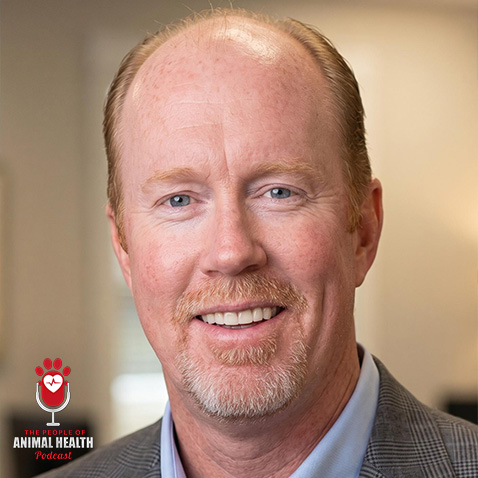
For Wesley Godwin, the Animal Health industry has never simply been a career. It has been the environment in which he grew up, the community that shaped his values, and ultimately the foundation upon which he has built a remarkable career spanning pharmaceutical sales, Veterinary practice management, private equity, mergers and acquisitions, biotechnology, and entrepreneurial innovation. Over more than two decades, he has helped build some of the industry’s fastest growing Veterinary organizations, founded one of the nation’s only biosecure animal blood banks, and continued searching for opportunities to solve complex problems that improve both animal care and the Veterinary profession.
During his appearance on The People of Animal Health Podcast with host Stacy Pursell, Godwin shared a career defined not by following conventional paths but by recognizing opportunities others often overlooked. From growing up sweeping floors in his father’s Veterinary hospital to helping scale Valley Veterinary Care into a multi state organization, his story illustrates that leadership begins long before anyone receives an executive title. It develops through hard work, humility, perseverance, and an unwavering commitment to relationships. Throughout the conversation, one theme surfaced repeatedly. Businesses succeed because of people, and every lasting accomplishment begins with investing in the individuals who make an organization stronger.
Learning the Business From the Ground Up
Unlike many executives who first discover the Animal Health industry after college, Godwin quite literally grew up inside it. His father, Dr. Tom Godwin, helped pioneer Veterinary emergency medicine by cofounding one of the first emergency animal hospitals in the United States and the first in Texas. As a result, Wesley’s childhood revolved around Veterinary hospitals, ranch work, cattle operations, and the constant activity that accompanies caring for animals around the clock.
“I grew up in the Veterinary business,” he explained. “My dad was a veterinarian and one of the founders of the first emergency hospital in Texas, potentially the first in the US.”
For many children, spending afternoons inside a Veterinary hospital might have seemed unusual. For Godwin, it simply represented everyday life. He watched emergency medicine develop during its earliest years while observing the dedication required to build entirely new models of Veterinary care. Those experiences exposed him to entrepreneurship long before he understood the word itself because his father continually pursued innovative ways to improve patient care while expanding opportunities within the profession.
The family’s life extended well beyond the hospital walls. They also operated cattle, farmed, and remained closely connected to agriculture, giving him an appreciation for the broader Animal Health industry rather than limiting his perspective solely to companion animal medicine. “We also ran cattle, farmed a little bit and did quite a few other things,” he recalled.
Looking back today, Godwin recognizes that this unusually broad upbringing gave him an understanding of Animal Health few people develop so early in life. Whether working with livestock, observing emergency medicine, or simply watching entrepreneurs build businesses from the ground up, every experience contributed to the leadership philosophy he would eventually carry throughout his own career.
Hard Work Became the First Leadership Lesson
Although growing up around Veterinary medicine offered countless opportunities to learn, Godwin did not begin by assisting with glamorous clinical procedures or shadowing veterinarians during complicated surgeries. Like countless children working in family businesses, he started with whatever jobs nobody else wanted.
His responsibilities included cleaning kennels, collecting trash throughout the property, washing chain link fencing, and completing countless janitorial tasks before moving on to more advanced responsibilities. “My job when I showed up at the hospital was to go out with a trash bag in the front parking lot and pick up trash and then go clean out the kennels,” he remembered.
Those assignments might have seemed insignificant at the time, yet they ultimately became some of the most valuable leadership lessons he ever received. “It was really healthy,” he reflected. “It was really good for me.”
Rather than creating entitlement because he happened to be the veterinarian’s son, his father expected him to earn every opportunity through hard work. If unpleasant jobs needed completing, he completed them. If someone had to spend hours washing kennels with a hose and spray nozzle, that responsibility frequently belonged to him. Through those experiences, he learned something that continues shaping his leadership style decades later. “It doesn’t really matter who does what,” he said. “Regardless, the job has to get done.”
That philosophy has remained remarkably consistent throughout every stage of his career. Whether leading organizations employing hundreds of people or launching entirely new companies, Godwin believes effective leaders never consider themselves above necessary work. Every role contributes to organizational success, and every employee deserves respect because each responsibility matters.
At the same time, he remembers those early Veterinary hospitals as places filled with humor despite the emotional demands of clinical medicine. “There was always somebody having a good time or joking in the hospital,” he said.
Veterinary professionals routinely encounter difficult situations, making camaraderie especially important. Those experiences introduced him not only to the realities of Animal Health but also to the strong sense of community that continues distinguishing the profession today. “It was always a sense of family and community,” he said.
That atmosphere ultimately became one of the primary reasons he later returned to the industry after briefly pursuing another career path.
Leaving Animal Health Before Coming Home
After graduating from Texas A&M University, Godwin surprised many people by intentionally leaving the Animal Health industry altogether. Having spent virtually his entire childhood surrounded by Veterinary medicine, he wanted to experience something different while exploring other professional opportunities. “When I first got out of Texas A&M, I stayed out of the Animal Health sector,” he explained. “I thought I’d had enough of that early on.”
For approximately five years, he worked in several unrelated industries, including the legal field. Those positions broadened his professional perspective while allowing him to experience organizational structures very different from Veterinary medicine. Although the work proved educational, something gradually became increasingly clear. He missed home. More specifically, he missed the sense of purpose and community that had surrounded him throughout his childhood.
“I realized at some point that I needed to come back home,” he recalled. “I missed the business as well as the sense of community that Animal Health had provided.”
The opportunity arrived around 2000 when Novartis Animal Health offered him a position. Joining the global pharmaceutical company allowed him to reenter the industry from an entirely different perspective. Instead of working inside Veterinary hospitals, he suddenly found himself representing one of the world’s largest Animal Health organizations while collaborating with veterinarians throughout the country.
Looking back, he considers that transition one of the most important decisions of his professional life because it combined the values he had learned growing up with entirely new experiences inside a global corporation.
Blending Corporate Experience With Entrepreneurial Thinking
Working for Novartis Animal Health exposed Godwin to a scale of business operations far beyond anything he had previously experienced. Traveling extensively while collaborating with colleagues throughout the United States and internationally allowed him to observe how large corporations develop products, build commercial strategies, and support Veterinary professionals across diverse markets.
“I’ve had quite a bit of a breadth of experience working for Novartis Animal Health,” he explained.
The position broadened his understanding of leadership, strategic planning, and organizational structure while introducing him to talented professionals from countless disciplines. Yet despite appreciating those opportunities, he gradually realized his own personality aligned more naturally with entrepreneurship than with large corporate environments. “What matters in a large global corporation is not necessarily what matters in a small practice or a small business,” he observed.
Large organizations often require lengthy planning cycles, multiple levels of approval, and gradual implementation. Godwin respected those processes but discovered they differed significantly from his preferred leadership style. “My personality is such that when we settle on a course of action, we like to get things done and move that forward,” he said.
Rather than waiting months for decisions to work their way through organizational structures, he preferred building businesses capable of moving quickly, adapting rapidly, and responding immediately to opportunities. “I fit the mold better of a bootstrapper,” he said.
That realization became one of the defining turning points of his career. Corporate experience provided valuable knowledge, but entrepreneurship offered the environment where he believed he could create the greatest long term impact.
Building a Foundation for Entrepreneurship
Looking back over the earliest chapters of his professional journey, Godwin sees a series of experiences that prepared him remarkably well for entrepreneurship, even though he did not recognize it at the time. Cleaning kennels taught humility. Ranching taught perseverance. Growing up around Veterinary hospitals demonstrated the importance of relationships. Working for Novartis provided global business experience. Each chapter contributed something essential before he eventually began building companies of his own.
Growing up on a ranch reinforced another lesson that continues influencing his decisions today. “There are certain things that are out of your control,” he explained.
Weather, markets, economic conditions, and unexpected setbacks affect every business regardless of preparation. Rather than becoming discouraged when challenges emerge, he learned to continue moving forward because perseverance ultimately separates successful organizations from unsuccessful ones. That perspective has proven especially valuable throughout an entrepreneurial career involving acquisitions, private equity, biotechnology ventures, and countless strategic decisions where uncertainty inevitably accompanies opportunity.
For Godwin, every experience, whether positive or difficult, represented progress rather than failure. “No matter what happened, positive or negative in my career, it was always a step forward,” he said.
That mindset would soon become invaluable as he entered the world of Veterinary practice consolidation, entrepreneurship, and innovation, helping build organizations that would reshape portions of the Animal Health industry while creating opportunities far beyond anything he could have imagined during those early days washing kennels in his father’s Veterinary hospital.
Building Veterinary Organizations That Could Scale
After gaining valuable experience with Novartis Animal Health, Wesley Godwin found himself increasingly drawn toward entrepreneurship. The corporate environment had strengthened his understanding of strategic planning, commercial operations, and organizational leadership, but he remained energized by opportunities where decisions could be implemented quickly and innovative ideas could immediately influence outcomes. That entrepreneurial instinct ultimately led him into Veterinary practice ownership, where he discovered the chance to combine everything he had learned throughout his childhood, corporate career, and family business experience.
One of his earliest major ventures involved Peak Pet Care, an organization focused on building exceptional companion animal hospitals while preserving the culture and relationships that made each practice successful. Unlike many consolidators that concentrated primarily on financial performance, Godwin believed lasting success depended upon creating an environment where veterinarians, technicians, and support staff wanted to build long term careers.
“Culture matters more than almost anything,” he explained. “If you don’t have the right culture, everything else becomes much more difficult.”
That philosophy continued guiding him as he later became involved with Best Friends Veterinary Hospital and ultimately Valley Veterinary Care. Each organization represented another opportunity to strengthen Veterinary medicine while creating businesses capable of supporting both outstanding patient care and sustainable long term growth. Rather than viewing acquisitions as simple financial transactions, Godwin emphasized building relationships with practice owners who wanted their hospitals to continue serving communities while providing new opportunities for employees.
“We wanted to create something people wanted to be part of,” he said.
As Valley Veterinary Care expanded into multiple states, the organization demonstrated that growth and culture did not have to compete with one another. Instead, thoughtful leadership, clear communication, and shared values allowed both objectives to advance together. Every new hospital brought additional people, experiences, and ideas, strengthening the organization while preserving the individuality of each practice.
Raising Capital and Navigating Industry Change
Growing Veterinary organizations across multiple states required more than operational expertise. It also demanded sophisticated financial planning, strategic partnerships with investors, and an ability to recognize broader trends reshaping the Animal Health industry. Throughout the interview, Godwin reflected on how dramatically Veterinary medicine evolved during the years when private equity and institutional investment became increasingly interested in companion animal practice.
For entrepreneurs, those changes created opportunities that had rarely existed previously. Access to capital made expansion possible on a much larger scale, allowing organizations such as Valley Veterinary Care to acquire practices, invest in facilities, recruit talented professionals, and build infrastructure supporting continued growth.
At the same time, Godwin believes successful organizations never lose sight of why they exist. “The capital is important,” he observed, “but the people always come first.”
Investors certainly expect strong financial performance, yet sustainable results ultimately depend upon engaged employees, satisfied clients, and exceptional patient care. Organizations focusing exclusively on financial metrics often struggle because Veterinary medicine remains fundamentally a relationship driven profession. Owners trust veterinarians with beloved family members, and employees dedicate themselves to emotionally demanding work because they genuinely care about animals.
Godwin also discussed the importance of raising capital responsibly while preparing businesses for successful transitions. Whether leading acquisitions, attracting investment, or completing eventual exits, he believes transparency and long term thinking create the strongest outcomes for everyone involved. “You always have to think several moves ahead,” he explained.
That strategic perspective helped Valley Veterinary Care become one of the industry’s most successful regional organizations while positioning the business for future opportunities within an increasingly competitive marketplace.
Solving Problems Through Innovation
Although Godwin achieved considerable success building Veterinary organizations, his entrepreneurial curiosity eventually expanded beyond traditional practice ownership. Once again, he became fascinated by a problem affecting Veterinary medicine that few people had seriously addressed: access to safe, reliable canine blood products.
That challenge led to the creation of Pura Sanguine, an innovative company dedicated to producing biosecure blood products while simultaneously supporting shelter dogs. Rather than relying exclusively on traditional donor programs, the organization developed a model capable of helping vulnerable animals while creating an important medical resource for Veterinary hospitals. “We wanted to solve two problems at the same time,” Godwin explained.
The concept reflected a recurring theme throughout his career. Successful businesses often emerge by addressing genuine needs rather than simply pursuing interesting ideas. By improving access to high quality blood products while helping shelter animals receive care and attention, Pura Sanguine demonstrated how thoughtful innovation can generate benefits across multiple areas of Animal Health.
His entrepreneurial interests also expanded through Texas Animal Health Innovations, where he continues exploring new technologies, therapies, and business opportunities capable of improving Veterinary medicine. Whether evaluating biotechnology, diagnostics, pharmaceuticals, or emerging treatment approaches, Godwin remains motivated by the same curiosity that has guided him throughout his career. “I’ve always loved solving problems,” he said.
Rather than becoming satisfied with previous accomplishments, he continues asking where the next opportunity exists to improve patient care, strengthen Veterinary practices, or support the broader Animal Health industry.
Leadership Through Relationships and Trust
As Stacy Pursell explored Godwin’s leadership philosophy, one principle surfaced repeatedly above every other: relationships. Although technology, capital, and strategic planning certainly matter, he believes organizations ultimately succeed because people choose to trust one another. Clients trust veterinarians. Employees trust leaders. Investors trust management teams. Entrepreneurs trust colleagues willing to pursue ambitious ideas together.
“It’s always about relationships,” he emphasized.
That conviction originated during childhood while watching his father build friendships throughout the Veterinary profession. It continued growing through years in pharmaceutical sales, practice ownership, mergers and acquisitions, and entrepreneurship. Regardless of industry segment or business model, relationships consistently determined whether organizations flourished over the long term. Mentorship has also played an essential role throughout his career. Looking back, Godwin readily acknowledges the influence of people who encouraged him, challenged his thinking, and expanded his perspective during pivotal moments.
“You never accomplish anything alone,” he reflected.
Consequently, he now considers developing future leaders one of his most important responsibilities. Creating opportunities for talented individuals not only strengthens organizations but also advances the entire Animal Health industry by preparing the next generation of innovators and executives.
Looking Toward the Future of Animal Health
When discussing the future of Veterinary medicine, Godwin expressed tremendous optimism despite acknowledging the challenges currently facing the profession. Consolidation, technological innovation, workforce shortages, changing client expectations, and economic uncertainty continue reshaping Animal Health, yet he believes those same forces also create remarkable opportunities for organizations willing to adapt thoughtfully.
The COVID pandemic reinforced that perspective by accelerating many trends already underway. Telemedicine discussions expanded, operational efficiency became increasingly important, and Veterinary hospitals demonstrated extraordinary resilience while continuing to care for patients during unprecedented circumstances.
Looking ahead, Godwin expects innovation to continue transforming every aspect of Veterinary medicine, from diagnostics and therapeutics to practice management and biotechnology. However, he also believes one truth will remain unchanged: people will always matter most.
Technology can improve efficiency, capital can accelerate growth, and innovation can create new possibilities. Yet compassionate professionals committed to serving animals and clients will always remain the foundation upon which successful Veterinary organizations are built. For young professionals considering careers in Animal Health, his advice reflects the lessons accumulated throughout decades of entrepreneurship:
- Work hard.
- Stay curious.
- Build relationships.
- Remain resilient.
Most importantly, continue moving forward regardless of setbacks. “Every experience teaches you something,” he explained. “Even the difficult ones.”
A Career Defined By Building What Comes Next
By the conclusion of his conversation with Stacy Pursell, Wesley Godwin had illustrated how remarkably diverse an Animal Health career can become when someone combines entrepreneurial vision with genuine commitment to serving the profession. From cleaning kennels in his father’s Veterinary hospital to leading multi state practice organizations, launching biotechnology companies, and developing innovative solutions addressing unmet medical needs, every chapter of his career has been connected by a common purpose: build something that makes the profession stronger.
That philosophy has shaped organizations, strengthened relationships, created opportunities for Veterinary professionals, and improved care for countless animals. More importantly, it reflects the values instilled during childhood while growing up inside a Veterinary hospital where hard work, humility, service, and integrity mattered every bit as much as business success.
His appearance on The People of Animal Health Podcast demonstrated that meaningful leadership rarely results from pursuing titles alone. Instead, it develops through consistent effort, thoughtful innovation, trusted relationships, and the courage to embrace opportunities others might overlook. As the Animal Health industry continues evolving, Wesley Godwin remains committed to helping shape its future, proving that the greatest entrepreneurs are often those who never stop asking how they can solve the next important problem while serving the people and animals who depend upon their work.
Listen to Dr. Wesley Godwin’s episode on The People of Animal Health Podcast with Stacy Pursell!