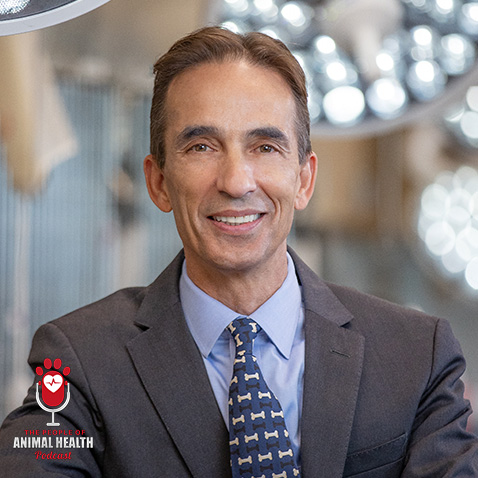
Over more than three decades, Dr. Steven Hansen has practiced companion animal medicine, become board certified in both Veterinary toxicology and animal welfare, directed one of the nation’s premier Animal Poison Control Centers, held leadership positions within the Animal Health pharmaceutical industry, served as Chief Operating Officer of the ASPCA, and now leads one of the largest and most innovative shelter medicine organizations in the United States as President and CEO of the Arizona Humane Society. Along the way, he has continually embraced opportunities that many veterinarians might never have imagined, proving that an open mind and a willingness to keep learning can create an extraordinary professional journey.
During his appearance on The People of Animal Health Podcast with host Stacy Pursell, Dr. Hansen reflected upon the people, experiences, and unexpected career turns that shaped his life. His story illustrates how one opportunity often leads naturally to another, provided someone remains prepared to recognize it.
Throughout the conversation, he repeatedly emphasized that success rarely follows a perfectly planned path. Instead, careers evolve through curiosity, hard work, trusted mentors, and a willingness to say yes when unexpected doors open. Looking back across decades of leadership within Veterinary medicine, Animal Health, and animal welfare, Dr. Hansen’s greatest lesson may be that no experience is ever wasted because every chapter contributes valuable knowledge that becomes useful somewhere later in the journey.
Growing Up in Rural Iowa
Dr. Hansen grew up in Muscatine, Iowa, a community of approximately 30,000 residents situated along the Mississippi River in the eastern part of the state. Surrounded by agriculture and small town values, Muscatine provided an ideal environment for a young boy fascinated by animals and the outdoors. “It was a great place to grow up,” he remembered.
His father worked as an engineer, but the family’s household always included an assortment of animals. Dogs were a constant presence, yet they also welcomed numerous other creatures into their home over the years, creating an environment where caring for animals became simply part of everyday life.
“We always had animals in the house,” said Dr. Hansen. “Always had dogs and lots of critters and just about anything you can imagine.”
Like many children growing up during that era, Dr. Hansen spent countless hours outdoors. Bicycles served as transportation rather than entertainment, allowing neighborhood children to explore freely throughout the community without many of the concerns that families face today. “We spent our time on our bicycles riding all over everywhere,” he recalled.
Those experiences cultivated both independence and curiosity while strengthening his appreciation for animals, nature, and science. Looking back, Dr. Hansen believes that the combination of growing up in an agricultural community while living with numerous pets naturally created the foundation for a future Veterinary career, even though he had not yet consciously chosen that profession.
One Teacher Changed Everything
Although animals had always played an important role in his life, Dr. Hansen did not seriously consider becoming a veterinarian until high school. The turning point came through an exceptional biology teacher whose enthusiasm for science inspired students to think beyond memorizing facts and instead appreciate how living systems actually functioned. The biology curriculum itself also proved unusually influential. Students participated in detailed animal dissections that exposed them to anatomy, physiology, and biological systems in ways uncommon for many secondary schools.
For Dr. Hansen, those experiences confirmed something that had been quietly developing for years. He genuinely enjoyed scientific investigation while remaining deeply interested in animals. Veterinary medicine offered the ideal combination of those two passions.
“At that point, I decided I wanted to be a veterinarian,” he said. “From then on, it didn’t change.”
Unlike many students who frequently reconsider career plans throughout college, Dr. Hansen remained remarkably focused after making that decision. Veterinary medicine became the destination toward which every educational choice pointed, eventually leading him to Iowa State University College of Veterinary Medicine.
Looking back today, he remains grateful for the tremendous influence a single dedicated teacher had on his future. Sometimes, one educator changes an entire life. In Dr. Hansen’s case, that’s exactly what happened.
A Mentor in Houston Opened the First Door
While attending Iowa State University, Dr. Hansen already knew that he wanted to broaden his experiences beyond the Midwest. Texas had long held a special attraction for him, and during one visit to Houston while in Veterinary school, he decided to create his own opportunity. Rather than waiting for positions to become available, he simply began knocking on clinic doors. One of those doors belonged to Missouri City Animal Clinic, owned by Dr. Bill Smiley.
“I asked him if he would be interested in taking a preceptor,” Dr. Hansen recalled. The answer changed his career. Not only did Dr. Smiley welcome him for his preceptorship, he ultimately offered Dr. Hansen his first professional position after graduation. Just as importantly, Dr. Smiley became an exceptional mentor during those critical early years when every new veterinarian transitions from student to independent practitioner.
Missouri City Animal Clinic occupied a unique location, serving clients from dramatically different socioeconomic backgrounds. One portion of the practice served affluent neighborhoods, while another cared for families with significantly fewer financial resources. That diversity exposed Dr. Hansen to realities extending well beyond routine medicine.
“I did get to see some of the challenges that families were encountering,” he reflected.
The medical caseload itself also proved ideal for a young veterinarian eager to learn. Canine parvovirus, canine distemper, heartworm disease, flea infestations, tick borne illnesses, and countless other conditions appeared regularly, providing extensive clinical experience in a remarkably short period. To supplement his income and further expand his skills, Dr. Hansen also worked shifts at a local emergency clinic, gaining valuable exposure to emergency medicine almost immediately after graduation.
Those long hours required tremendous effort, yet they accelerated his professional growth while introducing him to the demanding pace of emergency Veterinary medicine. Looking back, he considers accepting Dr. Smiley’s offer one of the best decisions he ever made because it established a foundation that supported every opportunity that followed.
Becoming a Veterinary Detective
Although Dr. Hansen enjoyed companion animal practice, another professional interest had quietly developed during Veterinary school: clinical toxicology. Intrigued by the challenge of solving complex poisoning cases, he interviewed for a residency at the University of Illinois. Initially, however, nothing seemed to happen. Believing the opportunity had disappeared, he accepted another clinical position in Chicago with one of his classmates. Then, unexpectedly, everything changed.
“I got a phone call from the university,” he recalled. “We’ve been having trouble finding you. We’ve got funding now.”
With residency support finally secured, Dr. Hansen returned to the University of Illinois to complete a residency in Veterinary clinical toxicology while simultaneously earning a master’s degree. “It was all about being a detective,” he explained.
Unlike many medical disciplines where diagnoses become obvious relatively quickly, toxicology frequently requires investigators to question initial assumptions. Many patients referred as suspected poisoning cases ultimately suffered from completely unrelated illnesses. Success depended upon asking thoughtful questions, collecting accurate histories, carefully analyzing evidence, and resisting premature conclusions. That investigative mindset permanently shaped Dr. Hansen’s approach to Veterinary medicine.
His residency also introduced him to one of the profession’s most influential mentors, Dr. Bill Buck, director of the Animal Poison Control Center. “He was my chief professor there and he was a great mentor,” Dr. Hansen said.
Working alongside Dr. Buck exposed him to an extraordinary combination of clinical medicine, research, epidemiology, consultation, and data analysis. Every telephone call presented another diagnostic puzzle requiring careful reasoning rather than simple pattern recognition. Beyond toxicology itself, the position taught him the importance of collecting meaningful data, conducting rigorous research, and continually questioning assumptions before reaching conclusions. Those lessons would later prove valuable not only within pharmaceutical development, but also throughout his leadership career in animal welfare.
An Unexpected Opportunity in Animal Health
After completing his residency, Dr. Hansen anticipated remaining within academia. Instead, another unexpected opportunity appeared in the form of Sandoz Animal Health. Because the company frequently collaborated with the Animal Poison Control Center, its leadership already knew Dr. Hansen’s expertise in toxicology, adverse event management, clinical research, and regulatory science. They recruited him to become their technical services veterinarian in Dallas. The transition introduced him to an entirely different side of Veterinary medicine.
Soon afterward, corporate mergers dramatically altered his career once again. Sandoz merged with Ciba-Geigy, relocating major operations to Chicago. Many Texas-based employees understandably preferred not to relocate north, creating unexpected leadership opportunities for those willing to move. “That made for huge opportunity,” Dr. Hansen recalled. He accepted the relocation and ultimately became Director of Veterinary Support and Clinical Research for Sandoz Animal Health.
Those years broadened his understanding of the Animal Health industry while exposing him to clinical trials, regulatory affairs, Environmental Protection Agency requirements, Food and Drug Administration submissions, product development, and scientific research. Looking back, he considers the experience another critical chapter that prepared him for future executive leadership.
Yet another merger would soon reshape his career. This time, however, the telephone call came from somewhere entirely different.
The American Society for the Prevention of Cruelty to Animals (ASPCA).
Returning to Animal Welfare with a Broader Perspective
After spending years in the Animal Health pharmaceutical industry, Dr. Steven Hansen had accumulated a remarkable combination of clinical experience, toxicology expertise, regulatory knowledge, scientific research, and executive leadership. Although he enjoyed the challenges of corporate leadership, another opportunity eventually emerged that allowed him to reconnect more directly with his lifelong passion for improving animal welfare.
When the ASPCA approached him about joining its leadership team, Dr. Hansen recognized an opportunity unlike anything he had previously encountered. Rather than focusing exclusively on companion animal medicine, research, or product development, the role would allow him to influence animal welfare on a national scale through advocacy, disaster response, shelter medicine, forensic science, and public education.
“It really gave me an opportunity to return to nonprofit work,” he explained.
Serving as Chief Operating Officer exposed him to virtually every aspect of the organization’s expanding mission. During those years, the ASPCA continued broadening its impact through disaster preparedness, anti cruelty investigations, poison control, shelter support, community outreach, and legislative advocacy. Dr. Hansen’s unusually diverse professional background proved valuable because he understood clinical medicine, scientific research, regulatory affairs, organizational leadership, and public policy equally well.
One lesson became increasingly clear throughout his time with the organization: animal welfare depends upon collaboration. No single veterinarian, shelter, nonprofit organization, or government agency can solve every challenge independently. Lasting progress occurs when professionals from different disciplines share knowledge, coordinate resources, and pursue common goals.
“We accomplish much more when we work together,” he observed.
That philosophy would continue shaping every leadership role he accepted afterward while reinforcing the importance of building relationships throughout the Veterinary profession rather than operating in isolation.
Transforming Animal Welfare in Arizona
Dr. Hansen eventually accepted perhaps the most ambitious leadership opportunity of his career when he became President and Chief Executive Officer of the Arizona Humane Society. The organization already possessed an impressive reputation for animal rescue and shelter medicine, yet Dr. Hansen believed even greater possibilities existed if innovation, strategic planning, and clinical excellence remained central priorities. “We wanted to think differently,” he explained.
One of the organization’s most visible accomplishments under his leadership became the development of the Lazin Animal Foundation Trauma Hospital, a state of the art, $52 million medical facility specifically designed to provide advanced treatment for injured, abused, neglected, and vulnerable animals. Rather than functioning solely as a traditional shelter hospital, the facility operates more like a sophisticated Veterinary referral center capable of delivering advanced emergency and specialty care.
Dr. Hansen emphasized that investing in high quality medicine directly supports the organization’s broader mission because improved clinical capabilities dramatically increase the number of animals successfully rehabilitated and placed into permanent homes. “It’s really changed what we’re able to accomplish,” he said.
The hospital also supports extensive programs addressing neonatal kitten care, parvovirus treatment, canine distemper management, foster medicine, rehabilitation, and countless other areas where specialized Veterinary expertise substantially improves survival rates. Instead of accepting historical limitations, the Arizona Humane Society continually evaluates new medical approaches capable of saving additional lives.
“We’re always asking, ‘How can we do this better?'” Dr. Hansen explained.
That relentless focus on improvement reflects the same curiosity that first attracted him to toxicology decades earlier. Whether solving poison cases or designing shelter medicine programs, progress begins by questioning assumptions and exploring new possibilities.
Expanding Access Through Innovation
Throughout his conversation with Stacy Pursell, Dr. Hansen repeatedly emphasized that one of the Veterinary profession’s greatest challenges involves improving access to care. Millions of animals require medical attention each year, yet financial limitations, workforce shortages, geographic barriers, and increasing demand continue creating obstacles for many families. Rather than viewing those realities pessimistically, he believes they represent opportunities for innovation. “We’ve got to think differently about access to care,” Dr. Hansen explained.
That includes exploring technologies such as telemedicine where appropriate, embracing spectrum of care principles that expand treatment options, strengthening relationships between shelters and private practitioners, and encouraging creative solutions capable of serving more animals without compromising quality. Dr. Hansen stressed that innovation does not necessarily require expensive technology or dramatic organizational change. Sometimes meaningful improvement begins simply by asking whether existing systems still represent the most effective way to accomplish a particular goal. “We have to be willing to challenge ourselves,” he said.
His involvement with the American College of Animal Welfare has reinforced that perspective by encouraging research, education, and evidence based approaches supporting continual improvement throughout the profession. Likewise, his work in legislative advocacy and Veterinary technician initiatives reflects a broader commitment to strengthening the entire Veterinary workforce rather than focusing exclusively on individual organizations. For Dr. Hansen, advancing Veterinary medicine requires collaboration among educators, clinicians, researchers, nonprofit organizations, legislators, and industry leaders working toward shared objectives.
Leadership Through Curiosity and Service
As the discussion turned toward leadership, Dr. Hansen reflected upon the habits and philosophies that have guided him throughout an exceptionally diverse career. Despite occupying executive positions for many years, he continues viewing himself first as a lifelong learner. “I still learn something every day,” he said.
That commitment to continual learning explains why he has successfully navigated careers spanning clinical practice, academia, toxicology, pharmaceuticals, nonprofit leadership, and animal welfare. Every new opportunity required mastering unfamiliar subjects while remaining humble enough to seek guidance from experts possessing different experiences.
Dr. Hansen also discussed the influence of Malcolm Gladwell’s Outliers, a book that reinforced his belief in deliberate practice, persistence, and continuous improvement rather than relying solely upon natural talent. Throughout the interview, he repeatedly credited mentors who recognized potential before he fully recognized it himself. From his high school biology teacher and Dr. Bill Smiley to Dr. Bill Buck and numerous colleagues throughout the Animal Health industry, each contributed valuable lessons that shaped his professional development.
Consequently, mentoring younger veterinarians has become one of his own priorities. “You never know how much influence you might have,” he reflected.
Sometimes a simple conversation, encouraging word, or unexpected opportunity can permanently alter someone’s career, just as others had done for him decades earlier.
Looking Toward the Future of Veterinary Medicine
When Stacy Pursell asked about the future of the Veterinary profession, Dr. Hansen expressed genuine optimism despite acknowledging the significant challenges currently facing Animal Health. Workforce shortages, growing demand for services, evolving client expectations, and increasing medical complexity all require thoughtful leadership, yet he believes the profession has never possessed greater opportunities to innovate.
Veterinarians today contribute far beyond traditional companion animal practice. They serve within public health, biomedical research, food safety, toxicology, pharmaceuticals, animal welfare, government, academia, biotechnology, and countless additional disciplines that continue expanding every year. “The opportunities are almost limitless,” he said. Dr. Hansen’s own career illustrates that reality perfectly.
Beginning with a childhood fascination for animals in rural Iowa, he eventually influenced companion animal medicine, toxicology, pharmaceutical development, nonprofit leadership, shelter medicine, and national animal welfare initiatives. None of those experiences followed a carefully orchestrated plan. Instead, each developed because he remained curious enough to embrace unexpected opportunities while continually asking how he could make a greater contribution.
A Career Dedicated to Improving Animal Lives
By the conclusion of his appearance on The People of Animal Health Podcast, Dr. Steven Hansen had shared far more than the story of an accomplished veterinarian. His journey demonstrated how Veterinary medicine provides countless opportunities for individuals willing to continue learning long after graduation while remaining open to careers extending well beyond traditional clinical practice.
Whether solving complex toxicology cases, leading scientific research, supporting pharmaceutical innovation, strengthening nonprofit organizations, building world class shelter medicine programs, or advocating for broader access to Veterinary care, every chapter of his career has reflected the same fundamental purpose: improve the lives of animals by strengthening the profession that serves them.
Throughout the interview, Dr. Hansen consistently returned to themes of curiosity, collaboration, mentorship, and lifelong learning because those principles have guided every major decision he has made. Looking back, he readily acknowledged that many of his greatest opportunities arrived unexpectedly. What mattered most was recognizing them, preparing for them, and having the confidence to say yes.
His appearance on The People of Animal Health Podcast offered an inspiring reminder that remarkable careers rarely unfold exactly as planned. Instead, they develop through steady growth, trusted mentors, thoughtful leadership, and a willingness to pursue new challenges whenever they appear. Through decades of service across Animal Health, Veterinary medicine, and animal welfare, Dr. Steven Hansen has done precisely that, leaving a lasting impact on both the profession and the countless animals whose lives have been improved through his leadership.
Listen to Dr. Steven Hansen’s episode on The People of Animal Health Podcast with Stacy Pursell!